We deliver across the EU. Pick the language you prefer; you can change it later at the top of the page.
Neu: clightstore.de ist jetzt Teil von clightstore.com.
Gleiche Produkte, gleiche Preise, gleiches Team. Bestellungen aus unserem bisherigen Shop werden wie gewohnt bearbeitet. Kundenkonten und Bestellhistorie des alten Shops sind vorübergehend nicht verfügbar. Bei Fragen erreichen Sie uns unter sales@clightstore.com.
Tili
LED Payback Period Calculator: ROI & Savings
How long does it take for an LED retrofit to pay for itself? Formula, industry scenarios, TCO comparison and grants explained concisely.
12 min readBy Clightstore lighting plannersUpdated 21.10.2026
The payback period of an LED retrofit is calculated by dividing the total investment by the annual total savings – for commercial installations with 4,000 or more operating hours per year, it typically falls between 1 and 4 years. Those who also factor in maintenance costs, grants and the maintenance factor to DIN EN 12464-1 gain a robust picture of Total Cost of Ownership (TCO) – and can use it to convince even the most sceptical CFO.
In brief
Basic formula: Payback period = Investment costs ÷ annual total savings (energy + maintenance – grants)
For industrial halls with 4,000 h/year and 0.22 €/kWh, LED typically pays back within 1–3 years
The maintenance factor (MF) to DIN EN 12464-1 influences the usable illuminance and therefore the number of luminaires required
BAFA and KfW grants can noticeably shorten the effective payback period
TCO over 5 and 10 years is more meaningful for buyers and facility managers than the simple payback period alone
The Basic Formula: How to Calculate the Payback Period
The simplest formula is:
Payback period (years) = Net investment costs ÷ Annual total savings
The annual total savings consist of energy savings plus savings on maintenance and lamp replacements. The net investment costs are arrived at after deducting all grant amounts.
Step-by-Step Calculation
Step 1 – Energy savings per year:
(Old wattage in W – LED wattage in W) × number of luminaires × operating hours/year ÷ 1,000 × electricity price (€/kWh)
Step 2 – Maintenance savings per year:
Previous maintenance costs (lamps + labour) – future LED maintenance costs
Step 3 – Net investment:
Gross investment – grant amounts (BAFA, KfW, regional programmes)
Enter your project data – the calculator determines the payback period, annual savings and TCO over 5 years:
Four Industry Scenarios with Pre-Filled Values
Generic calculators often produce unrealistic results because operating hours, electricity prices and maintenance requirements vary considerably by sector. The following four scenarios are based on typical commercial conditions.
High-bay warehouse with LED high bays: at 6,000 operating hours per year and a large wattage difference compared to the old luminaire, the retrofit can pay back in under 18 months.
Scenario
Existing luminaire
LED replacement
Operating hours/year
Luminaires
Electricity price
Net investment
Annual savings
Payback
Industrial hall (IP65)
400W HQL
150W LED high bay
4,000 h
40
0.22 €/kWh
8,000 €
7,040 €
approx. 14 months
High-bay warehouse (24/7)
250W HQL
100W LED high bay
6,000 h
60
0.22 €/kWh
10,800 €
9,900 €
approx. 13 months
Office / administration
58W fluorescent tube
22W LED panel
2,500 h
80
0.22 €/kWh
6,400 €
3,168 €
approx. 24 months
External installation (IP66, DALI)
150W HQL
60W LED floodlight
3,500 h
20
0.22 €/kWh
4,200 €
2,772 €
approx. 18 months
Note: The values are indicative figures based on typical operating conditions. Individual projects may differ. Maintenance savings are not included in the annual savings figures and will shorten the payback period further. Calculation check: Scenario 1: (400–150) W × 40 × 4,000 h ÷ 1,000 × 0.22 €/kWh = 8,800 €/year (energy savings); Scenario 2: (250–100) W × 60 × 6,000 h ÷ 1,000 × 0.22 €/kWh = 11,880 €/year. The figures shown in the table differ from these; they may include project-specific deductions (e.g. control gear losses, control system costs). Always use actual measured values for your own project.
Why Operating Hours Are the Key Lever
At 2,000 operating hours per year (e.g. basements, ancillary rooms) the payback period extends to 3–6 years – the retrofit is still worthwhile once lamp replacements and maintenance costs are factored in. At 6,000 hours (shift operation, 24/7 warehouses) it can fall to under 18 months. Operating hours are therefore the most important input value in any payback calculation.
Maintenance Factor to DIN EN 12464-1: An Underestimated Cost Driver
The maintenance factor (MF) describes how much luminous flux an installation still delivers after a defined period. It comprises four components: LLMF (lamp lumen maintenance factor), LSF (lamp survival factor), LMF (luminaire maintenance factor) and RSMF (room surface maintenance factor). Setting the MF too high results in too few luminaires being planned – and the installation no longer meeting the maintained illuminance Em required by DIN EN 12464-1 after a few years.
Environment
Typical MF (LED, 3 years)
Example application
Recommended IP rating
Very clean
0.92
Office, cleanroom
IP20–IP44
Normal
0.80
Workshop, retail
IP44–IP54
Dirty
0.70
Production hall, warehouse
IP65
Very dirty
0.60
Foundry, welding shop
IP65–IP66
Outdoor
0.75
Car park, façade
IP66–IP67
A lower MF means you need more luminaires to consistently achieve the required maintained illuminance levels. This increases the investment but also extends the service life of the installation without remedial work. Further information on IP protection ratings can be found in our guide IP Protection Ratings Explained: IP20, IP41, IP44, IP54, IP69K.
For office workplaces, DIN EN 12464-1 specifies a maintained illuminance Em of at least 500 lx on the working plane. The values applicable to other areas are explained in our guide How Much Lux Do You Need?
TCO Instead of Payback: The CFO's Perspective
The simple payback period says nothing about how much money an installation saves over its entire service life. Total Cost of Ownership (TCO) over 5 and 10 years is the more meaningful metric for investment decisions in a B2B environment.
TCO formula (simplified):
TCO = Investment costs + energy costs (operating period) + maintenance costs (operating period) – grants
An example: an industrial hall with 40 luminaires at 400W incurs approximately 70,400 € in energy costs over 10 years (4,000 h/year, 0.22 €/kWh; calculation: 0.4 kW × 40 × 4,000 h × 10 × 0.22 €/kWh = 140,800 € – note: the control gear losses of the 400W HQL must be included; the total connected load of the luminaire is typically around 430W). The LED equivalent at 150W costs approximately 52,800 € over the same period (0.15 kW × 40 × 4,000 h × 10 × 0.22 €/kWh). Even with an investment of 12,000 € for the LED installation, a substantial TCO advantage remains over 10 years. For a reliable calculation, always use the actual connected loads of both systems.
LED linear light systems in production: the TCO advantage over fluorescent tubes accumulates to a multiple of the investment costs over 10 years.
For production and storage halls, LED high bays with high efficacy (150–210 lm/W) are recommended, as operating hours are highest in these environments. Linear systems can be found in our category Linear LED High Bays.
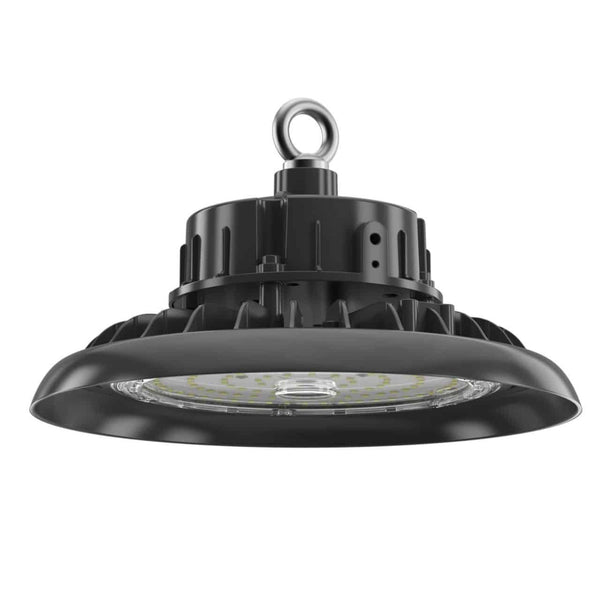
Recommended LED high bays for industry and warehousing – high efficacy, 5-year warranty:
Government grants reduce the net investment and therefore the payback period. An overview of the most important programmes for commercial LED retrofits:
Programme
Grant type
Typical grant rate
Application
BAFA Federal Funding for Energy and Resource Efficiency (BEE)
Direct grant
15–40% of eligible costs
Before contract award, via BAFA
KfW 293/294 – Federal Funding for Efficient Buildings (BEG)
Important: BAFA applications must in principle be submitted before the contract is awarded. Seek advice at an early stage – a retrospective application is generally not eligible for funding. The exact conditions change regularly; always check the current guidelines directly on the BAFA and KfW websites.
Common Mistakes in Payback Calculations
Many calculations produce results that are either too optimistic or too pessimistic because individual factors are overlooked or incorrectly applied.
Mistake 1: Outdated electricity price
Commercial electricity prices vary considerably depending on consumption volume, network charges and contract terms. Always use your current unit rate from your most recent annual bill – not the average household price.
Mistake 2: Forgetting maintenance costs
HQL and HQI lamps need replacing every 8,000–12,000 hours. When luminaires are mounted at heights of 8–12 metres, the associated labour costs are considerable. LED luminaires with a rated service life of 50,000 hours significantly reduce this burden.
Mistake 3: Not factoring in grants
Anyone who fails to account for BAFA or KfW grants will overestimate the payback period by the corresponding grant percentage.
Mistake 4: Ignoring the maintenance factor
Failing to apply the MF results in too few luminaires being planned, and the installation will fall below the maintained illuminance Em required by DIN EN 12464-1 after a few years – incurring remedial costs.
Mistake 5: Not accounting for dimming and controls
DALI or 1–10V controls can reduce energy consumption by a further 20–40% depending on the usage profile. Presence detectors in warehouse aisles or dusk-to-dawn switches in outdoor areas considerably reduce effective operating hours. See also our guide Lumens vs. Lumens per Watt: The Difference Explained Simply.
Special Case: Outdoor Installations and Sports Facilities
For outdoor installations, IP66 is the usual minimum requirement; for sports facilities, the lighting standards of DIN EN 12193 must additionally be observed, which specify requirements for illuminance, uniformity and glare limitation (GR value) depending on the sport and competition level. The payback period here is typically 2–4 years, as operating hours of 2,000–4,000 h/year are lower than in shift operation.
For sports facilities, suitable products can be found in our category LED Sports Field Lighting. For outdoor areas, LED floodlights with IP66 and optional DALI control are recommended.
For wet areas, production halls with wash-down operations or cold stores, LED tri-proof lights are the standards-compliant choice.
High-performance LED high bays for high-bay warehouses and 24/7 operation – with DALI control and 5-year warranty:
Safety Notice: Electrical Work Must Be Carried Out by Qualified Electricians
The planning and calculation of an LED retrofit can be carried out independently by facility managers and buyers. The electrical installation – in particular work on 230V and 400V systems – must be performed exclusively by approved, qualified electricians. DIN VDE 0100, DGUV Regulation 3 and the five safety rules apply. Always engage a qualified electrical contractor for installation and connection work.
How do you calculate the payback period of an LED retrofit?
Payback period = net investment costs ÷ annual total savings. The annual savings consist of energy savings (wattage difference × operating hours × electricity price) plus maintenance savings. Grant amounts are deducted from the investment before dividing.
When does an LED retrofit pay back particularly quickly?
With high operating hours (from 4,000 h/year), a high electricity price, inefficient existing luminaires (HQL, HQI, halogen) and available grants, the payback period is often under 2 years. Shift operation and 24/7 warehouses are the most economically attractive applications.
Is LED worthwhile even with infrequent use, e.g. in a basement or outdoor area?
At under 1,000 operating hours per year, the payback period extends to 5 years or more. Nevertheless, the retrofit can still be worthwhile once lamp replacements and maintenance costs are factored in – and because LED luminaires require no warm-up time and deliver full brightness instantly.
Which grants shorten the payback period?
The BAFA programme "Federal Funding for Energy and Resource Efficiency" (BEE) supports commercial LED retrofits with a 15–40% direct grant. KfW programmes offer low-interest loans with repayment grants. Regional funding programmes from the federal states complement the offering. Applications must be submitted before the contract is awarded.
What is the maintenance factor and why is it relevant to the payback calculation?
The maintenance factor (MF) to DIN EN 12464-1 describes the luminous flux retention of an installation over time. A low MF (e.g. 0.60 in foundries) means more luminaires are required to consistently meet the maintained illuminance Em. Ignoring the MF leads to underestimating investment costs and risks the need for remedial work.
How does a rising electricity price affect the payback period?
As the electricity price rises, the annual energy savings increase proportionally – the payback period falls. Long-term electricity price forecasts should therefore be incorporated into the TCO calculation.
What does it cost to retrofit a complete industrial hall with LED?
Investment costs depend on the size of the hall, mounting height, number of luminaires and the chosen efficacy class. As a guide: a hall with 40 LED high bays at 150W each will typically cost between 6,000 € and 12,000 € net for the luminaires (excluding installation), depending on the product and specification. Request an individual quotation.
Does Clightstore offer support with light planning and payback calculations?
Yes. Clightstore produces free DIALux light plans for commercial projects – including illuminance verification, maintenance factor calculation and luminaire selection to DIN EN 12464-1. Request your individual light plan via the contact form.
How long will the payback period be for your specific project?
Clightstore will produce a free DIALux light plan for you, including an individual ROI analysis, maintenance factor calculation and grant overview – for industrial halls, warehouses, outdoor installations and sports facilities. EU-wide delivery in 2–5 working days, up to 5 years' warranty.
Välttämättömät evästeet pitävät verkkokaupan toiminnassa. Luvallanne käytämme evästeitä myös tilastointiin ja asiaankuuluviin mainoksiin. Voitte muuttaa valintaanne milloin tahansa. Tietosuojakäytäntö
Tilaatko yrityksenä?
Hinnat sisältävät ALV:n. EU-yritykset, joilla on voimassa oleva ALV-tunnus, maksavat 0 % ALV:a (käännetty verovelvollisuus). Belgialaiset yritykset maksavat 21 % ja hakevat sen takaisin.
Syötä kassalla yrityksenne nimi kenttään “Yritys”.
Sen alle ilmestyy kenttä “ALV-tunnus”: syöttäkää ALV-tunnuksenne (esim. NL123456789B01).
ALV vähennetään automaattisesti ja laskulla näkyy käännettyä verovelvollisuutta koskeva merkintä.