IK Protection Rating Explained: Meaning, Table & Application
The IK protection rating defines the mechanical impact resistance of luminaire housings – this guide explains all levels, standards and sector-specific minimum requirements.
The IK protection rating describes, in accordance with IEC 62262 (EN 62262), how well a housing is protected against mechanical impact – from untested (IK00) to 20 joules of impact energy (IK10). For facility managers, electricians and buyers, selecting the correct IK class is essential to minimise downtime, replacement part costs and liability risks.
- IK stands for "Impact Protection" and is standardised in EN 62262 – independently of the IP rating.
- The scale runs from IK00 (untested) to IK10 (20 joules) and beyond as IK10+.
- IK08 (5 joules) is the recommended minimum for industrial and warehouse environments; IK10 (20 joules) is strongly recommended in sports halls and vandalism-prone outdoor areas.
- IP and IK ratings are two separate designations that must be combined – e.g. IP65 + IK08 for outdoor storage areas.
- A higher IK class reduces whole-life costs: fewer breakages, less downtime, lower insurance risks.
What is the IK rating? Definition and standard
The IK rating denotes the resistance of a housing to external mechanical impact. The basis is the international standard IEC 62262, in Europe EN 62262, which superseded EN 50102.
The IK rating is not part of the IP code. The IP code defines protection against solid particles and water; the IK code assesses mechanical impact resistance only. More on IP in IP Ratings Explained.
The luminaire standard EN 60598-1 requires adequate mechanical strength. The specific IK class depends on the installation location and the risk assessment.
Complete IK table: IK00 to IK10+
| IK level | Impact energy | Test body / method | Practical comparison |
|---|---|---|---|
| IK00 | Untested | – | No defined protection; not suitable for industry |
| IK01 | 0.14 J | Polyamide pendulum, 200 g / 70 mm | Light finger impact |
| IK02 | 0.20 J | Polyamide pendulum, 200 g / 100 mm | Light tool contact |
| IK03 | 0.35 J | Polyamide pendulum, 200 g / 175 mm | Office, protected interiors |
| IK04 | 0.50 J | Polyamide pendulum, 200 g / 250 mm | Normal rooms, offices |
| IK05 | 0.70 J | Polyamide pendulum, 200 g / 350 mm | Minimum for distribution boards operated by laypersons (IEC 61439-3) |
| IK06 | 1.00 J | Polyamide pendulum, 500 g / 200 mm | Light workshop areas, stairwells |
| IK07 | 2.00 J | Steel pendulum, 500 g / 400 mm | School corridors, car parks (pedestrian areas) |
| IK08 | 5.00 J | Steel pendulum, 1.7 kg / 300 mm | Industry, warehouses, workshops with machinery |
| IK09 | 10.00 J | Steel pendulum, 5 kg / 200 mm | Heavy industry, outdoor areas with vehicles |
| IK10 | 20.00 J | Steel pendulum, 5 kg / 400 mm | Sports halls, public areas, vandalism protection |
| IK10+ | > 20 J (rec. 50 J) | Manufacturer-specific; standard recommends 50 J | High security, prisons, tunnels |
IK00 means that no test was carried out, not that the housing failed. For all commercial applications, specify at least IK06. IK10+ values are outside the standard's table; the test method is agreed between manufacturer and client.

IK08 vs. IK10
IK10 withstands four times as much impact energy as IK08.
| Feature | IK08 | IK10 |
|---|---|---|
| Impact energy | 5 joules | 20 joules |
| Test body | 1.7 kg steel pendulum, 300 mm drop | 5 kg steel pendulum, 400 mm drop |
| Typical application | Industry, warehouses, workshops, outdoor storage | Sports halls, public areas, vandalism protection |
| Housing material | Reinforced polycarbonate or aluminium | High-impact polycarbonate, stainless steel or die-cast aluminium |
| Price premium vs. IK07 | Low | Moderate – offset by longer service life |
| Recommendation | Standard for commercial indoor and outdoor areas | Recommended where there is ball impact, vandalism or public infrastructure |
IP and IK belong together
A luminaire rated IP65 is dust-tight and jet-water resistant – but without an adequate IK value, a single impact can damage the housing and compromise the IP protection.
| Application | Recommended IP | Recommended IK | Rationale |
|---|---|---|---|
| Office, administration | IP20–IP44 | IK03–IK05 | No elevated impact risk |
| Stairwells, corridors | IP44 | IK07 | Occasional mechanical stress |
| Workshop, production | IP54–IP65 | IK08 | Dust, swarf, tool contact |
| High-bay warehouse, forklifts | IP65 | IK08–IK09 | Impact risk from goods and vehicles |
| Sports hall (ball sports) | IP44–IP54 | IK10 or protective grille | Ball-impact resistance (tested e.g. to DIN 18032-3) |
| Outdoor area, car park | IP65–IP66 | IK08–IK09 | Weather and vehicles |
| Public areas, vandalism | IP65–IP66 | IK10 | Deliberate damage |
| Tunnels, high security | IP66–IP67 | IK10+ | Extreme mechanical stress |
Sector-specific requirements
Industry and logistics
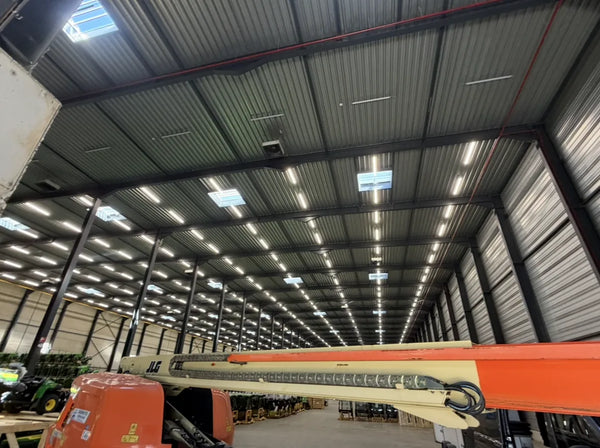
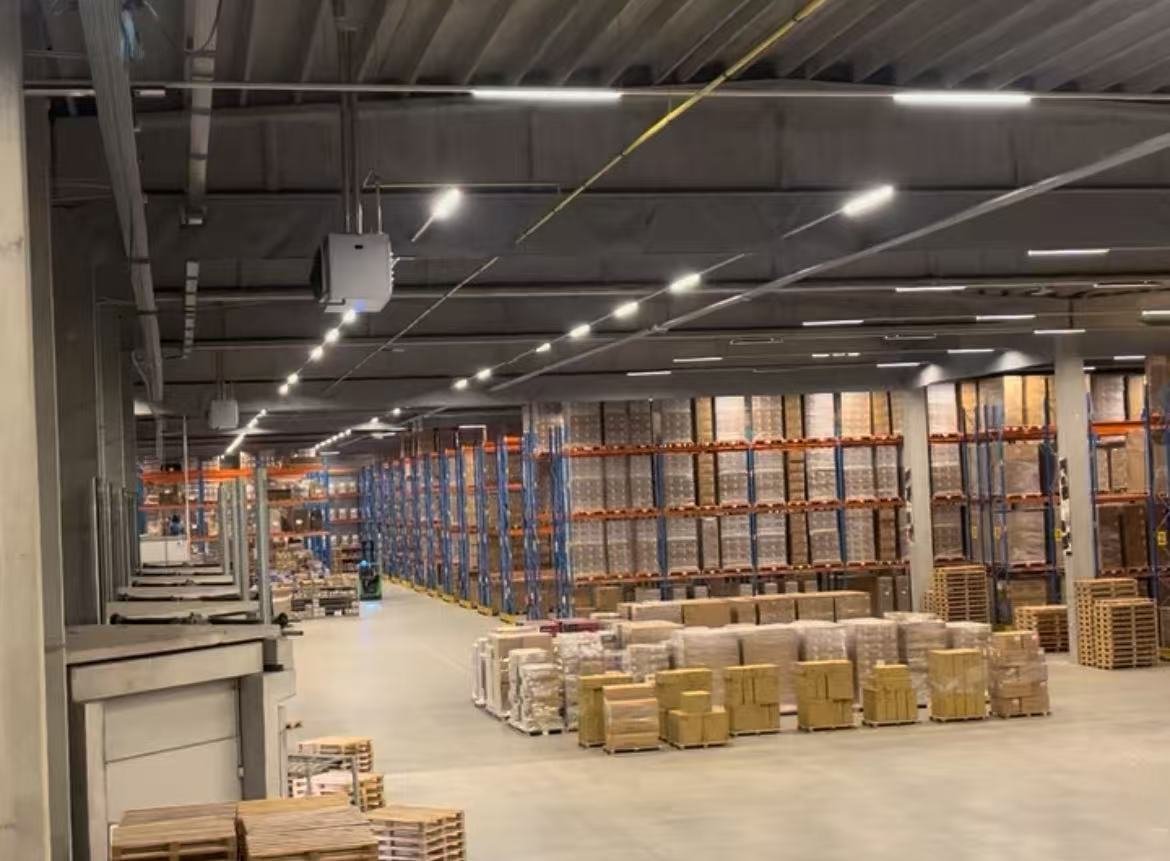
In high-bay warehouses with forklifts, IK08 is the recommended minimum. For outdoor storage or covered loading zones, IP65 + IK09 is recommended. Choose LED tri-proof lights with a documented IK value (see Warehouse Lighting).
Sports halls
In sports halls with ball sports, luminaires must be ball-impact resistant. In Germany this is tested to DIN 18032-3, a ball-throw test rather than an IK class. In practice, luminaires with IK10 or a protective grille are used. See Sports Hall Lighting.
Public infrastructure and vandalism
Bus shelters, underpasses, car parks and public toilets are particularly vulnerable. Here IK10 with IP65 or IP66 is the industry standard. For LED street lights in public areas, define IK08 as minimum and IK10 as target.
Hazardous areas
In ATEX zones, explosion protection rules apply in addition. See ATEX & Ex-Proof LED Lighting and our ATEX luminaires.
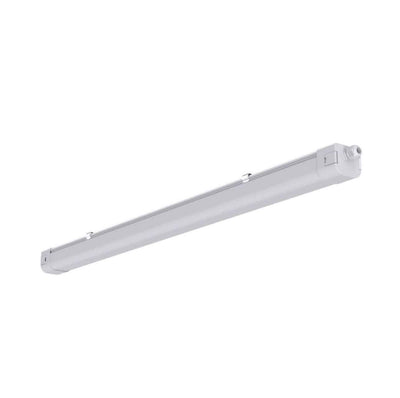
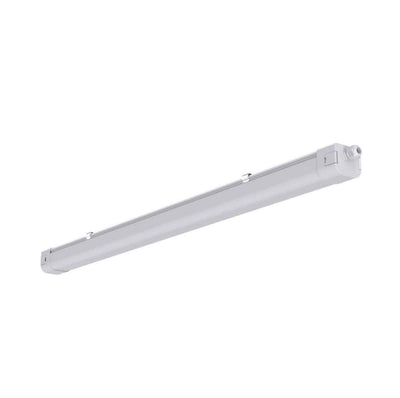
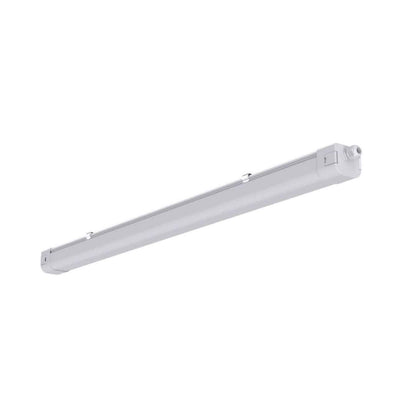
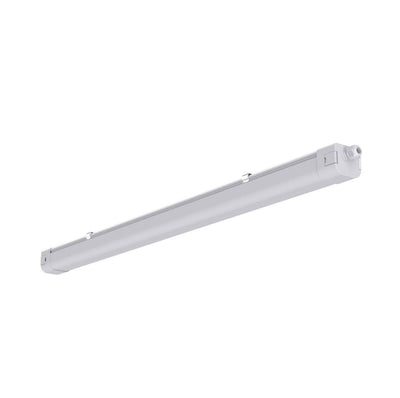
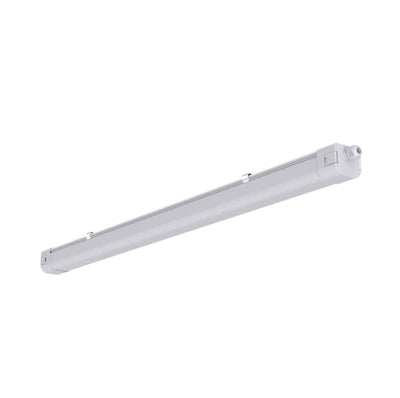
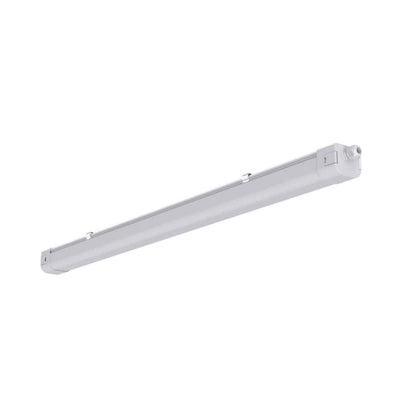
LED tri-proof lights with high IK protection for industry and warehouses – from stock, 5-year guarantee:
TCO: why a higher IK class saves money
Scenario: outdoor storage with 50 luminaires, IK08 vs. IK10 over 5 years
- IK08: assume 2 failures a year from impact = 10 replacements in 5 years, plus installation and downtime.
- IK10: assume 0–1 failures in 5 years.
- Result: the IK10 premium is typically more than offset by saved replacement and installation costs.

How is the IK value tested?
A standardised pendulum impact test: up to IK06 with polyamide bodies, from IK07 with steel pendulums of defined mass and drop height. The housing passes if it still fulfils its protective function afterwards. Always request the test report from an accredited laboratory; an IK value printed without evidence has no legal standing.
Safety notice
All work on 230V and 400V installations must be carried out by qualified electricians. See Connecting an LED Light Fitting.
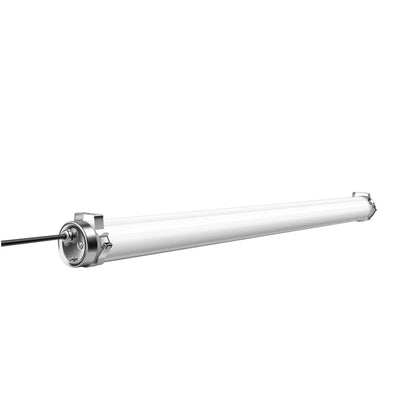
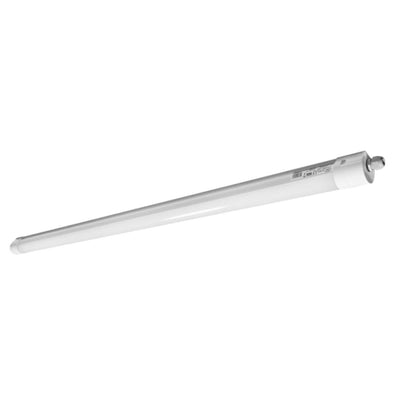
Ammonia-resistant and high-protection LED tri-proof lights – up to IP69K, 5-year guarantee:
Frequently asked questions
What is the difference between the IP and IK rating?
IP describes protection against solid particles and water; IK protection against mechanical impact. They are independent and must be considered together in demanding environments.
What does IK00 mean?
That the housing has not been tested for impact. For commercial applications, specify at least IK06.
What IK value do I need for a sports hall?
Luminaires in sports halls with ball sports must be ball-impact resistant (tested in Germany to DIN 18032-3). This ball-throw test is not an IK class; in practice luminaires with IK10 or a protective grille meet the requirement. Check the data sheet for proof of ball-impact resistance.
Do I always need to combine IK and IP?
In practice, yes. For outdoor and industrial environments at least IP65 + IK08; for vandalism-prone areas IP65 + IK10.
What is IK10+?
Impact resistance above 20 joules, outside the standard's table; IEC 62262 recommends 50 joules. Used in prisons, tunnels and military installations.
Are there mandatory minimums for specific areas?
Distribution boards for laypersons need at least IK05 (IEC 61439-3). Sports halls require ball-impact resistance. For luminaires in general, EN 60598-1 requires adequate mechanical strength without a fixed IK value – the risk assessment determines it.
How can I tell whether an IK value was genuinely tested?
Request the test report from an accredited laboratory. At Clightstore, all relevant technical documents are available.
Can I upgrade a luminaire with a protective cover?
Covers improve mechanical protection but change thermal properties and may affect the guarantee. Better to choose the right IK class from the outset.
Our team supports you free of charge with a DIALux light plan, including selection of the right protection classes. EU-wide delivery in 2–5 working days, up to 5 years' guarantee, prices 2–4× below branded equivalents.
Request free light planning