LED Light Lines and Trunking Systems: Planning Guide
When is a continuous LED light line better than high bays? Trunking vs linkable linear lights vs tri-proof rows, row spacing, optics for racking aisles, wiring and an example calculation.
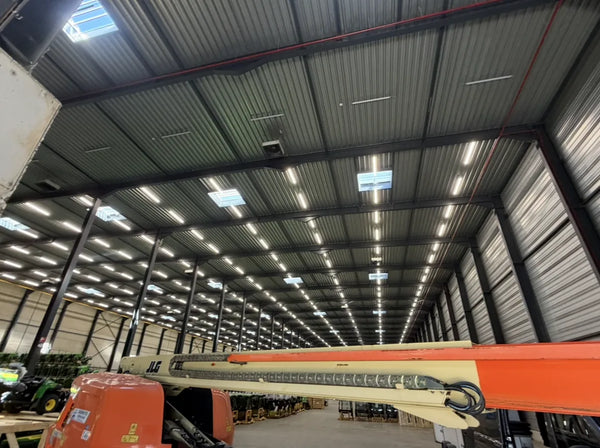
A continuous line of LED light – a trunking system, linkable linear lights or tri-proof lights mounted end to end – is the most even way to light long spaces: warehouse aisles, production lines, workshops, supermarkets and car parks. This guide explains when a light line beats individual high bays, which system to choose, how to plan rows, optics and wiring, and how many watts a line needs.
- Light lines give very even light with few shadows and lower glare than point sources, ideal for aisles, assembly lines and low to medium ceilings (3–10 m).
- Three systems: trunking (rail with modules), linkable linear lights and tri-proof lights in a row. They differ in flexibility, IP rating and price.
- Rows run parallel to the aisles or working lines; row spacing is usually no more than 1–1.5 × the mounting height above the working plane.
- Optics decide the result: narrow or asymmetric for racking aisles, wide for open areas, double-asymmetric to light both rack faces from one line.
- Plan the wiring before ordering: number of conductors, phase distribution, emergency circuit, DALI or 1–10V, and the maximum number of drivers per circuit breaker.
Light line or individual luminaires?
Individual high bays are the efficient choice for open halls with high ceilings. Light lines win wherever the space is long and narrow or the work follows a line:
| Criterion | Light line | Individual high bays |
|---|---|---|
| Uniformity along aisles | Very high, hardly any dark zones | Lower between luminaires, more planning needed |
| Vertical light on rack faces | Very good with asymmetric optics | Limited, depends on beam angle |
| Glare | Low: light spread over a long, low-luminance surface | Higher: small, very bright source |
| Typical mounting height | 3–10 m (up to 14 m with narrow optics) | 6–16 m |
| Installation | One supply point per line, quick click or link connections | One supply point per luminaire |
| Changes in layout | Modules can be moved or added along the rail | Luminaires must be rewired |
| Best for | Aisles, production lines, workshops, retail, car parks | Open halls, bulk storage, sports halls |
Many projects combine both: high bays over open storage and loading areas, light lines over racking aisles and workstations. For hall lighting in general, see LED high bay lighting guide.

Three systems compared
Trunking system (rail + modules)
A steel or aluminium rail carries the wiring (typically 5, 7 or 11 conductors) over the full length. LED modules click into the rail wherever light is needed; blank covers close the gaps. The rail is installed once, and modules, optics and wattages can be changed later without new cabling. This is the most flexible system and the standard for large warehouses and retail.
Linkable linear lights
Self-contained luminaires with a driver, which are connected end to end with plug connectors and splice joints. Mains power and, if needed, the dimming signal are looped through from one luminaire to the next. They are lighter and cheaper than trunking and very quick to install, which makes them a good choice for workshops, offices with high ceilings, shops and smaller warehouses.
Tri-proof lights in a row
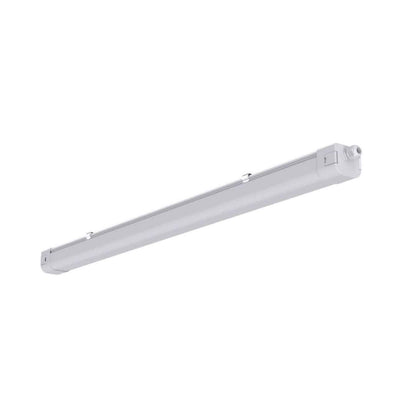
Sealed IP65 luminaires mounted one after another, with through-wiring between them. They are the right choice where dust, moisture or cleaning rule out open systems: production, food processing, cold stores, car parks and loading bays. See Cold store lighting and Production and food industry lighting.
| System | Typical IP | Flexibility later | Price level | Typical use |
|---|---|---|---|---|
| Trunking | IP20–IP54 | Very high | Medium–high | Large warehouses, supermarkets, assembly |
| Linkable linear light | IP20–IP40 | Medium | Low–medium | Workshops, shops, offices, smaller warehouses |
| Tri-proof in a row | IP65–IP69K | Low | Low–medium | Damp, dusty or washed areas, car parks |
| Linear high bay in a row | IP65 | Low | Medium | Higher halls (6–12 m), racking aisles |
Linkable LED linear lights and linear high bays for light lines – power adjustable, dimmable, up to 5 years' warranty:
- Liquid error (snippets/cs-article-render line 51): invalid url input from
-
 Linearna LED Industrijska Svjetiljka za Hale 100W 4000K Neutralno Bijela
€58,95
-
 Linearna LED Industrijska Svjetiljka za Hale 150W 4000K Neutralno Bijela
€73,95
- Liquid error (snippets/cs-article-render line 51): invalid url input from


Planning the rows
Direction and position
- Racking aisles: one line along the centre of every aisle, parallel to the racks. Lines over the racks themselves light the tops of the shelves, not the aisle.
- Production and assembly lines: lines parallel to the line, offset slightly so that workers do not stand in their own shadow.
- Workshops and open areas: parallel rows across the space, spaced evenly, preferably parallel to the windows so daylight control can switch row by row.
- Offices with screen work: rows parallel to the line of sight and to the side of the desks, never directly in front of or behind the screens (see Office lighting).
Row spacing
As a rule of thumb, the distance between rows should not exceed 1 to 1.5 times the mounting height above the working plane for wide optics, and less for narrow optics. At 6 m mounting height and a 0.85 m working plane, rows about 5–7 m apart give good uniformity. The distance from the outer row to the wall should be about half the row spacing.
Continuous or interrupted lines?
A line does not have to be lit over its full length. With trunking, modules can alternate with blank covers to reach the target lux without over-lighting; with linkable lights, short gaps are bridged with cable. Continuous lines give the best uniformity and look tidier; interrupted lines save investment where the lux target is low.
Optics: the decisive choice
| Optic | Beam | Where to use it |
|---|---|---|
| Wide (90–120°) | Broad, even area light | Workshops, open halls, low ceilings up to about 6 m |
| Narrow (30–60°) | Concentrated downwards | High ceilings, deep aisles, picking zones |
| Asymmetric | Mainly to one side | Lighting one rack face or a wall from a line close to it |
| Double-asymmetric | To both sides, little straight down | Racking aisles: lights both rack faces from one line in the centre |
| Opal / diffuse | Soft, low glare | Retail, offices, low ceilings |
In high-bay racking the vertical illuminance on the rack faces matters more than the floor value. A double-asymmetric optic in the centre of a 3 m aisle typically gives 200 lux on the rack faces with roughly half the wattage that a wide optic would need. Lux targets per zone are listed in Warehouse lighting and How much lux do you need?

Wiring: plan it before you order
Number of conductors
- 5 conductors (L1, L2, L3, N, PE): three switching groups or phase distribution.
- 7 conductors: plus two for the DALI or 1–10V control signal, or an emergency circuit.
- 11 conductors: phases, control and emergency lighting in one rail, for maximum flexibility later.
Choose the next size up if you are unsure; adding conductors later means replacing the rail.
Line length per circuit
The limit is usually not the total wattage but the inrush current of the drivers. The driver data sheet states how many drivers one circuit breaker (for example B16 or C16) can switch. Spread long lines over the three phases or several circuits, and check the voltage drop on long runs. Splice joints and plug connectors must be rated for the full current that is looped through. More in Connecting an LED light fitting and LED drivers explained.
Control and emergency lighting
With DALI or 1–10V, lines can be dimmed per aisle with presence detection: low standby level when empty, full light when a forklift enters. In warehouses this typically saves 30–50% (see DALI and lighting control). Emergency modules can be integrated into the line on a separate circuit or with a battery pack (see Emergency lighting).
Mounting
- Suspended: on wire ropes or chains, the usual method in halls. Keep suspension points within the spacing given by the manufacturer, typically every 2–3 m, and at every joint.
- Surface-mounted: directly on the ceiling or on brackets, for low ceilings.
- On cable trays or racking: possible, but check vibration and the clearance to sprinklers and forklift masts.
All connection work on 230V/400V must be carried out by a qualified electrician in accordance with HD 60364 and the national wiring regulations.
Example calculation: warehouse with racking aisles
Warehouse 40 × 30 m, 10 aisles of 40 m, mounting height 8 m, target 200 lux on the rack faces, maintenance factor 0.8.
- Old installation: 60 high bays with 250W metal halide (approx. 270W system) = 16.2 kW.
- New: one line per aisle with double-asymmetric optic, about 2 × 100W linear high bays per 10 m, i.e. 8 per aisle, 80 in total = 8.0 kW.
- With presence control (standby 20%, aisles busy about 40% of the time): average load about 4.2 kW.
- Savings at 4,000 h/year and €0.22/kWh: from about €14,250 to about €3,700 a year, i.e. roughly €10,500 saved every year.
The exact layout depends on aisle width, rack height and optic; we calculate it in DIALux before you order. The payback method is explained in Calculating LED payback period.
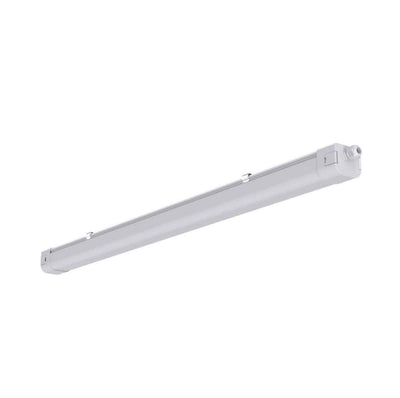
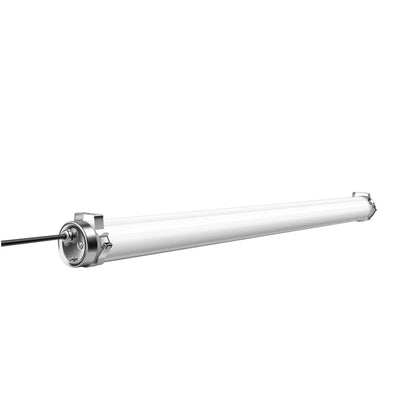
IP65 tri-proof lights for light lines in damp, dusty or cold areas – through-wiring, Tridonic or Osram driver, up to 5 years' warranty:
Frequently asked questions
What is a light line or trunking system?
A continuous row of LED light. A trunking system uses a rail that carries the wiring and holds clip-in LED modules; linkable linear lights and tri-proof lights are connected end to end to form a line.
When is a light line better than high bays?
In long, narrow spaces and where work follows a line: racking aisles, production lines, workshops, supermarkets and car parks, typically up to 10 m mounting height. High bays are more efficient in open halls with high ceilings.
How far apart should light lines be?
As a guide, no more than 1 to 1.5 times the mounting height above the working plane for wide optics, and closer for narrow optics. In racking warehouses, one line per aisle.
Which optic do I need for racking aisles?
A double-asymmetric optic in the centre of the aisle lights both rack faces and gives the best vertical illuminance. For very high racking, narrow optics are an alternative.
How many luminaires can I connect in one line?
It depends on the inrush current of the drivers and the circuit breaker. The data sheet states how many drivers one breaker can switch. Long lines are split over several circuits or the three phases.
5, 7 or 11 conductors – which do I need?
5 for switching in groups or phase distribution, 7 when you add DALI or 1–10V control or an emergency circuit, 11 when you want phases, control and emergency lighting in one rail.
Can light lines be dimmed?
Yes, with DALI or 1–10V drivers. Combined with presence detection per aisle, dimming saves 30–50% in most warehouses.
Can I use light lines in damp areas?
Use IP65 tri-proof lights in a row for damp, dusty or washed areas. Open trunking systems are usually IP20–IP54 and meant for dry rooms.
Send us your floor plan and rack layout. We prepare a free DIALux light plan with row positions, optics, lux values on the floor and on the rack faces, and a parts list. EU-wide delivery in 2–5 working days, up to 5 years' warranty.
Request a free light plan