LED Power Factor and THD Explained: What Installers and Buyers Need to Know
What power factor and THD mean for commercial LED installations, which values to ask for, how PF affects luminaires per circuit, and why capacitor banks need checking after a retrofit.
Power factor (PF) and harmonic distortion (THD) are on every LED data sheet, but rarely get attention until something goes wrong: an unexpected reactive-power charge on the electricity bill, breakers tripping, or a capacitor bank that suddenly causes problems after an LED retrofit. This guide explains what PF and THD mean for commercial installations, which values to ask for, and what to check before replacing hundreds of old luminaires with LED.
- Power factor is the ratio of real power (W) to apparent power (VA). The closer to 1, the less current a luminaire draws for the same wattage.
- For professional luminaires, ask for PF ≥ 0.95 and THD ≤ 10–15% at full load. EU Ecodesign rules require at least 0.9 for mains light sources above 25W.
- Low PF means more current, thicker cables, fewer luminaires per circuit and, for businesses, possible reactive-power charges.
- Watch out after a large LED retrofit: an existing capacitor bank designed for old inductive lighting can overcompensate and make the installation capacitive.
- PF and THD get worse when LED drivers are dimmed deeply or run far below their rated load; size drivers to the luminaire.
What power factor actually is
An electrical load draws apparent power (S, in VA = volts × amps) from the grid. Only part of it does useful work: the real power (P, in W). The rest circulates between the grid and the load without being converted into light or heat. The power factor is the ratio:
PF = real power (W) ÷ apparent power (VA)
Two things lower the PF of a luminaire:
- Phase shift between voltage and current (displacement factor, cos φ). Classic magnetic ballasts were inductive; cheap LED drivers are often slightly capacitive.
- Distorted current: drivers without active power-factor correction draw current in short peaks instead of a smooth sine wave. That distortion is measured as THD (total harmonic distortion).
A good LED driver has an active power-factor correction (PFC) stage that keeps the current almost sinusoidal and in phase: PF above 0.95 and THD below 10–15%. A driver without PFC can have a PF of 0.5–0.6 and a THD of 80–150%.
Why it matters in commercial installations
| Effect of low PF / high THD | What it means in practice |
|---|---|
| Higher current for the same wattage | A 200W luminaire at PF 0.95 draws about 0.92 A at 230V; at PF 0.55 it draws about 1.6 A. |
| Fewer luminaires per circuit | Cables and breakers are sized for current, not watts. Low PF can halve the number of luminaires per circuit. |
| Losses and heating | Extra current heats cables, transformers and the neutral conductor. |
| Overloaded neutral | Third-order harmonics from many single-phase drivers add up in the neutral of a three-phase system instead of cancelling out. |
| Reactive-power charges | Many grid operators bill business connections for reactive power (kvarh) beyond a free allowance. |
| Interference | High harmonics can disturb sensitive equipment and cause nuisance tripping. |
For a single office lamp none of this matters. For a warehouse with 300 high bays on long cable runs, it does: PF and THD decide how many circuits you need, how heavy the cabling is and what appears on the energy bill.

Which values to ask for
| Parameter | Recommended for professional luminaires | Legal / normative reference |
|---|---|---|
| Power factor at full load | ≥ 0.95 | EU Ecodesign Regulation 2019/2020: displacement factor ≥ 0.9 for mains light sources above 25W (lower minimums for smaller wattages) |
| THD (current) at full load | ≤ 10–15% | EN 61000-3-2, class C (lighting equipment) sets harmonic current limits |
| PF and THD when dimmed | Stated in the driver data sheet, e.g. PF ≥ 0.9 at 50% load | Not regulated; check the data sheet |
| Inrush current | Stated as peak current and duration, plus drivers per breaker | Needed for circuit design |
Quality drivers from Meanwell, Sosen, Philips, Tridonic or Osram typically reach PF > 0.95 and THD < 10% at full load. All high bays, floodlights and sports lights in our range are specified with PF > 0.95. More on drivers in LED drivers explained.
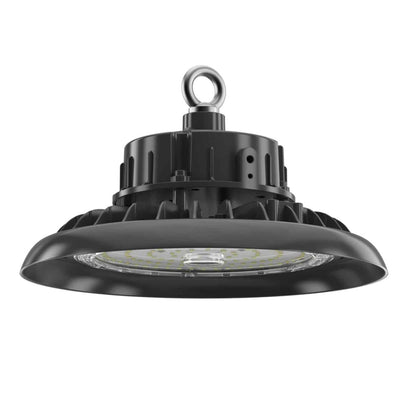
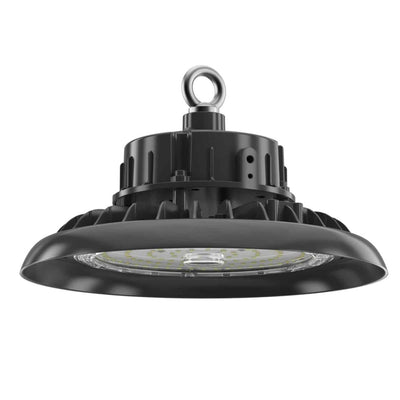
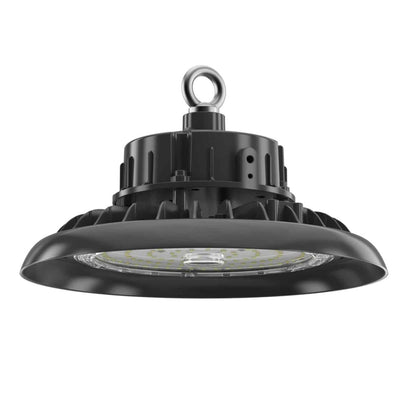
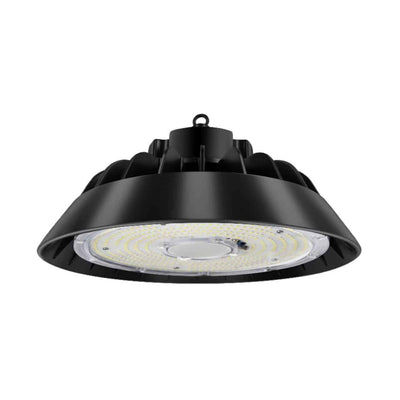
LED high bays with Sosen or Meanwell drivers – PF > 0.95, 1–10V dimmable, 5-year warranty:
The overlooked risk: capacitor banks after an LED retrofit
Many factories and warehouses have a capacitor bank for power-factor correction. It was sized for the old installation: motors and lighting with magnetic ballasts, both inductive. When a large part of that inductive lighting is replaced by LED with a high power factor, the inductive load disappears – but the capacitors stay.
The result can be overcompensation: the installation becomes capacitive. That can lead to:
- reactive-power charges for capacitive (leading) reactive power, which some grid operators also bill;
- raised voltage at light load, for example at night when only the lighting runs;
- resonance between the capacitors and the transformer, amplified by the harmonics of electronic drivers, which can damage capacitors and drivers.
What to do: before a large retrofit, have the existing compensation checked. Automatic (stepped) capacitor banks usually adapt by switching off steps; fixed capacitors on lighting circuits or old ballasts should be removed. Where harmonics are significant, detuned (filtered) banks are the safer choice. An energy-quality measurement before and after the retrofit shows whether adjustment is needed.
Dimming and partial load
The power factor of an LED driver is highest near its rated load. When it is dimmed deeply or runs a much smaller LED load than it was designed for, PF drops and THD rises. In practice:
- Choose drivers matched to the luminaire's wattage, not oversized ones.
- For installations that are dimmed most of the time (warehouses with presence control, sports facilities in training mode), check PF and THD at 50% load in the data sheet.
- Power-adjustable luminaires set to their lowest step behave like a partly loaded driver; the PF at that setting is usually still above 0.9 for quality drivers.
More on dimming interfaces in 0-10V, 1-10V and TRIAC dimming and DALI and lighting control.
Example: what PF does to a warehouse circuit
A warehouse wants to connect 150W high bays to 16 A circuits (230V). Assuming the cable and breaker allow about 13 A continuous load:
- PF 0.95: 150 W ÷ (230 V × 0.95) ≈ 0.69 A per luminaire → about 18 luminaires per circuit.
- PF 0.60: 150 W ÷ (230 V × 0.60) ≈ 1.09 A per luminaire → about 11 luminaires per circuit.
For 180 luminaires that is 10 circuits instead of 16, with matching savings on cable, breakers and installation time. In practice the inrush current often sets a tighter limit than the continuous current, so always check the driver data sheet as well (see Connecting an LED light fitting).
Checklist for buyers and installers
- PF ≥ 0.95 and THD ≤ 10–15% at full load on the data sheet.
- PF and THD at partial load if the installation will be dimmed often.
- Inrush current and maximum number of drivers per breaker.
- Existing capacitor bank checked before a large retrofit.
- Neutral conductor sized for harmonic currents in three-phase installations with many drivers.
- Energy-quality measurement after commissioning for large projects.
Frequently asked questions
What is a good power factor for LED lighting?
For professional luminaires, 0.95 or higher at full load. Values of 0.9–0.95 are acceptable; below 0.9 is a sign of a simple driver without power-factor correction.
Do I pay more for electricity with a low power factor?
Energy is billed on real power (kWh), so a low PF does not directly increase the kWh. Business connections can, however, be charged for reactive power (kvarh), and low PF increases current, losses and the required cable and breaker capacity.
What is THD and why does it matter?
THD (total harmonic distortion) shows how far the current deviates from a clean sine wave. High THD heats cables and transformers, overloads the neutral in three-phase systems and can disturb other equipment. Aim for 10–15% or lower.
Is there a legal minimum power factor for LED?
The EU Ecodesign Regulation 2019/2020 sets minimum displacement factors for mains light sources, rising to 0.9 above 25W. EN 61000-3-2 limits harmonic currents for lighting equipment.
Can an LED retrofit cause problems with my capacitor bank?
Yes. A capacitor bank sized for old inductive lighting can overcompensate once that lighting is replaced by high-PF LED, making the installation capacitive. Have the compensation checked and adjusted before or after a large retrofit.
Does dimming affect the power factor?
Yes. PF drops and THD rises at low load. Quality drivers usually stay above 0.9 at 50% load; check the data sheet if the installation will be dimmed most of the time.
How many LED luminaires can I connect to one circuit?
It depends on the current per luminaire (which depends on PF) and on the inrush current of the drivers. The driver data sheet states how many drivers one breaker can switch; use the lower of the two limits.
We supply data sheets with PF, THD and inrush values for every luminaire, and prepare a free DIALux light plan with luminaire quantities per circuit. EU-wide delivery in 2–5 working days, up to 5 years' warranty.
Request a free light plan