How Many Lux Does a Football Pitch Need? Standards & Planning
All lux requirements for football pitches to EN 12193, national associations, UEFA and FIFA – with GR value, uniformity, ROI calculator and funding guidance.
A football pitch requires between 75 lux (recreational training) and 2,500 lux (FIFA world-class with TV broadcast) depending on its use. The governing standard is EN 12193:2019, supplemented by the licensing conditions of national associations, UEFA and FIFA. Planning the wrong illuminance class risks licence problems, glare and unnecessarily high operating costs.
- EN 12193 defines three illuminance classes (I–III) with 75, 200 and 500 lux as minimum values for horizontal illuminance.
- Professional football follows association requirements: around 1,200 lux (lower professional divisions), 1,400 lux (top national league), 1,500–2,500 lux (UEFA/FIFA).
- In addition to lux, uniformity (Uo) and GR value (glare) are prescribed – both are frequently underestimated.
- LED floodlighting typically saves 50–60% in electricity costs compared with HQI for a comparable light output; payback depends heavily on the funding rate.
- In Germany, the NKI Municipal Directive funds 50% for local authorities and sports clubs, up to 65% for financially weak municipalities (as of May 2026) – applications must be made before construction begins.
Lux table: all classes at a glance
EN 12193 is the European standard for the lighting of sports facilities. It distinguishes three illuminance classes and sets minimum values for each class covering mean horizontal illuminance (Eh,av), the uniformity coefficient (Uo) and the glare rating (GR).
For competition levels above the standard, the licensing conditions of the associations additionally apply. These are not contained in the standard but are binding for match operations.
| Class / Level | Typical use | Eh,av (lux) | Uniformity Uo | GR (max.) | CRI / Ra (min.) |
|---|---|---|---|---|---|
| Class III | Recreational, school, training | 75 | ≥ 0.5 | 55 | 20 |
| Class II | Regional leagues, club match play | 200 | ≥ 0.6 | 50 | 20 |
| Class I | National / international (amateur level) | 500 | ≥ 0.7 | 50 | 65 |
| Lower professional divisions | Professional play, licence required | approx. 1,200 | ≥ 0.7 | 50 | 65 |
| Top national league | Professional play, licence required | approx. 1,400 | ≥ 0.7 | 50 | 65 |
| UEFA competitions | Europa League, Champions League | 1,500 (HDTV: 2,000) | ≥ 0.7 | 50 | 65 |
| FIFA world-class | World Cup, Olympics, 4K TV production | 2,500 | ≥ 0.7 | 50 | 80 |
For most club and municipal projects, Classes II and III are relevant. A complete overview of lux reference values for various applications can be found in our guide How many lux do you need?.

What lux alone does not tell you: uniformity, GR value and vertical illuminance
Uniformity coefficient Uo
The value Uo describes the ratio of the minimum to the mean illuminance across the playing surface. A Uo of 0.6 means the darkest point on the pitch has at least 60% of the mean illuminance. Poor uniformity creates bright patches and dark zones – a safety issue for players and referees, and a technical exclusion criterion for TV cameras.
Typical planning errors arise when too few luminaires are used on too few masts. A DIALux simulation demonstrates during the planning phase whether Uo will be met.
GR value: glare rating to CIE 112
The GR value (Glare Rating) assesses the glare effect of exterior lighting installations to CIE 112. The scale runs from 10 (virtually no glare) to 90 (intolerable glare). EN 12193 prescribes GR ≤ 50 for football – a value that is quickly exceeded with incorrectly aimed or too-low-mounted luminaires.
The key factors for a low GR value are sufficient mounting height, asymmetric light distribution and correct aiming angles. Luminaires with narrow beam angles (20°–40°) on tall masts achieve significantly better GR values than wide-beam luminaires on low masts.
Vertical illuminance Ev
For TV broadcasts, vertical illuminance is also critical. Cameras require sufficient light on players, balls and goals. UEFA and FIFA prescribe minimum values for Ev, which must be demonstrated separately in the DIALux light planning.
LED technology: what B2B buyers need to consider
Luminous efficacy (lm/W)
Modern LED sports floodlights achieve 160–180 lm/W; older HQI luminaires deliver 80–100 lm/W. For the same light output you need roughly half the connected load with LED. For a club pitch at Class II (200 lux), the installed load falls from a typical 8 × 2,000W (HQI) to 8 × 400W (LED) at equal or better light quality. More in our guide Lumens vs. lumens per watt.
IP rating and IK rating
Outdoors, a minimum of IP65 to IEC 60529 is required; for exposed locations with spray water or pressure washing, IP66 is recommended. The IK rating should be at least IK08. Detailed explanations are available in our guides on IP ratings and IK ratings.
Colour temperature and CRI
For match play and TV broadcasts, 5,000K (daylight white) is recommended; for training only, 4,000K is sufficient. Ra should be at least 65 from Class I upwards; for TV productions Ra ≥ 80. More in our guide LED colour temperature.
Service life and warranty
Look for L80 values of at least 50,000 operating hours – at 500 hours per year that is a calculated 100 years. A manufacturer's warranty of at least 5 years is frequently required for tenders and funding applications.
| Criterion | HQI / metal halide | LED (current) | Recommendation for football |
|---|---|---|---|
| Luminous efficacy | 80–100 lm/W | 160–180 lm/W | ≥ 160 lm/W |
| Service life | 6,000–15,000 h | 50,000–100,000 h | L80 ≥ 50,000 h |
| Start-up time | 3–5 minutes | Instant | Instant (required for TV) |
| Dimmability | Not possible | 0–10V, DALI | DALI for professional installations |
| IP rating | IP65 | IP65–IP67 | Minimum IP66 |
| Maintenance costs | High (lamp replacement) | Minimal | LED clearly superior |
| Electricity costs/year* | approx. €1,760 | approx. €352 | Saving: approx. €1,408/year |
*Example: 8 luminaires, 500 operating hours/year, €0.22/kWh; HQI 8 × 2,000W, LED 8 × 400W.
Our LED sports field lighting and the specialist football pitch lighting range include luminaires for all classes – from club pitches to licensed stadiums.
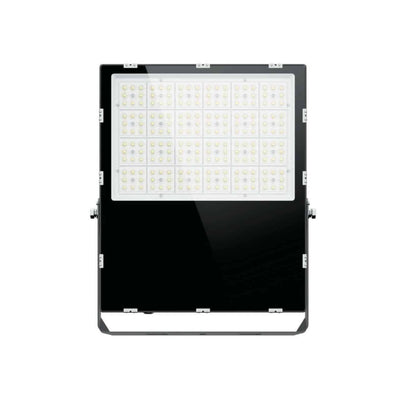
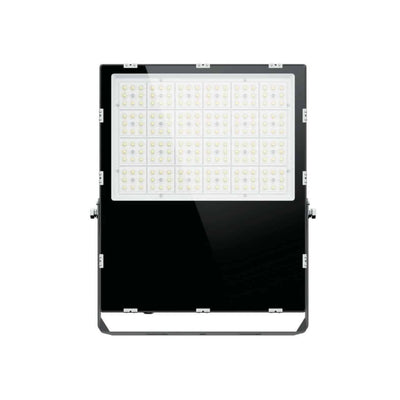
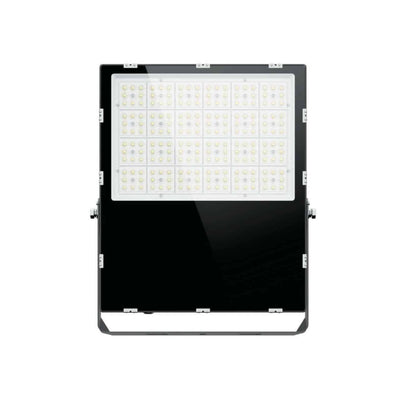
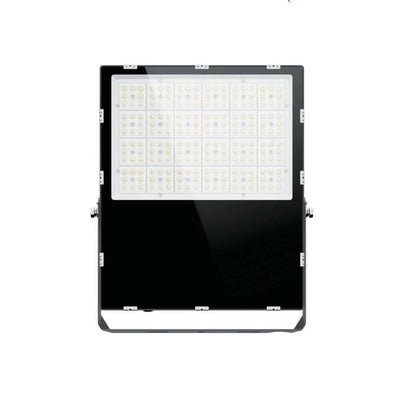
LED floodlights for football pitches at Class II and III – 400W, IP66, 5-year warranty:
Mast planning: height, quantity, structural integrity
Recommended mounting heights
Mounting height is the single most important factor for GR value and uniformity: at least 16 m for training installations and 18–20 m for competition installations. Lower masts force steeper beam angles, which increases glare and reduces uniformity.
Number of masts and layout
Typical configurations for a standard pitch (105 × 68 m):
- Class III (75 lux): 4 masts at 16 m, each with 2–3 luminaires at 150–200W
- Class II (200 lux): 4–6 masts at 16–18 m, each with 3–4 luminaires at 240–400W
- Class I (500 lux): 6–8 masts at 18–20 m, each with 4–6 luminaires at 400W
- Professional (approx. 1,200 lux): 8–12 masts at 20–25 m, each with 6–10 luminaires at 1,000–1,500W
Structural integrity of existing masts
For existing masts, obtain a structural stability assessment from a qualified engineer before retrofitting to LED (in Germany, DIN 4131 applies from 12 m). Although LED luminaires are lighter than HQI fittings, new housing geometries change the wind-load surfaces.
Safety notice: all connection and installation work on 230V/400V systems must be carried out by qualified electricians, with fall protection for work on masts.

Cost-effectiveness and ROI: worked examples by class
Class II: club pitch at 200 lux
Starting situation: 8 HQI luminaires at 2,000W, 500 operating hours/year, €0.22/kWh.
- HQI electricity costs/year: 8 × 2.0 kW × 500 h × €0.22 = €1,760
- LED replacement: 8 × 400W luminaires (170 lm/W, IP66)
- LED electricity costs/year: 8 × 0.4 kW × 500 h × €0.22 = €352
- Annual saving: €1,408
- LED investment (without funding): approx. €18,000–28,000
- Payback without funding: approx. 13–20 years
- Payback with 50% funding: approx. 6–10 years
- Payback with 65% funding: approx. 4–7 years
Class I: performance sports centre at 500 lux
Starting situation: 16 HQI luminaires at 2,000W, 600 operating hours/year, €0.22/kWh.
- HQI electricity costs/year: 16 × 2.0 kW × 600 h × €0.22 = €4,224
- LED electricity costs/year: €845 (16 × 400W) to €1,584 (12 × 1,000W)
- Annual saving: approx. €2,640–3,379
- Investment: approx. €45,000–68,000
- Payback with 50% funding: approx. 7–13 years
We will produce a detailed calculation for your project free of charge using DIALux. More on the methodology in our guide Calculating LED payback period.
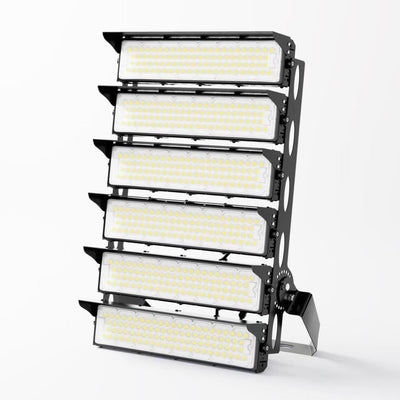
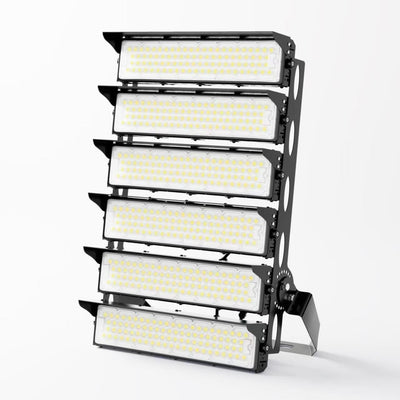
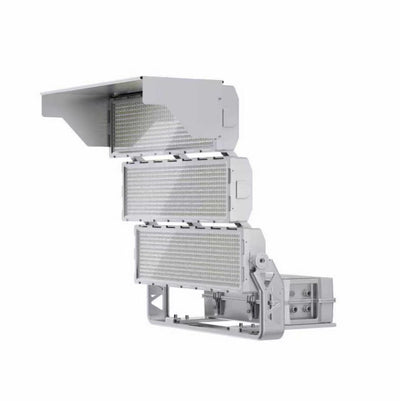
LED floodlights for stadiums and Class I installations – 1,500W, DALI, Philips driver:

Funding 2026
Germany: NKI Municipal Directive
The Municipal Directive (Kommunalrichtlinie) of the National Climate Initiative funds the LED conversion of floodlights and sports hall lighting. Local authorities and non-profit sports clubs are eligible. The funding rate is 50%, and up to 65% for financially weak municipalities (as of May 2026). Applications go to the responsible project agency before construction begins. BAFA funding for interior lighting ended on 21 July 2026 (see BAFA LED Funding 2026). State sports federation programmes can sometimes be combined.
Other countries
In the Netherlands, sports clubs can use the BOSA scheme; in Belgium, regional and municipal support applies. Conditions change regularly – always check the current rules.
Step-by-step process
- Needs analysis: determine the illuminance class and commission DIALux light planning.
- Funding advice: review available programmes and their combinability.
- Submit the funding application before construction begins and before signing supplier contracts.
- Await the approval – only then place orders.
- Tender and award under public procurement rules (for public clients).
- Installation by a qualified electrical contractor, acceptance and documentation.
- Submit proof of use and call down funding.
Typical planning errors and checklist
The most common mistakes
- Funding application after construction begins: results in loss of funding.
- Illuminance class too low: if the club is promoted, a costly upgrade follows. Plan one class higher as a buffer.
- No structural assessment for existing masts.
- GR value not simulated: glare problems are virtually impossible to correct retrospectively.
- Wrong colour temperature: 3,000K is unsuitable for sport; 4,000K or 5,000K are standard.
- IP rating underestimated: IP65 is the minimum, IP66 recommended.
- No dimming infrastructure: DALI training and match modes typically save 20–40% during training.
Planning checklist for B2B buyers
| Check point | Done |
|---|---|
| Illuminance class determined to EN 12193 and association requirements | |
| DIALux simulation with Eh,av, Uo and GR | |
| Funding application submitted before construction begins | |
| Structural assessment for existing masts obtained | |
| IP66 specified for all exterior luminaires | |
| CRI/Ra requirement per class in the tender | |
| Dimming protocol (DALI/0–10V) and control concept defined | |
| Qualified electrical contractor engaged | |
| Warranty ≥ 5 years secured contractually | |
| Acceptance with lux measurement planned |
For other sports see our guides Tennis Court Lighting, Sports Hall Lighting and Riding Arena Lighting. General principles are explained in Light distribution on sports fields.
Frequently asked questions
How many lux does a club pitch need for training?
For training only, 75 lux to Class III of EN 12193 is sufficient. As soon as league matches are played, at least Class II with 200 lux is required. Planning directly to Class II avoids costly upgrades later.
Which illuminance class applies to regional leagues?
Generally Class II of EN 12193 with 200 lux average and Uo ≥ 0.6. Also check the current requirements of your association, which may deviate.
What does the GR value mean?
The GR value assesses glare from exterior lighting to CIE 112, from 10 (no glare) to 90 (intolerable). EN 12193 prescribes GR ≤ 50 for football. Too high a value impairs players and can lead to failed inspections.
Can I use existing floodlight masts for the LED retrofit?
In principle yes, but only after a structural stability assessment by a qualified engineer, because new luminaires have different wind-load surfaces.
Is there funding for LED floodlighting on sports pitches?
In Germany, the NKI Municipal Directive funds 50% for local authorities and non-profit sports clubs, up to 65% for financially weak municipalities (as of May 2026). Other countries have their own schemes, such as BOSA in the Netherlands. Applications must be submitted before construction begins.
How long does the payback period take?
Without funding, a Class II club pitch with few operating hours typically pays back in 13–20 years. With 50% funding, around 6–10 years; with 65%, 4–7 years. Saved maintenance costs come on top. See Calculating LED payback period.
What is the difference between horizontal and vertical illuminance?
Horizontal illuminance (Eh) measures the light on the playing surface; vertical illuminance (Ev) the light on vertical surfaces, relevant for TV cameras.
How tall do floodlight masts need to be?
At least 16 m for training installations and 18–20 m for competition installations. Taller masts allow shallower beam angles, better uniformity and lower GR values.
Clightstore produces a complete DIALux light plan free of charge, with lux values, uniformity Uo and GR value – as a basis for funding applications and association inspections. EU-wide delivery in 2–5 working days, up to 5 years' warranty.
Request free light planning