Padel Court Lighting: Lux Levels, Poles and LED Planning
How much lux does a padel court need, where do the luminaires go and how many watts per court? Standards, layouts, glare control and costs for outdoor courts and padel halls.
A padel court is small, enclosed by glass and played at high speed, often with the ball high in the air after a lob. That makes its lighting more demanding than its size suggests: the light has to be even across the whole 20 × 10 m court, bright enough on the vertical walls and free of glare for players looking up. This guide covers the lux levels per class, where to place the luminaires, how many watts a court needs and what it costs to run.
- Outdoor padel courts need around 200 lux for recreational play, 300 lux for club competition and 500 lux for national competition, with uniformity of 0.5, 0.6 and 0.7 respectively (EN 12193 classes III, II and I).
- Indoor courts and padel halls are usually lit to 300–500 lux; televised events need 750 lux or more.
- Luminaires go on the long sides, mounted on the court's own columns at about 6–7 m, with asymmetric optics aiming inwards – never above the court and never behind the end walls.
- A typical outdoor court reaches 300 lux with 4 LED floodlights of about 200–250W, and 500 lux with 8 floodlights; that is roughly 1–2 kW per court.
- Compared with metal halide, LED cuts energy use by around 60%, starts instantly and can be dimmed between bookings.
Why padel lighting is harder than it looks
Padel is played on a 20 × 10 m court enclosed by glass back walls and mesh side walls about 3–4 m high. The ball comes off the floor, the glass and the mesh, so players follow it from every direction, including straight up after a lob. Three things follow from that:
- Uniformity matters more than the average. A dark corner near the back glass is exactly where the ball comes back into play.
- Vertical light matters. Players read the ball against the walls, so the glass and mesh must be lit, not only the floor.
- Glare is the biggest risk. A luminaire in the field of view during a lob, or a reflection in the glass, makes the ball disappear for a moment.
Glass also reflects light. Luminaires aimed too steeply produce bright reflections on the back walls that players see while waiting for the rebound. Good planning keeps the luminaires low enough to control spill, high enough to avoid reflections, and always on the long sides.
Lux levels for padel courts by class
EN 12193 (sports lighting) works with three lighting classes. Class III covers training, school and recreational play, class II club and regional competition, and class I national and international competition. Padel federations and tour organisers refer to the same levels; for TV broadcasts the organiser sets higher values.
| Use | Class | Outdoor: Em (lux) | Indoor: Em (lux) | Uniformity U₀ (min.) | Ra (min.) |
|---|---|---|---|---|---|
| Recreational play, training, school | III | 200 | 300 | 0.5 | 20 / 60 |
| Club and regional competition | II | 300 | 500 | 0.6 | 60 |
| National and international competition | I | 500 | 750 | 0.7 | 60 |
| Televised tour events | – | 750–1,500 (organiser) | 750–1,500 (organiser) | 0.7 | ≥ 80 |
Most commercial padel clubs plan for class II: 300 lux outdoors, 500 lux indoors. It is the level players expect in the evening, and it leaves room for club tournaments. Planning a court below that saves little on the luminaires but is expensive to upgrade later. For the classes of other sports, see Light distribution on sports fields and How much lux do you need?

Where the luminaires go
Outdoor courts: on the long sides, on the court's own columns
Almost every outdoor padel court is lit from its own structure. The standard layout is two columns on each long side, at about 6–7 m above the playing surface, each carrying one or two floodlights that point inwards across the court. That gives four or eight luminaires per court.
- 4 luminaires (one per column): enough for 200–300 lux with a good asymmetric optic.
- 8 luminaires (two per column): for 500 lux, better uniformity and a lower glare rating.
Do not mount luminaires on the end walls or behind the back glass: players face that direction for most of the rally. Do not mount them above the court either: every lob would pass straight through the light source.
Several courts side by side
On a row of courts, the columns between two courts can carry luminaires for both. Plan each court as if it were lit on its own, though: when a neighbouring court is switched off, the remaining court must still meet its target. Many clubs switch and dim each court separately, which saves energy outside booking hours.
Indoor courts and padel halls
In halls, luminaires are usually mounted at 7–9 m along the long sides of each court, again pointing inwards, so that no luminaire sits directly above the playing area. Linear high bays or floodlights with an asymmetric beam work well; round high bays above the centre of the court are best avoided because of glare during lobs. Hall lighting in general is covered in Sports hall lighting.

Choosing the right LED luminaire
| Criterion | Recommendation for padel | Why |
|---|---|---|
| Optic | Asymmetric, or 40–60° beam aimed across the court | Puts the light on the far half of the court and keeps the luminaire out of the players' view |
| Glare control | Visor or shield, low tilt angle | Reduces glare during lobs and reflections in the glass |
| Efficacy | ≥ 150 lm/W | Lower connected load and running costs per court |
| Colour temperature | 4000–5000K | Good contrast for the yellow ball on blue or green turf |
| Colour rendering | Ra ≥ 70, ≥ 80 for TV | Natural colours for players, spectators and cameras |
| Protection | IP66, IK08 or higher | Rain, cleaning and the occasional ball hit |
| Weight | As light as possible | Padel columns are slender; check the permitted load with the court manufacturer |
| Dimming | 1–10V or DALI | Lower level for training, full level for matches, off between bookings |
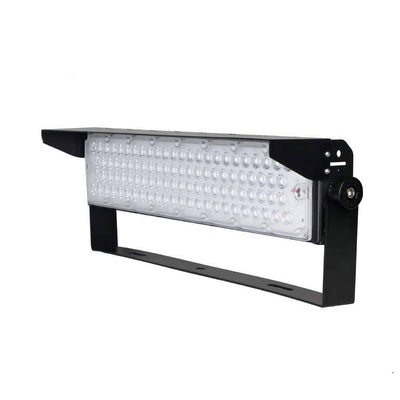
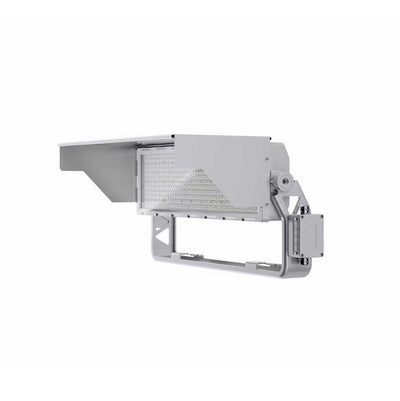
Our 250W sports floodlights with a 40° or 60° beam are a common choice for one outdoor court at 300 lux with four luminaires; for 500 lux or larger courts the 500W versions with a narrow beam are used. All luminaires come with photometric files (IES/LDT) for DIALux planning. More on beam angles and efficacy in Lumen vs. lumen per watt.
LED floodlights for outdoor padel courts – IP66, narrow and medium beams, Philips or Sosen driver, 5-year warranty:

How many watts does a padel court need?
As a guide for one standard outdoor court (20 × 10 m), mounting height 6–7 m, maintenance factor 0.8:
| Target | Luminaires | Per luminaire | Total per court |
|---|---|---|---|
| 200 lux (class III) | 4 | 150–200W | approx. 0.6–0.8 kW |
| 300 lux (class II) | 4 | 200–250W | approx. 0.8–1.0 kW |
| 500 lux (class I) | 8 | 200–250W | approx. 1.6–2.0 kW |
These figures assume asymmetric or well-aimed optics. Courts with a covered roof, very dark surroundings or unusual column positions need a separate calculation. We check every layout in DIALux, including uniformity, glare rating and spill light, before you order.
Running costs and payback
Padel courts are often booked every evening and at weekends, so operating hours add up quickly. Example for one outdoor court at 300 lux, 1,500 operating hours a year and €0.25/kWh:
- Metal halide: 4 × 400W (approx. 430W system) = 1.72 kW → 2,580 kWh → about €645 a year
- LED: 4 × 250W = 1.0 kW → 1,500 kWh → about €375 a year
- With dimming to 60% for training and off between bookings: often below €300 a year
On a club with six courts that is €1,600–2,100 saved every year, before maintenance. LED also starts instantly, so lights can be switched per booking instead of being left on. The full method is in Calculating LED payback period.
Neighbours, spill light and permits
Many padel courts are built close to homes, on hotel grounds or in town centres. Local permits often limit spill light and operating hours. Three measures help:
- Low tilt angles and asymmetric optics, so the light stays on the court.
- Visors or shields on the side facing the neighbours.
- A spill-light calculation in the light plan, which most permit applications require anyway.
Installation and safety
Before mounting luminaires on a padel structure, check with the court manufacturer how much weight and wind area the columns are designed for. Cables run inside or along the columns and need protection against impact and moisture. All connection work on 230V/400V must be carried out by a qualified electrician in accordance with HD 60364 and the national wiring regulations (see Connecting an LED light fitting).
Frequently asked questions
How many lux does an outdoor padel court need?
About 200 lux for recreational play, 300 lux for club competition and 500 lux for national competition, with uniformity of at least 0.5, 0.6 and 0.7. Most clubs plan for 300 lux.
How many lux does an indoor padel court need?
Indoor courts are lit to a higher level: about 300 lux for training, 500 lux for club competition and 750 lux for national competition. Televised events need more, as specified by the organiser.
How many floodlights does a padel court need?
Usually four (one per column) for 200–300 lux, or eight (two per column) for 500 lux and better uniformity. The exact number depends on the optic, mounting height and target level.
How high should the lights be on a padel court?
About 6–7 m above the playing surface on outdoor courts, mounted on the columns of the court structure on the long sides. In halls, usually 7–9 m.
Can I put the lights above the court or behind the glass?
Better not. Luminaires above the court are in the players' view during every lob, and luminaires behind the end walls shine straight into the players' eyes and reflect in the glass. Mount them on the long sides and aim them inwards.
Which colour temperature suits padel?
4000K or 5000K. Both give good contrast for the yellow ball on blue or green turf. For televised events 5000K and Ra ≥ 80 are common.
Can padel court lights be dimmed?
Yes, with a 1–10V or DALI driver. Many clubs use a lower level for training and full output for matches, and switch each court off between bookings.
Can I replace metal halide floodlights on an existing court with LED?
Yes. Check the load capacity of the columns first, and plan the new luminaires photometrically, because LED floodlights have a different light distribution. In most cases fewer watts give more light and better uniformity.
Send us the layout and we will prepare a free DIALux light plan with lux levels, uniformity, glare rating and spill light, and propose the floodlights and quantities per court. EU-wide delivery in 2–5 working days, up to 5 years' warranty.
Request a free light plan