0-10V, 1-10V & TRIAC Dimming: Differences Explained
Which dimming technology suits your industrial hall, warehouse or sports facility? This guide explains 0-10V, 1-10V and TRIAC precisely side by side.
The three most widely used dimming technologies for LED luminaires – 0-10V, 1-10V and TRIAC – differ fundamentally in signal direction, dimming range, installation effort and compatibility. Choosing the wrong technology in a B2B context risks flickering, non-compliance with standards and unnecessary follow-on costs. This guide shows you which method is right for which project.
- 1-10V is the older standard (originally for fluorescent lamps): the control signal runs from the driver to the dimmer; minimum brightness is typically 10%, and switching off completely requires a separate mains switch.
- 0-10V reverses the signal direction: the dimmer actively feeds in a control voltage; the dimming range extends to 0% (dim to off), provided the driver is explicitly designed for this.
- TRIAC (leading-edge/trailing-edge phase cut) works directly on the 230V mains line, requires no separate control cable, but is more susceptible to flickering and compatibility issues with LED drivers.
- For industry, warehouses and sports halls, 0-10V or 1-10V is recommended due to interference immunity, high load capacity and compliance with DIN EN 12464-1 and ASR A3.4.
- All connection work on 230V cables must be carried out exclusively by approved qualified electricians (DIN VDE 0100, DGUV Regulation 3).
Fundamentals: How does analogue dimming work with LED?
LED luminaires are not dimmed by reducing voltage but via their driver. The driver regulates the current to the LED board – and this is precisely where the dimming signal comes in. Depending on the technology, this signal is generated, transmitted and interpreted differently.
Analogue dimming systems such as 0-10V and 1-10V use a DC control cable routed in parallel with the mains supply. TRIAC, on the other hand, modulates the 230V AC voltage directly. Both approaches have their merits – but not in every application.
1-10V Dimming: The classic industrial standard
Operating principle
With 1-10V dimming, the LED driver itself generates a control voltage between 1V and 10V. The external dimmer (a low-impedance resistor or an active controller) pulls this voltage down to the desired level. At 10V the luminaire operates at 100%; at 1V it reaches minimum brightness – typically 10% of rated luminous flux.
If the control cable is open (no dimmer connected), the luminaire automatically runs at 100% – an important safety advantage in industrial environments. If the control cable is short-circuited, minimum brightness is reached.
Important limitation: No dim to off
1-10V cannot switch the luminaire off completely. Switching off always requires a separate mains switch in the 230V supply line. Anyone who overlooks this point during planning will need to incorporate additional switching circuits retrospectively – a common and costly mistake in hall installations.
0-10V Dimming: The modern successor with an extended dimming range
Operating principle
With 0-10V the signal direction is reversed: the dimmer actively feeds a control voltage of 0V to 10V into the control cable. The driver receives this signal passively. At 10V the luminaire operates at 100%; at 0V it extinguishes completely – provided the driver supports dim to off.
A single 0-10V dimmer can control a large number of drivers, as the control cable carries only a very small current (typically <1 mA per driver). This makes 0-10V particularly economical for large halls with many luminaires.
Practical pitfall: Dim to off is not a given
Many drivers marketed as "0-10V dimmable" stop in practice at 5–10% brightness and do not switch off completely. True dim to off requires a driver that explicitly states this function in its datasheet. Always check the driver datasheet for the minimum dimming value before purchasing.
Compatibility: 0-10V dimmer with a 1-10V driver
This combination is a common installation error. Because the signal directions are opposite, flickering, stuttering and uncontrolled flashing can occur at low dimming levels. Always use matched dimmers and drivers of the same technology.

TRIAC Dimming: Simple, but with pitfalls
Operating principle
TRIAC dimmers (also known as leading-edge or trailing-edge phase-cut dimmers) modulate the 230V AC voltage directly. They "cut" part of each half-wave, reducing the effective power and therefore the brightness. No separate control cable is required – the dimmer simply sits in the mains line.
This makes TRIAC dimming particularly attractive for refurbishments where no additional cables are to be routed. In residential settings and small commercial projects, TRIAC is therefore widespread.
Limitations in a B2B context
Conventional TRIAC dimmers have minimum load requirements (typically 40–60W). LED luminaires with low wattage can fall below this and flicker or fail to start. In addition, phase modulation generates harmonic distortion that can cause flicker in sensitive drivers – relevant with regard to EN IEC 61000-3-2.
For industrial halls, warehouses and sports facilities, TRIAC dimming is generally not suitable: cable runs are too long, loads too heterogeneous, and the susceptibility to flicker is difficult to reconcile with the requirements of DIN EN 12464-1 and ASR A3.4.
Direct comparison: 0-10V vs. 1-10V vs. TRIAC
| Feature | 1-10V | 0-10V | TRIAC |
|---|---|---|---|
| Signal direction | Driver → Dimmer (source in driver) | Dimmer → Driver (source in dimmer) | Directly on 230V mains line |
| Dimming range | 10–100% | 0–100% (with dim-to-off driver) | Approx. 5–100% (driver-dependent) |
| Dim to off | No (separate switch required) | Yes (with suitable driver) | Yes (mains voltage is interrupted) |
| Separate control cable | Yes (2-core, SELV) | Yes (2-core, SELV) | No |
| Load capacity per dimmer | Very high (many drivers in parallel) | Very high (many drivers in parallel) | Limited (typically 300–1000W) |
| Flicker risk | Low | Low | Elevated (with incompatibility) |
| Installation effort | Medium (control cable required) | Medium (control cable required) | Low (existing cable usable) |
| Typical application | Industry, warehouses, halls | Industry, warehouses, sport, outdoors | Residential, small commercial spaces |
| Standards compliance (DIN EN 12464-1) | Well suited | Very well suited | Limited |
Application matrix: Which dimming technology for which project?
The following matrix helps planners and buyers make the right choice for specific B2B scenarios. The standards references are authoritative for commercial and industrial new installations.
| Application | Recommended dimming technology | Minimum IP | Standards reference | Note |
|---|---|---|---|---|
| Production hall | 0-10V or 1-10V | IP65 | DIN EN 12464-1, ASR A3.4 | Maintained illuminance Em depending on visual task 300–500 lx; adjustable via dimming |
| High-bay warehouse | 0-10V (with dim to off) | IP65 | DIN EN 12464-1, ASR A3.4 | Daylight and presence sensor integration possible |
| Sports hall (indoor) | 0-10V (flicker-free) | IP44 | DIN EN 12193 | Flicker-free for TV broadcasts; uniformity U₀ ≥ 0.5 |
| Sports pitch / outdoors | 0-10V | IP65–IP66 | DIN EN 12193 | Long control cable runs: check voltage drop; screened cable recommended |
| Office / administration | 0-10V or TRIAC | IP20–IP41 | DIN EN 12464-1 | TRIAC for refurbishment without control cable; 0-10V for new build |
| Car park / outdoor parking | 0-10V (with motion sensor) | IP65 | DIN EN 12464-1 Part 2 | Energy saving via presence control; set base illuminance on a project-specific basis |
| Residential / retail | TRIAC | IP20 | – | Simple installation; select a TRIAC-compatible driver |
For the lighting of sports facilities – whether LED sports field lighting, football pitch lighting or tennis court lighting – 0-10V is the preferred dimming technology, as it delivers flicker-free light without phase modulation.
Standards and regulations: What applies in commercial settings?
DIN EN 12464-1:2021-11 – Lighting of workplaces
This standard sets minimum requirements for illuminance (maintained value Em), uniformity and glare limitation (UGR) for indoor workplaces. The required maintained values Em vary according to the visual task; for general storage and production areas they typically lie between 100 lx and 500 lx. Dimmable systems with 0-10V make it possible to maintain the maintained value constant over the lifetime of the installation – a decisive advantage over non-dimmable installations.
ASR A3.4 – Lighting and visual connection
This Technical Rule for Workplaces supplements DIN EN 12464-1 with safety-relevant requirements. It stipulates, among other things, that lighting installations must be planned so as to avoid glare and flicker. TRIAC dimming does not always reliably meet this requirement with LED luminaires.
DIN EN 12193 – Sports facility lighting
For sports facilities, this standard defines lighting classes (I to V) with specific illuminance and uniformity requirements. Flicker-free 0-10V systems are the standards-compliant choice here, particularly where TV broadcasts or high-speed cameras are used. Further information on light planning can be found in our guide Light distribution on sports fields: Standards & planning.
Practical pitfalls and common installation errors
Voltage drop on long control cable runs
With 0-10V and 1-10V, voltage drop can occur on long control cable runs (over 50 m), distorting the dimming curve. In such cases, use screened control cables (min. 0.75 mm²) and check the actual voltage at the driver. For very long runs, a digital protocol such as DALI is recommended.
Minimum load with TRIAC
Conventional TRIAC dimmers require a minimum load of typically 40–60W. If few or low-wattage LED luminaires are connected, the dimmer may not operate correctly. The result: flickering, humming or failure to start. Always check the dimmer's minimum load specification against the actual total load.
Missing dim-to-off function
As already mentioned: not every "0-10V dimmable" driver actually switches off at 0V. Many stop at 5–10% brightness. If complete switch-off via the control cable is required, "dim to off" must be explicitly stated in the driver datasheet.
Mixed operation of different dimming technologies
In existing buildings, 0-10V dimmers are sometimes connected to 1-10V drivers or vice versa. The opposing signal directions lead to uncontrolled behaviour. Document the technology used for every installation and label control cables clearly.
Safety notice
All work on 230V cables – including the installation of TRIAC dimmers and the routing of control cables – must be carried out exclusively by approved qualified electricians. DIN VDE 0100, DGUV Regulation 3 and the 5 safety rules apply. Further information on safe connection can be found in our guide Connecting an LED lamp: Step-by-step guide.
Cost comparison: TCO analysis for a warehouse
Initial costs alone rarely determine the most economically sensible solution. Consider the Total Cost of Ownership (TCO) over a typical operating period of 5 years at 4,000 operating hours per year:
TRIAC: Low material costs (no separate dimmer controller required), but higher risk of driver failures due to harmonic distortion, limited load capacity per dimmer and possible retrofit costs in the event of incompatibility. Suitable for small areas up to approx. 500 m².
1-10V: Medium material costs (control cable + compatible dimmer), high reliability, proven technology for halls. No dim to off without an additional mains switch – a disadvantage with presence control. Suitable for halls from 500 m² where complete switch-off via the control cable is not required.
0-10V: Similar material costs to 1-10V, but with dim-to-off functionality and better integration into building automation (KNX, BMS). Energy savings through more precise control can offset the additional cost compared with 1-10V within a few years, depending on the operating profile. Recommended for all new installations in industry, warehouses and sport. Further information on payback calculation can be found in our guide Calculating LED payback period: ROI & savings.

Product recommendations: Dimmable LED high bays for industry and warehouses
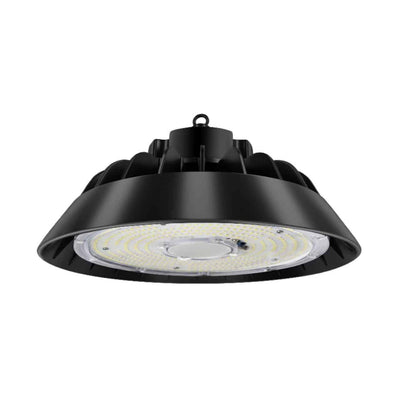
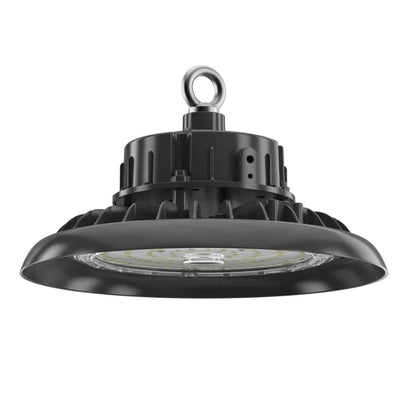
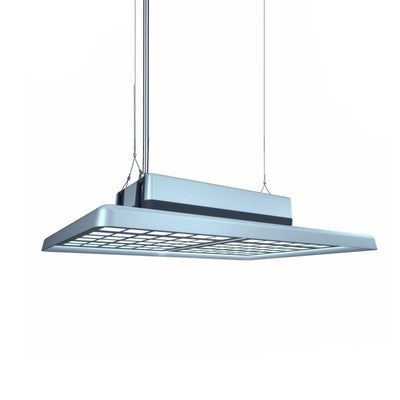
Our LED high bays with 1-10V and 0-10V dimmable SOSEN drivers are ready for immediate use in production halls, high-bay warehouses and logistics centres – with up to 5 years' warranty and EU-wide delivery in 2–5 working days.
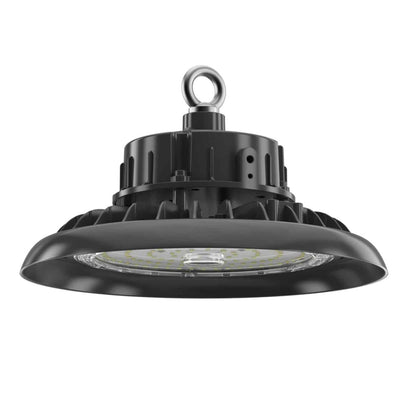
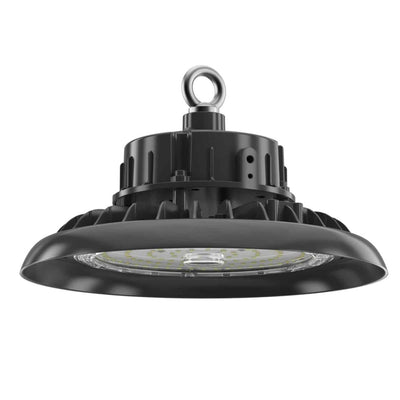
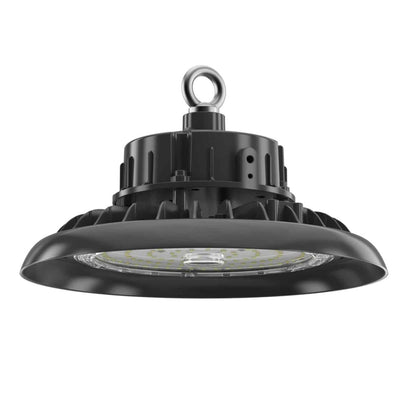
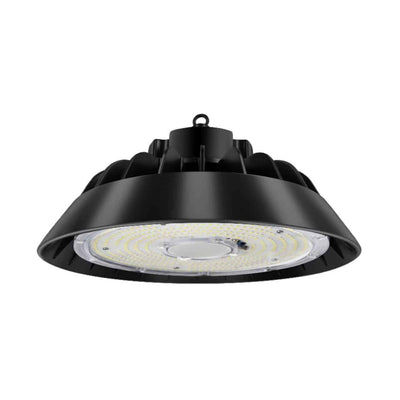
For high-performance applications with 0-10V dimming and maximum efficiency, our LED high bays 240W with up to 190 lm/W are recommended:
Dimmable LED high bays with 0-10V technology – ideal for large halls, warehouses and sports facilities with ceiling heights from 6 m.
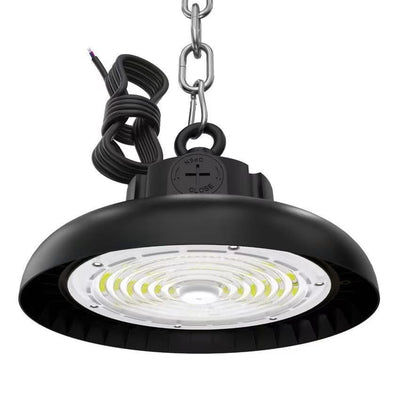
For damp locations, outdoor areas and production facilities with elevated protection requirements, please refer to our guide on IP protection ratings as well as our range of LED tri-proof lights.
Frequently asked questions
What is the precise difference between 0-10V and 1-10V dimming?
The key difference lies in the signal direction and dimming range. With 1-10V, the driver itself generates the control voltage (1–10V); the dimmer pulls it down. The dimming range ends at approx. 10% brightness; switching off completely requires a separate mains switch. With 0-10V, the dimmer actively feeds in a voltage of 0–10V; the driver receives it passively. At 0V the luminaire can switch off completely (dim to off), provided the driver supports this function.
Can I connect a 0-10V dimmer to a 1-10V driver?
No, this is not recommended. Because the signal directions are opposite, flickering, stuttering and uncontrolled flashing occur at low dimming levels. In the worst case, damage to the driver can result. Always use matched components of the same dimming technology.
Why does my LED luminaire flicker when dimmed with a TRIAC dimmer?
Flickering with TRIAC dimming is usually caused by incompatibility between the dimmer and the LED driver, an insufficient minimum load, or harmonic distortion from phase modulation. Check whether the driver is explicitly listed as "TRIAC-compatible" and compare the dimmer's minimum load specification with the actual total load of the connected luminaires.
How many luminaires can a 0-10V dimmer control?
Because the control cable in a 0-10V system carries only a very small current (typically under 1 mA per driver), a single dimmer controller can control a large number of drivers in parallel. The practical limit is determined by the maximum output capacity of the dimmer controller and the cable run length. For very long runs (over 50 m), screened cables should be used and voltage drop checked.
Is TRIAC dimming suitable for LED high bays in industrial halls?
Generally no. TRIAC dimming is unsuitable for industrial halls for several reasons: the minimum load requirements of conventional TRIAC dimmers are often not met by efficient LED luminaires, the susceptibility to flicker is difficult to reconcile with the requirements of DIN EN 12464-1 and ASR A3.4, and the limited load capacity per dimmer requires many dimmer units. For halls, 0-10V or 1-10V is recommended.
Which standards apply to dimmable lighting in industrial halls?
The authoritative standards are DIN EN 12464-1:2021-11 (Lighting of indoor workplaces) and ASR A3.4 (Lighting and visual connection). For sports facilities, DIN EN 12193 additionally applies. These standards specify requirements for maintained illuminance Em, uniformity and glare limitation (UGR). Dimmable 0-10V systems facilitate compliance with the maintained illuminance value throughout the entire service life of the installation.
What does installing 0-10V cost compared with TRIAC?
TRIAC has lower material costs, as no separate control cable is required. 0-10V requires an additional 2-core SELV control cable routed in parallel with the mains cable. The additional costs for cabling and the dimmer controller can be offset by higher energy savings (more precise control, dim to off, sensor integration) within a few years, depending on the operating profile.
Can 0-10V dimming be combined with presence and daylight control?
Yes, this is one of the greatest advantages of 0-10V. Many presence sensors and daylight controllers output a 0-10V signal and can be connected directly to compatible drivers. In warehouse halls, for example, a base illuminance level can be set that automatically rises to 100% when people are present – standards-compliant and energy-efficient. For the light planning of such systems, we offer a free DIALux light planning service.
Our expert team will prepare a free DIALux light plan for you – compliant with DIN EN 12464-1, ASR A3.4 and DIN EN 12193. We recommend the appropriate dimming technology, calculate the maintained illuminance value and deliver EU-wide in 2–5 working days.
Request a free light plan