LED Payback Period Calculator: ROI & Savings
How long does it take for an LED retrofit to pay for itself? Formula, industry scenarios, TCO comparison and current funding explained concisely.
The payback period of an LED retrofit is the total investment divided by the annual total savings – for commercial installations with 4,000 or more operating hours per year it typically falls between 1 and 3 years. Factoring in maintenance costs, funding and the maintenance factor to EN 12464-1 gives a robust picture of Total Cost of Ownership (TCO) – enough to convince even the most sceptical CFO.
- Basic formula: Payback period = net investment ÷ annual total savings (energy + maintenance)
- For industrial halls with 4,000 h/year and €0.22/kWh, LED typically pays back within 1–2 years
- The maintenance factor (MF) to EN 12464-1 influences usable illuminance and therefore the number of luminaires required
- German BAFA funding for interior lighting ended on 21 July 2026; for local authorities and sports clubs the Municipal Directive remains at 50–65%
- TCO over 5 and 10 years is more meaningful for buyers and facility managers than the simple payback period
The basic formula
Payback period (years) = Net investment ÷ Annual total savings
Annual total savings consist of energy savings plus savings on maintenance and lamp replacements. Net investment is the gross investment minus any funding.
Step-by-step calculation
Step 1 – Energy savings per year:
(Old system wattage in W – LED wattage in W) × number of luminaires × operating hours/year ÷ 1,000 × electricity price (€/kWh)
Step 2 – Maintenance savings per year:
Previous maintenance costs (lamps + labour) – future LED maintenance costs
Step 3 – Net investment:
Gross investment – funding (e.g. municipal or regional programmes)
Step 4 – Payback period:
Net investment ÷ (energy savings + maintenance savings)
Important: for discharge lamps (HQL, HQI, sodium) and fluorescent tubes, use the system wattage including ballast, not just the lamp wattage. A 400W HQL luminaire actually draws around 430W.
Interactive ROI calculator
Enter your project data – the calculator determines the payback period, annual savings and TCO over 5 years:
Four industry scenarios
Generic calculators often produce unrealistic results because operating hours, electricity prices and maintenance vary considerably by sector. The following four scenarios are based on typical commercial conditions and count energy savings only, without funding.

| Scenario | Existing luminaire (system) | LED replacement | Operating hours/year | Luminaires | Electricity price | Net investment | Annual savings | Payback |
|---|---|---|---|---|---|---|---|---|
| Industrial hall (IP65) | 400W HQL (approx. 430W) | 150W LED high bay | 4,000 h | 40 | €0.22/kWh | €8,000 | €9,856 | approx. 10 months |
| High-bay warehouse (24/7) | 250W HQL (approx. 270W) | 100W LED high bay | 6,000 h | 60 | €0.22/kWh | €10,800 | €13,464 | approx. 10 months |
| Office / administration | 2 × 58W fluorescent (approx. 130W) | 40W LED panel | 2,500 h | 80 | €0.22/kWh | €6,400 | €3,960 | approx. 19 months |
| Outdoor installation (IP66) | 150W HQL (approx. 170W) | 60W LED floodlight | 3,500 h | 20 | €0.22/kWh | €4,200 | €1,694 | approx. 30 months |
Calculation for scenario 1: (430 – 150) W × 40 × 4,000 h ÷ 1,000 × €0.22/kWh = €9,856/year. Maintenance savings (lamp changes, cherry picker) are not included and shorten the payback further. Always use your actual connected loads and unit rate for your own project.
Why operating hours are the key lever
At 2,000 operating hours per year (e.g. basements, ancillary rooms) payback extends to 3–6 years – still worthwhile once lamp replacements and maintenance are included. At 6,000 hours (shift operation, 24/7 warehouses) it can fall below one year. Operating hours are the most important input in any payback calculation.
Maintenance factor to EN 12464-1: an underestimated cost driver
The maintenance factor (MF) describes how much luminous flux an installation still delivers after a defined period. It comprises LLMF (lumen maintenance), LSF (survival), LMF (luminaire soiling) and RSMF (room surface soiling). Setting the MF too high results in too few luminaires and an installation that no longer meets the maintained illuminance Em after a few years.
| Environment | Typical MF (LED, 3 years) | Example application | Recommended IP rating |
|---|---|---|---|
| Very clean | 0.92 | Office, cleanroom | IP20–IP44 |
| Normal | 0.80 | Workshop, retail | IP44–IP54 |
| Dirty | 0.70 | Production hall, warehouse | IP65 |
| Very dirty | 0.60 | Foundry, welding shop | IP65–IP66 |
| Outdoor | 0.75 | Car park, façade | IP66–IP67 |
A lower MF means you need more luminaires to consistently achieve the required illuminance. More on protection ratings in IP Ratings Explained; lux values per area are covered in How Much Lux Do You Need?
TCO instead of payback: the CFO's perspective
The simple payback period says nothing about how much an installation saves over its whole life. TCO over 5 and 10 years is the more meaningful metric for B2B investment decisions.
TCO formula (simplified):
TCO = Investment + energy costs (period) + maintenance costs (period) – funding
Example: an industrial hall with 40 HQL luminaires of 400W (approx. 430W system) incurs around €151,360 in energy costs over 10 years (0.43 kW × 40 × 4,000 h × 10 × €0.22/kWh). The LED equivalent at 150W costs around €52,800 over the same period. The difference of around €98,500 exceeds an LED investment of €8,000–12,000 many times over – before maintenance savings.

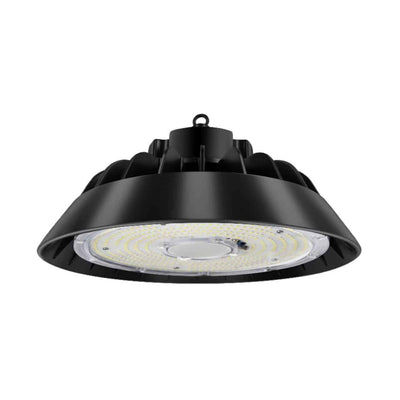
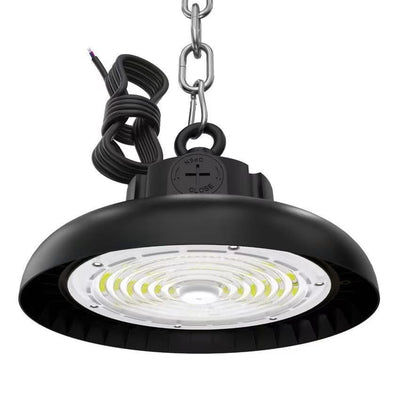
For production and storage halls, LED high bays with high efficacy (150–210 lm/W) are recommended, as operating hours are highest there. Linear systems can be found under Linear LED High Bays.
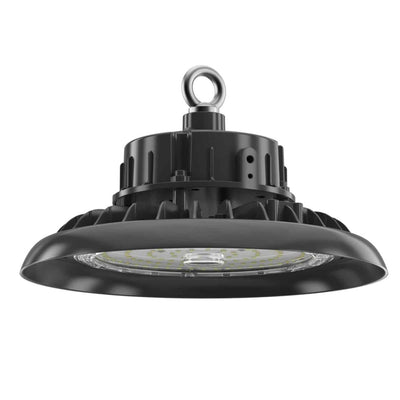
Recommended LED high bays for industry and warehousing – high efficacy, 5-year warranty:
Funding 2026: what is still possible
In Germany, BAFA funding for energy-efficient interior lighting in non-residential buildings (BEG) ended on 21 July 2026 (see BAFA LED Funding 2026). Remaining routes:
| Programme / route | For whom | Typical amount | Note |
|---|---|---|---|
| Municipal Directive (National Climate Initiative, Germany) | Local authorities, non-profit sports clubs | 50%, up to 65% for financially weak municipalities (as of May 2026) | Apply before construction |
| State and regional programmes | Depends on programme | Variable | State development bank or energy agency |
| Investment deduction (§ 7g EStG, Germany) | Small and medium businesses | Up to 50% of planned investment deductible in advance | Tax adviser |
| Leasing, hire purchase, contracting | Companies, municipalities | No upfront financing | Instalments from electricity savings |
Other countries have their own schemes, such as the EIA in the Netherlands. Important: funding applications generally have to be made before awarding contracts, and conditions change regularly. Always check the current status.
Common mistakes in payback calculations
Mistake 1: Outdated electricity price
Commercial prices vary with consumption, network charges and contract. Always use your current unit rate from the latest annual bill.
Mistake 2: Lamp wattage instead of system wattage
Ballasts of old luminaires use an extra 8–15%. Calculating with lamp wattage only underestimates the saving.
Mistake 3: Forgetting maintenance costs
HQL and HQI lamps need replacing every 8,000–12,000 hours. At mounting heights of 8–12 metres, labour costs are considerable. LED luminaires with a 50,000-hour rated life significantly reduce this.
Mistake 4: Ignoring the maintenance factor
Without the MF, too few luminaires are planned and the installation falls below the required Em after a few years – incurring remedial costs.
Mistake 5: Not accounting for dimming and controls
DALI or 1–10V controls can reduce consumption by a further 20–40% depending on the usage profile (see DALI and Lighting Control).
Special case: outdoor installations and sports facilities
Outdoors, IP66 is the usual minimum; sports facilities must also meet EN 12193. Because sports pitches are often lit only a few hundred to 2,000 hours a year, payback takes longer – funding such as the German Municipal Directive shortens it considerably (see How Many Lux Does a Football Pitch Need?).
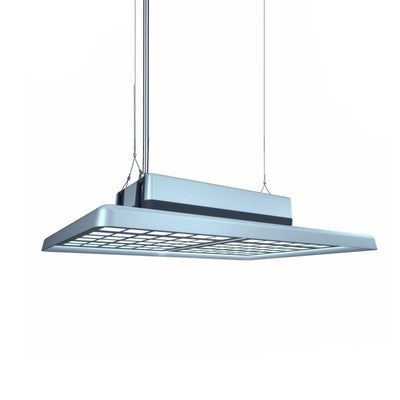
Suitable products: LED Sports Field Lighting, LED floodlights with IP66 for outdoor areas, and LED tri-proof lights for wet areas and cold stores.
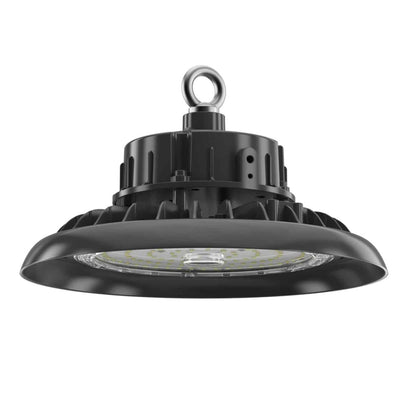
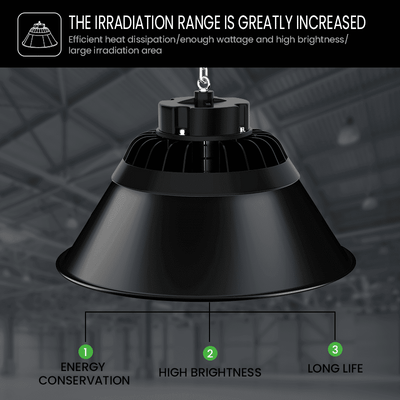
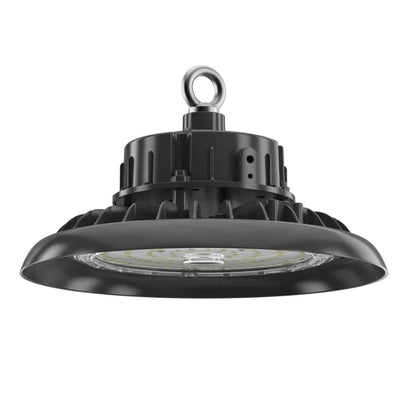
High-performance LED high bays for high-bay warehouses and 24/7 operation – with DALI control and 5-year warranty:
Safety notice: electrical work by qualified electricians only
Facility managers and buyers can plan and calculate an LED retrofit themselves. The electrical installation – especially work on 230V and 400V systems – must be carried out exclusively by qualified electricians. General guidance can be found in Connecting an LED Light Fitting.
Frequently asked questions
How do you calculate the payback period of an LED retrofit?
Payback period = net investment ÷ annual total savings. Annual savings are energy savings (system wattage difference × operating hours × electricity price) plus maintenance savings. Funding is deducted from the investment first.
When does an LED retrofit pay back particularly quickly?
With high operating hours (from 4,000 h/year), a high electricity price and inefficient existing luminaires (HQL, HQI, halogen), payback is often under 2 years and frequently under one year – even without funding.
Is LED worthwhile with infrequent use, e.g. in a basement or outdoor area?
Below 1,000 operating hours per year, payback extends to 5 years or more. The retrofit can still be worthwhile once lamp replacements and maintenance are included.
Which funding is still available in 2026?
German BAFA funding for interior lighting ended on 21 July 2026. Local authorities and non-profit sports clubs can still use the Municipal Directive (50%, up to 65%). Companies can use regional programmes, investment deductions, leasing or contracting.
What is the maintenance factor and why does it matter?
The maintenance factor (MF) to EN 12464-1 describes luminous flux retention over time. A low MF means more luminaires are needed to meet the maintained illuminance Em consistently.
How does a rising electricity price affect payback?
As the electricity price rises, annual savings increase proportionally and the payback period falls.
What does it cost to retrofit a complete industrial hall with LED?
It depends on hall size, mounting height, number of luminaires and efficacy class. As a guide, a hall with 40 LED high bays of 150W costs €6,000–12,000 net for the luminaires (excluding installation). Request an individual quote.
Does Clightstore help with light planning and payback calculations?
Yes. Clightstore produces free DIALux light plans for commercial projects, including illuminance verification, maintenance factor calculation and luminaire selection to EN 12464-1.
Clightstore produces a free DIALux light plan with an individual ROI analysis, maintenance factor calculation and funding overview – for industrial halls, warehouses, outdoor installations and sports facilities. EU-wide delivery in 2–5 working days, up to 5 years' warranty.
Request a free light plan