Modernising LED Lighting: Benefits & Savings
Standards-compliant LED modernisation for industry, warehouses & outdoor use: payback calculator, segment tables and B2B savings tips at a glance.
Switching to LED reduces energy consumption in commercial installations by 60–80% depending on the technology replaced. Factoring in maintenance, service life and standards compliance, payback is typically achieved in under three years. This guide shows how to calculate savings by segment and which standards apply.
- LED luminaires use 60–80% less electricity than mercury vapour or metal halide lamps for the same light output.
- Service lives of 50,000–100,000 hours greatly reduce maintenance and replacement costs – especially at high mounting heights.
- EN 12464-1 sets minimum requirements for illuminance (Em), UGR and Ra in workplaces.
- ROI can be calculated precisely from operating hours, system wattage and electricity price – use the calculator below.
- Clightstore supplies compliant LED solutions for industry, warehouses, sport and outdoor use, with free DIALux light planning and up to 5 years' warranty.
Why legacy lighting becomes a cost driver
Mercury vapour (HQL), metal halide (HQI/HIT) and fluorescent lamps are still common in existing buildings. Their efficacy is typically 60–100 lm/W; modern LED high bays achieve 150–210 lm/W. For the same light, LED needs 50–75% less power. Hidden costs add up too: lamps, starters and ballasts need replacing every 8,000–15,000 hours, and at 8–14 m mounting heights the cherry picker and labour alone are considerable.

Requirements by application
| Application | Em (lux) | UGR max. | Ra min. | Recommended IP |
|---|---|---|---|---|
| Warehouse / racking faces | 200 | 25 | 60 | IP65 |
| Coarse assembly / packing | 300 | 25 | 80 | IP54–IP65 |
| Production hall (medium-fine work) | 500 | 22 | 80 | IP54–IP65 |
| Fine assembly / quality inspection | 750 | 19 | 90 | IP54 |
| Sports hall (EN 12193) | 200–750 (by class) | 22 | 65 | IP40–IP54 |
| Outdoor / yard (EN 12464-2) | 5–200 | – | 20–80 | IP65–IP66 |
Detailed lux values in How Much Lux Do You Need?; glare in UGR Value Explained.
Energy savings in concrete terms
Calculated with the old luminaire's system wattage including ballast:
| Legacy technology | Old system wattage | LED replacement | New wattage | Saving |
|---|---|---|---|---|
| HQL mercury vapour 400W | approx. 430W | LED high bay | 150W | approx. 65% |
| HQI metal halide 250W | approx. 270W | LED high bay | 100W | approx. 63% |
| Fluorescent T8 (2×58W) | approx. 130W | LED tri-proof light | 40–55W | approx. 60–70% |
| Halogen floodlight 500W | 500W | LED floodlight | 100–150W | 70–80% |
| Fluorescent T5 (1×54W) | approx. 60W | LED tube | 18–22W | approx. 63–70% |
Which LED replaces which lamp: Replacing HQL, HQI and Sodium Lamps and Replacing Fluorescent Tubes with LED. Lumens vs. efficacy: Lumen vs. Lumen per Watt.
Payback calculator
Enter your operating data – the calculator shows annual savings, CO₂ reduction and payback period:
Full methodology: LED Payback Period Calculator.
Recommendations by segment
Industry and production
Production halls need 300–750 lux depending on the task, UGR ≤ 22 and Ra ≥ 80. Linear high bays or linear systems with 1-10V or DALI dimming enable demand-led control. Spray-painting and inspection areas need Ra ≥ 90. In explosive atmospheres only ATEX luminaires are permitted.

High-bay warehouses and logistics
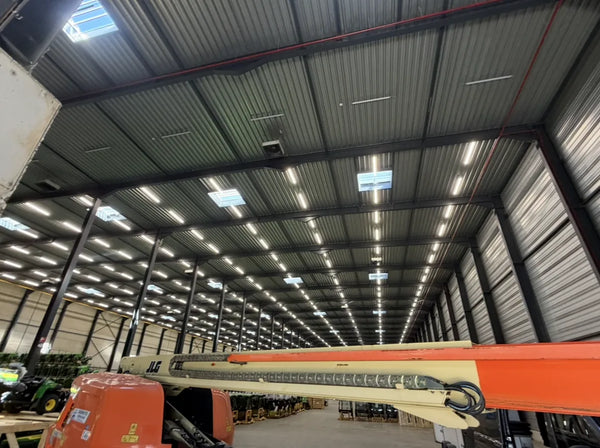
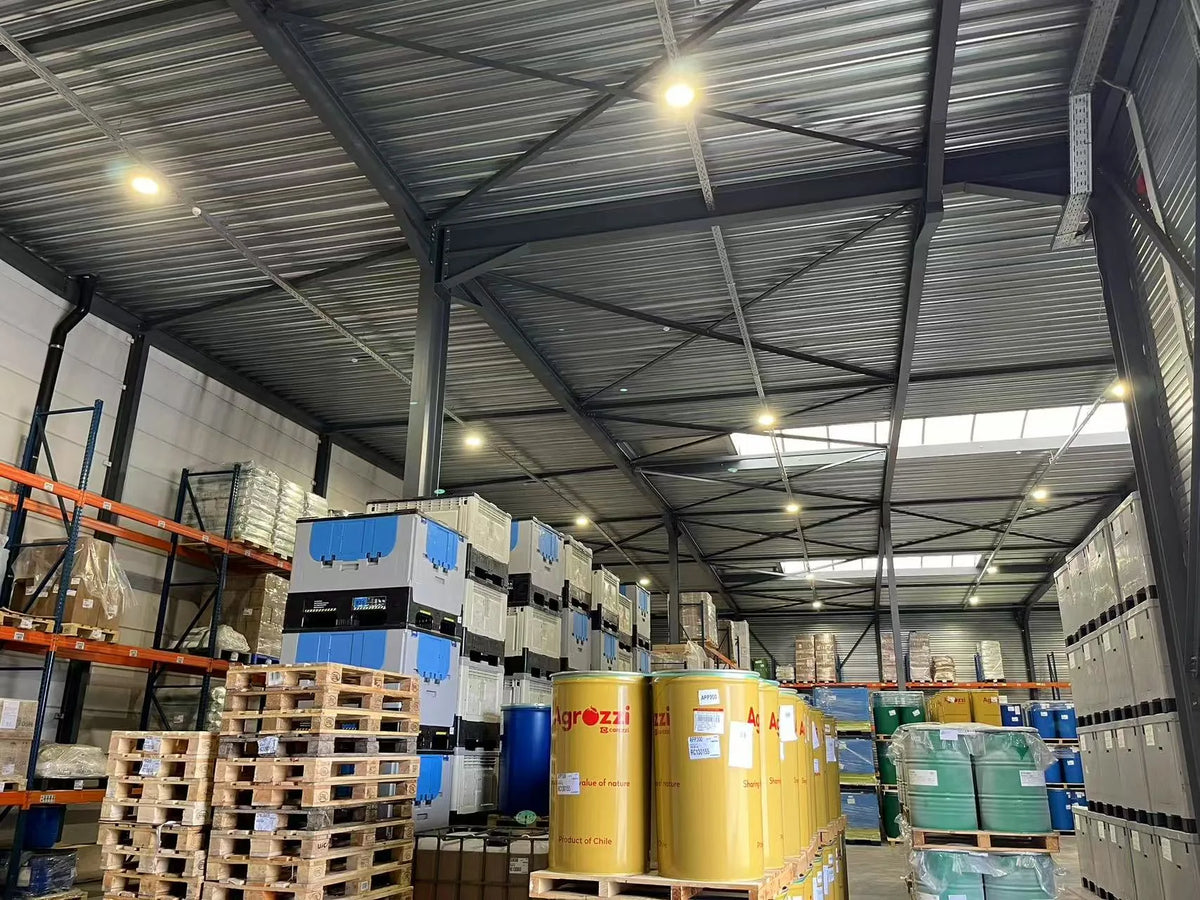
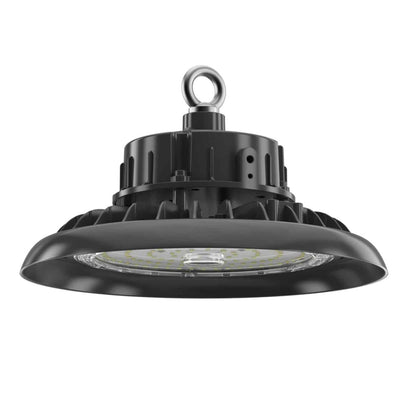
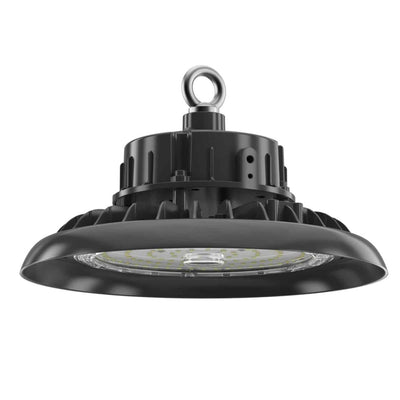
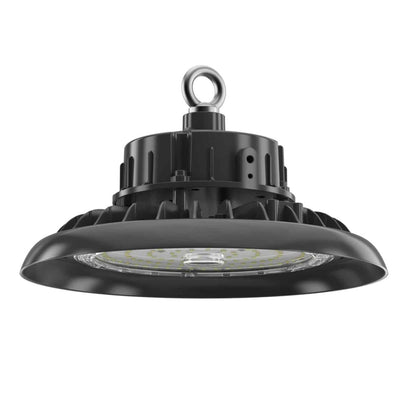
Mounting heights of 8–14 m are typical. UFO or linear high bays with 60–90° optics reach the required 200 lux on racking faces. IP65 is standard. With a 50,000-hour life and 16 hours a day, more than 8 years pass before any replacement is due (see Warehouse Lighting).
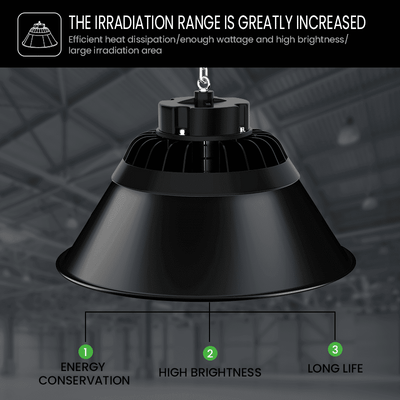
LED high bays for warehouses and logistics – IP65, up to 210 lm/W, 5-year warranty:
Sports halls and sports facilities
EN 12193 sets 200–750 lux for sports halls depending on the lighting class, with good uniformity; outdoor pitches start at 75 lux. See LED sports field lighting, football pitch lighting, padel court lighting and the guides Sports Hall Lighting and Light Distribution on Sports Fields.
Outdoor areas and yards
EN 12464-2 sets 5–200 lux depending on the task. Minimum IP65, IP66 with water jets. LED floodlights and LED street lights meet this; for irregular use, floodlights with motion sensor save more (see Outdoor Lighting for Business Premises).
Offices and administration
At screen workstations, UGR ≤ 19 applies. Backlit panels with appropriate glare control meet this (see Backlit vs. Edge-Lit and Office Lighting).
The hidden ROI: maintenance and operational reliability
Conventional lamps in halls need replacing every 8,000–15,000 hours. With 50 luminaires at 10 m, each cycle costs considerably in cherry picker hire, labour and lamps – plus possible downtime. LED with a 50,000-hour life and 5-year warranty greatly reduces these cycles (see LED Lifetime Explained). Mercury vapour lamps also contain mercury and fall under RoHS (2011/65/EU); LED is mercury-free.
Dimming and controls
Modern LED high bays support 1-10V or DALI dimming; with daylight or presence control a further 20–40% can be saved (see DALI and Lighting Control and 0-10V, 1-10V and TRIAC). 4000K suits production halls, 5000–6000K inspection areas (see LED Colour Temperature).
Large projects
From 20 light points, a professional DIALux light plan is recommended. Clightstore provides it free of charge, including compliant lux calculations, luminaire positions and an economic viability report. As a B2B direct importer we deliver EU-wide within 2–5 working days.
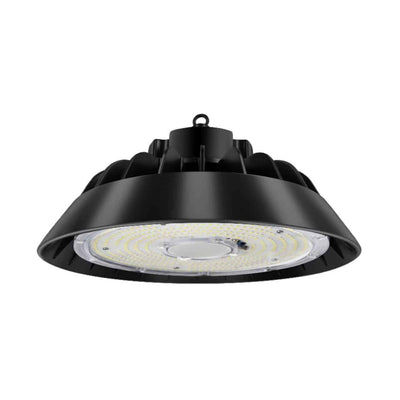
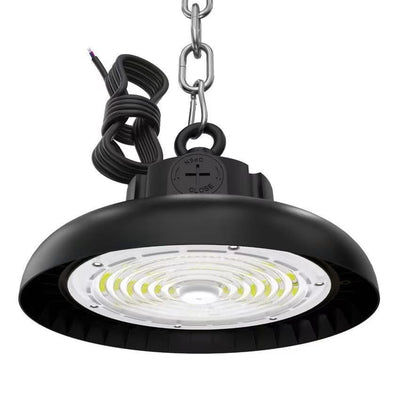
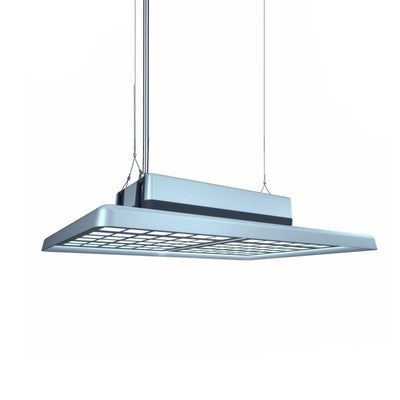
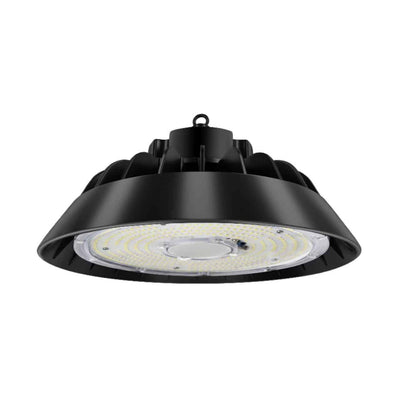
High-performance LED high bays for large projects – DALI and 1-10V dimmable, up to 210 lm/W:
Safety notice
Replacing luminaires and connecting to 230V or 400V must be carried out by qualified electricians (see Connecting an LED Light Fitting).
Frequently asked questions
How much energy do I actually save with LED?
It depends on the technology replaced. Replacing a 400W HQL luminaire (approx. 430W system) with a 150W LED high bay saves around 65%; fluorescent to LED typically 60–70%. Use the calculator above for your data.
When does the LED investment pay for itself?
With 10–16 operating hours a day, often within 1–3 years; faster with maintenance savings. See LED Payback Period Calculator.
Which standards apply to workplace lighting?
EN 12464-1 for indoor workplaces, EN 12464-2 outdoors and EN 12193 for sports facilities. National workplace rules refer to these.
What IP rating do I need for my hall?
Dry production halls often IP54; with dust, splash water or cleaning IP65; with high-pressure cleaning IP66 (see IP Ratings Explained).
What does UGR mean for screen workstations?
UGR measures glare. EN 12464-1 requires UGR ≤ 19 at screen workstations; higher values cause fatigue and loss of concentration.
Is LED more environmentally friendly?
Yes: mercury-free, much lower consumption and far longer life – fewer resources, less waste and lower CO₂ emissions.
Which LED luminaires suit high-bay warehouses?
UFO or linear high bays with 60–90°, IP65 and at least 150 lm/W. At 8–10 m typically 100–150W, at 10–14 m 150–240W. See our LED high bays.
Does Clightstore offer light planning for large projects?
Yes, free of charge for commercial projects – with lux calculations, luminaire positions and an economic viability report.
Clightstore provides a free DIALux light plan to EN 12464-1, with lux verification, luminaire positions and payback calculation. EU-wide delivery in 2–5 working days, up to 5 years' warranty.
Request free light planning