School Lighting: Classroom Lux Levels, Board Lighting and LED Retrofit
How to light schools and universities: EN 12464-1 lux values per room, board lighting, glare-free panels, presence and daylight control, savings example.
Good lighting in schools and universities supports concentration and wellbeing; poor lighting tires students and makes reading the board and screen harder. At the same time, schools are large electricity consumers with many old fluorescent fittings. This guide shows the EN 12464-1 values, proper board lighting and how presence and daylight control cut consumption.
- Classroom: 300 lux, 500 lux for evening classes and adult education, UGR no more than 19, Ra at least 80.
- Chalkboard and whiteboard: 500 lux vertical, with a dedicated asymmetric board luminaire.
- Lecture theatres, labs, specialist rooms: around 500 lux.
- Corridors around 100 lux, canteen around 200 lux, sports halls to their own standard.
- Presence and daylight sensors often save an extra 30–50% in schools.
Lux values in educational buildings
| Area | Illuminance | UGR max. | Ra min. |
|---|---|---|---|
| Classroom | 300 lux | 19 | 80 |
| Classroom for evening classes, adult education | 500 lux | 19 | 80 |
| Chalkboard, whiteboard (vertical) | 500 lux | 19 | 80 |
| Lecture theatre, seminar room | 500 lux | 19 | 80 |
| Lab, workshop, technology room | 500 lux | 19 | 80 |
| Art room | 500 lux | 19 | 90 |
| Library, reading area | 500 lux | 19 | 80 |
| Corridors, stairs | 100–150 lux | 25 | 80 |
| Canteen, common hall | 200 lux | 22 | 80 |
The values follow EN 12464-1 and are maintained values. Sports halls have their own guide: Sports Hall Lighting.

Board lighting
The board is the most important visual task in the classroom, but ceiling lighting only strikes it at a shallow angle. Every board therefore needs its own luminaire with asymmetric optics, mounted on the ceiling about 1 m in front of the board. It puts around 500 lux evenly on the board surface without dazzling students or teachers, and is switched separately.
Glare-free luminaires for learning spaces
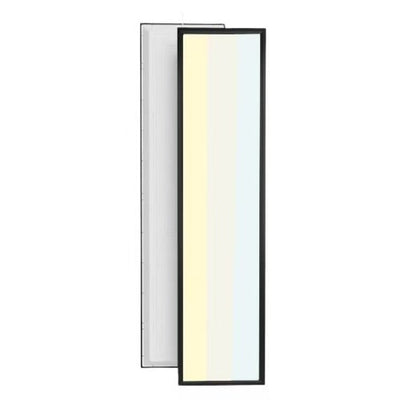
- UGR<19: Students switch between notebook, board and screen. Glare-free panels with microprismatic diffusers are essential (see UGR Value Explained).
- Colour temperature: 4000K is standard. Tunable-white luminaires can be cooler in the morning and warmer in the afternoon, supporting the daily rhythm.
- Impact resistance: Use robust, impact-resistant luminaires in corridors and common halls.
Luminaires for schools


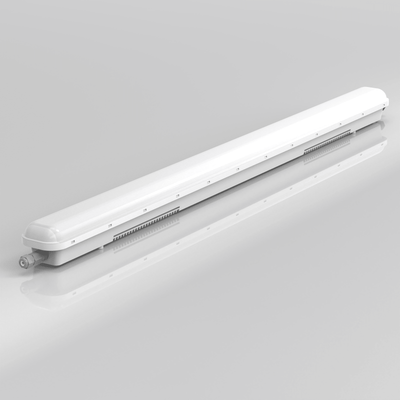
Controls: presence and daylight
Classrooms are empty for many hours a day, and daylight is often enough along the windows. Presence detectors switch the light off when the room is empty; daylight sensors automatically dim the window row. Together they typically save 30–50% on top of the LED retrofit (see DALI and Lighting Control).
Worked example: school with 30 classrooms
30 rooms, each with 9 grid luminaires 4 × 18W (approx. 80W), 1,800 operating hours, €0.30/kWh. Replaced by 270 LED panels of 36W: saving 270 × 44W × 1,800 h = 21,384 kWh, around €6,400 a year. Considerably more with presence and daylight control. School authorities can often access funding for retrofits.
Frequently asked questions
How many lux does a classroom need?
300 lux under EN 12464-1; 500 lux for evening classes and adult education. The board needs 500 lux vertical.
Does every board need its own luminaire?
Yes. For compliant, glare-free lighting of the board, an asymmetric board luminaire about 1 m in front of the board is standard.
Which colour temperature is best for schools?
4000K neutral white. Tunable-white systems can adjust the colour temperature through the day.
Are presence detectors worthwhile in classrooms?
Yes. Classrooms are often empty, and lights are frequently left on. Presence detectors save reliably here.
What matters in lecture theatres?
500 lux in the audience area, dimmable for presentations, and separate lighting for lectern and board.
Send us a room list or floor plans. We prepare a free DIALux lighting plan to EN 12464-1 and a no-obligation quote at direct-import prices 2–4× below comparable branded products.
Request a lighting planCover photo: Harrison Keely, Wikimedia Commons, licence CC BY 4.0.