Outdoor Basketball Court Lighting: Lux Levels and Pole Layout
Lux levels, pole layout and floodlight choice for outdoor basketball and 3x3 courts – plus vandal resistance, switching and spill light for public courts.
Outdoor basketball courts are among the most-used sports facilities in towns and schools – and among the most often badly lit ones. A single street light at the edge of the court leaves the far basket in the dark, blinds players looking up at a rebound and lights up the bedrooms across the road. This guide shows how to light an outdoor basketball court properly: lux levels per class, where to put the poles, which floodlights to use, and how to keep neighbours and vandals out of the equation.
- EN 12193 sets about 75 lux for recreational play, 200 lux for club competition and 500 lux for national competition on outdoor courts, with uniformity of 0.5, 0.6 and 0.7.
- A full court (28 × 15 m) is usually lit from 4 or 6 poles of 8–10 m on the long sides; a half court or 3x3 court from 2 poles.
- Never place floodlights behind the baskets or above the key: players look up at the rim constantly.
- Use asymmetric, flat-mounted floodlights to keep light on the court and out of nearby homes.
- Public courts need vandal-resistant equipment (IK08–IK10, high mounting, closed cabinets) and a timer or push-button with automatic switch-off.
Lux levels for outdoor basketball
EN 12193 (sports lighting) divides outdoor basketball into three lighting classes. The values below are maintained average horizontal illuminance on the playing area including the safety zone.
| Use | Class | Em (lux) | Uniformity U₀ (min.) | Ra (min.) | Glare GR (max.) |
|---|---|---|---|---|---|
| Recreational play, school yard, public park | III | 75 | 0.5 | 20 | 55 |
| Club training and local competition | II | 200 | 0.6 | 60 | 50 |
| National and international competition | I | 500 | 0.7 | 60 | 50 |
For most public courts, class III is the legal minimum, but 100–150 lux makes a clear difference in practice: the ball is easier to follow, the court feels safer and it attracts more use in the evening. Clubs that train outdoors plan for class II. For the other sports and their classes, see Light distribution on sports fields.

Where the poles go
Full court (28 × 15 m)
- 4 poles at the four corners, offset along the long sides, 8–10 m high: enough for class III and, with good optics, class II.
- 6 poles, three per long side, 10 m high: the better choice for class II and for good uniformity under the baskets.
- Keep poles at least 1.5–2 m outside the safety zone so players cannot run into them; protect them with padding if space is tight.
Half court and 3x3 courts
A half court or 3x3 court (15 × 11 m) is usually lit from two poles on the side lines, about 8 m high, aimed across the court. In compact urban sites, a single taller pole on the side opposite the basket can also work, but uniformity suffers.
What to avoid
- Behind the baskets: players look towards the basket for most of the game; a floodlight behind the backboard is directly in view at every shot.
- Above the key or the court: every rebound and lob passes through the light source.
- Street lights as court lighting: one lantern on the edge gives a bright patch and dark baskets, and fails every uniformity requirement.
Choosing the floodlights
| Criterion | Recommendation | Why |
|---|---|---|
| Optic | Asymmetric, or 40–60° aimed across the court | Light stays on the court; low tilt angle means less glare and spill |
| Mounting | As flat as possible (tilt ≤ 15–20°) | Limits glare for players and light into neighbouring windows |
| Efficacy | ≥ 150 lm/W | Low running costs on municipal budgets |
| Colour temperature | 4000K (3000K near homes if required) | Good contrast; warmer light where local rules ask for it |
| Protection | IP66, IK08–IK10 | Rain, balls and vandalism |
| Control | Timer, push-button or app with automatic switch-off | Light only when the court is in use, no lighting late at night |
As a guide for a full court: 4 × 250W floodlights give about 100–150 lux, 6 × 250W or 4 × 500W about 200 lux. A half court reaches 75–150 lux with 2 × 250W. The exact result depends on pole height and optic, so we always check it in DIALux first. More on beam angles: Lumen vs. lumen per watt.
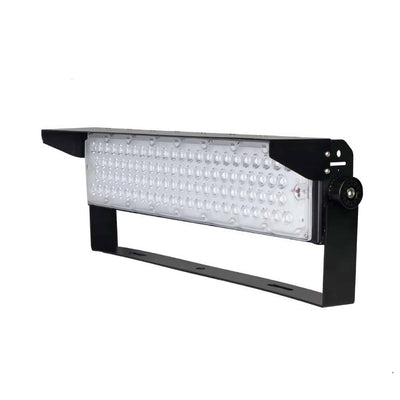
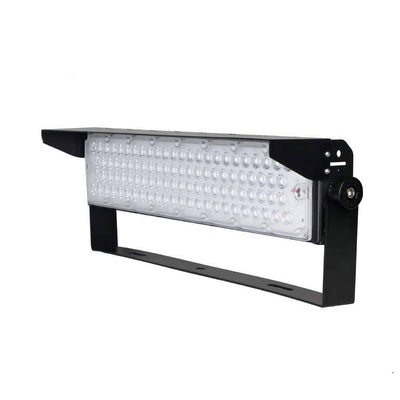
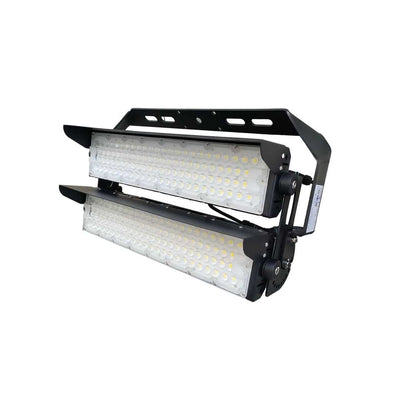
LED floodlights for outdoor basketball courts – IP66, narrow to medium beams, Philips or Sosen driver, 5-year warranty:

Public courts: vandalism, switching and safety
Courts in parks, school yards and housing estates are used without supervision. That changes the design:
- Mount high: 8 m or more keeps floodlights out of reach of thrown objects.
- Robust housings: aluminium with tempered glass, IK08 minimum, IK10 where vandalism is common (see IK rating explained).
- Lockable cabinets at the pole base, tamper-proof screws and cable protection.
- Push-button with timer (for example 30 or 60 minutes) and a fixed switch-off time in the evening. This saves energy and avoids lighting an empty court at night.
- Path lighting to and from the court, so the area does not become a dark island once the court lights go off.
Neighbours and light pollution
Many basketball courts are close to homes. Most municipalities and permits limit both the spill light on facades and the hours of use. In practice:
- Use asymmetric floodlights mounted flat, aimed away from the houses.
- Add shields or visors on the side facing homes.
- Choose 3000K where local rules ask for warmer light, and dim or switch off at a fixed hour.
- Have the spill light on nearby facades calculated in the light plan before applying for a permit.
More on colour temperature outdoors in LED colour temperature.
Running costs
Example: a full public court with 4 × 250W LED floodlights, used about 800 hours a year, at €0.25/kWh:
- LED: 1.0 kW × 800 h = 800 kWh → about €200 a year.
- Old metal halide with similar light output (4 × 400W, about 1.7 kW): about €340 a year, plus lamp replacements every few years.
- With push-button and timer: often 30–50% fewer burning hours than a fixed evening schedule.
Many countries support sports facilities for municipalities and clubs; see Calculating LED payback period for the method and the funding routes.
Installation
Poles for sports lighting must be designed for the wind load of the floodlights at their mounting height (Eurocode EN 1991-1-4) and installed on a suitable foundation. Underground cables need protection and correct earthing. All connection work on 230V/400V must be carried out by a qualified electrician in accordance with HD 60364 and the national wiring regulations (see Connecting an LED light fitting).
Frequently asked questions
How many lux does an outdoor basketball court need?
Around 75 lux for recreational play, 200 lux for club training and competition, and 500 lux for national competition, with uniformity of at least 0.5, 0.6 and 0.7. For public courts, 100–150 lux is a good practical target.
How many light poles does a basketball court need?
A full court usually has 4 or 6 poles on the long sides; a half court or 3x3 court 2 poles. More poles give better uniformity and less glare.
How high should the light poles be?
8–10 m for a full court, about 8 m for a half court. Higher poles allow flatter aiming, which means less glare and less spill light.
Can I put floodlights behind the baskets?
No. Players look towards the basket for most of the game, so a floodlight behind the backboard is in their view at every shot. Place the poles on the long sides.
Is a street light enough for a basketball court?
Usually not. A single street light gives a bright spot and dark areas under the baskets, and does not meet the uniformity requirements of EN 12193. Use floodlights on the long sides.
How do I prevent complaints from neighbours?
Use asymmetric floodlights mounted flat and aimed away from homes, add shields where needed, limit the hours with a timer, and have the spill light calculated before installation.
Which IK rating do public courts need?
At least IK08; IK10 where vandalism is a known problem. Combined with high mounting and lockable cabinets, this keeps maintenance low.
Can the lights switch on and off automatically?
Yes. A push-button with a timer, a twilight switch combined with a fixed switch-off time, or app control are common on public courts.
Send us the site plan. We prepare a free DIALux light plan with lux values, uniformity, glare and spill light on nearby homes, and propose poles and floodlights. EU-wide delivery in 2–5 working days, up to 5 years' warranty.
Request a free light plan