LED Street Lighting: EN 13201 Classes, Pole Spacing and Savings
LED street lighting for municipalities and businesses: EN 13201 classes, pole heights and spacing, colour temperature and insect protection, night dimming and savings.
For many municipalities, street lighting is one of the largest electricity consumers, and at the same time a matter of road safety. Converting old sodium or mercury vapour luminaires to LED typically saves 50–70%, and even more with night dimming. This guide explains the EN 13201 lighting classes, pole heights and spacing, and what municipalities and businesses should look for when choosing luminaires.
- EN 13201 divides roads into classes: M for motorised traffic (luminance), C for conflict areas, P for footpaths, cycle paths and residential streets.
- Residential streets and paths (P classes): roughly 2 to 15 lux depending on use.
- Residential streets typically 4–6 m pole height, main roads 8–10 m.
- 3000K or warmer is increasingly standard in residential areas, for residents and insect protection.
- Existing poles can almost always be reused: LED luminaires fit the usual 60 mm spigots.
Lighting classes to EN 13201
| Class | Application | Criterion |
|---|---|---|
| M1–M6 | Roads with motorised traffic, medium to high speed | Road surface luminance (cd/m²) |
| C0–C5 | Conflict areas: junctions, roundabouts, pedestrian crossings | Illuminance (lux) |
| P1–P6 | Footpaths and cycle paths, residential streets, residential car parks | Illuminance (lux) |
For the P classes, average illuminance ranges from about 15 lux (P1) through 10, 7.5, 5 and 3 down to 2 lux (P6). Which class applies depends on traffic volume, speed, ambient brightness and crime risk, and is set by the municipality or designer.

Pole height, spacing and power
| Road type | Pole height | Pole spacing | LED power |
|---|---|---|---|
| Footpath and cycle path, park path | 3–5 m | 15–25 m | 20–40W |
| Residential street | 4–6 m | 20–30 m | 30–60W |
| Collector road, industrial estate | 6–8 m | 25–35 m | 60–100W |
| Main road | 8–10 m | 30–40 m | 100–200W |
The values are a guide. For a compliant design, each road is calculated for luminance or illuminance and uniformity, which we do free of charge in DIALux.
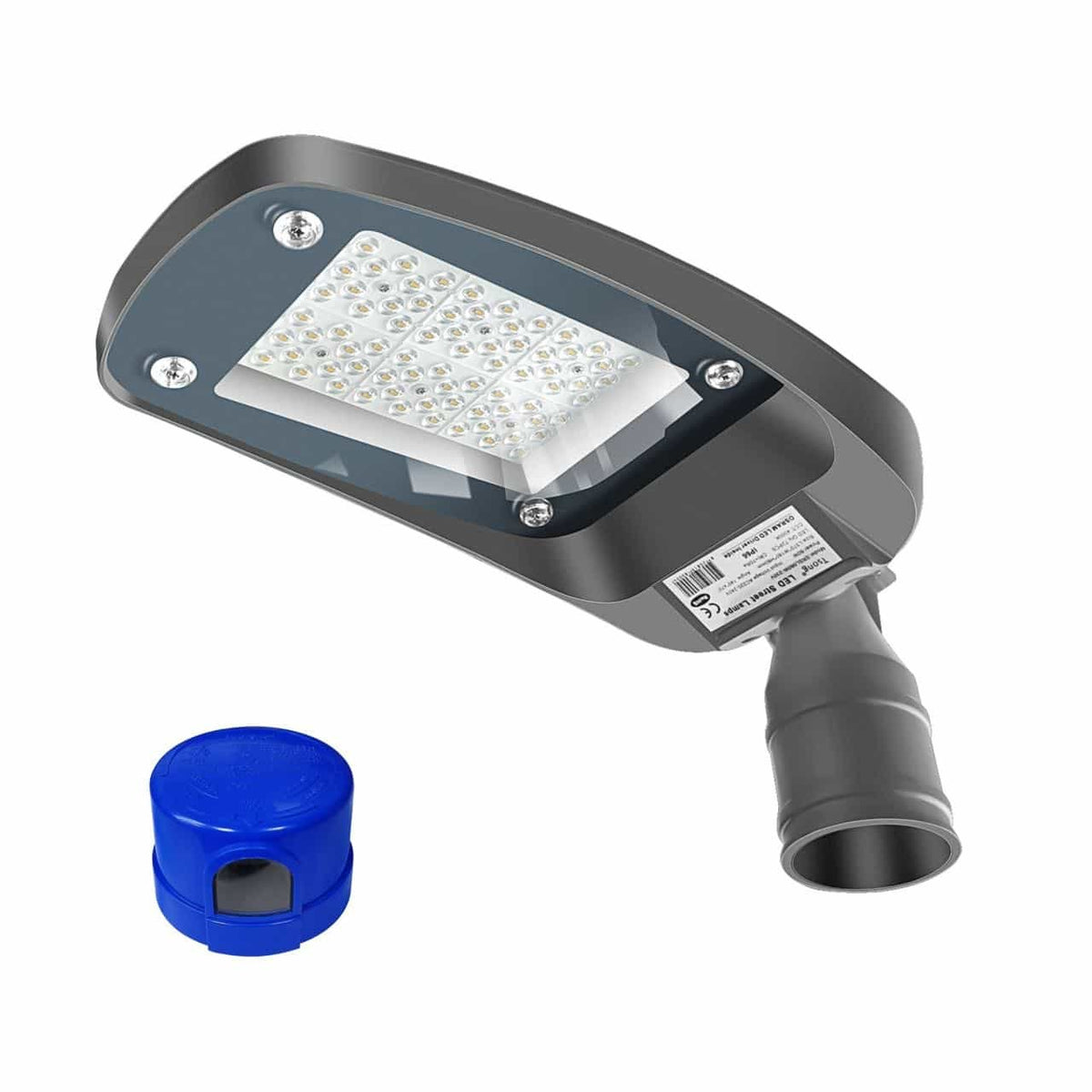
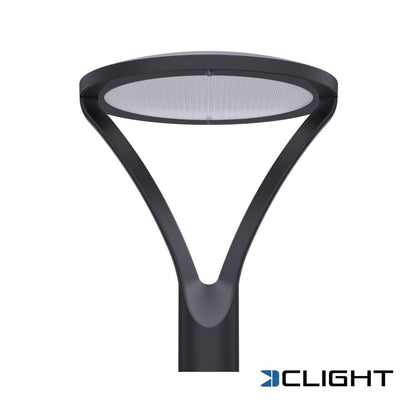
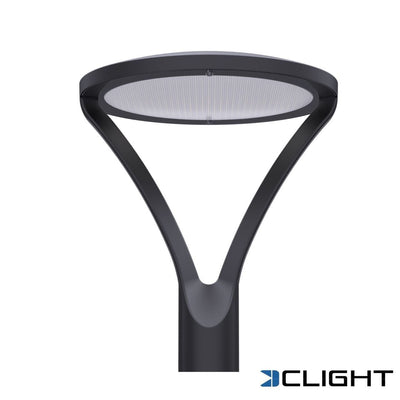
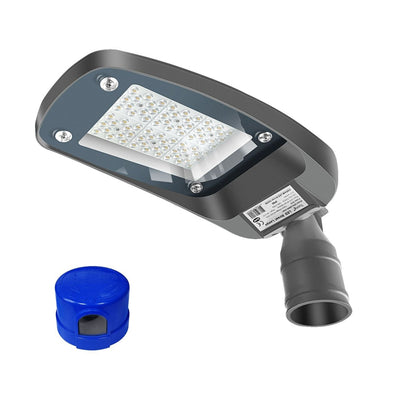
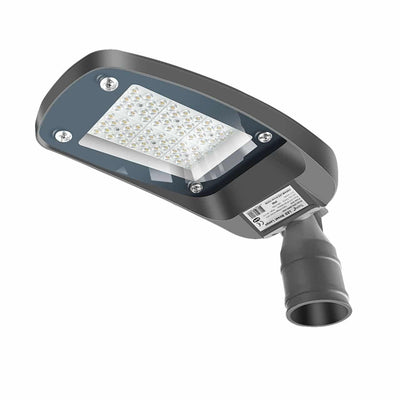
LED street lights
Colour temperature, insects and light pollution
Neutral white light (4000K) improves contrast and colour recognition. In residential areas, near water and close to nature reserves, municipalities and regulations increasingly require 3000K or warmer, because short-wave light attracts insects and disturbs residents. It is also important that no light is emitted upwards: modern LED street lights with flat glass emit practically only downwards.
Controls: night dimming and sensors
- Daylight sensor: Switches at dusk without central control.
- Night dimming: Drivers with a time profile automatically dim to 50% or less at night.
- Presence-based: On paths with little traffic, the luminaire only ramps up when someone approaches.
More on dimming systems in 0-10V, 1-10V and TRIAC.
Worked example: municipality with 500 light points
500 sodium luminaires of 70W (approx. 85W with ballast), 4,100 operating hours a year, €0.30/kWh. Replaced by 30W LED luminaires with night dimming (averaging 75% output):
- Before: 500 × 85W × 4,100 h = 174,250 kWh, around €52,300 a year
- After: 500 × 30W × 0.75 × 4,100 h = 46,125 kWh, around €13,800 a year
- Saving around €38,500 a year, plus less maintenance
Funding programmes for municipal outdoor lighting upgrades exist in many countries. How to calculate your own case is shown in LED Payback Period Calculator. Car parks have their own guide: Car Park Lighting.
Frequently asked questions
How bright must a residential street be?
Residential streets usually fall into the EN 13201 P classes with around 3 to 10 lux average illuminance, depending on traffic and surroundings.
Can I fit LED street lights to existing poles?
Yes, in most cases. The luminaires fit the usual 60 mm spigots and are lighter than old luminaires.
Which colour temperature for street lighting?
3000K in residential and natural areas, 4000K on main roads and in industrial estates.
How much does LED street lighting save?
Compared with sodium or mercury vapour, typically 50–70%, plus another 20–30% with night dimming.
Is funding available for municipalities?
Yes, many countries have funding programmes for outdoor and street lighting upgrades. Conditions change regularly; applications usually have to be made before awarding the contract.
Send us the road plan, pole heights and spacing. We prepare a free lighting calculation to EN 13201 and a no-obligation quote at direct-import prices 2–4× below comparable branded products.
Request a lighting plan