LED Tri-Proof Lights: How to Choose the Right IP65 Batten for Industry, Garages and Cold Stores
How to choose an LED tri-proof light for commercial use: housing material and chemical resistance, length and wattage, efficacy series, linking several fittings on one circuit, mounting height and spacing, DALI, senso...
The tri-proof light is the workhorse of commercial lighting: a sealed linear batten that hangs in workshops, car parks, cold stores, food production, stables and plant rooms. Because they all look alike, buyers often compare only price and wattage. Yet the differences that decide whether a fitting lasts fifteen years or fails after two are in the housing material, the seals, the driver and how the fittings are wired together. This guide explains what to check before you order.
- “Tri-proof” means protected against water, dust and impact or corrosion. For commercial use, choose at least IP65 and IK08; see IP ratings explained.
- The housing material matters more than the IP number: polycarbonate is impact-resistant but sensitive to some chemicals; in stables and food production, check the declared chemical resistance.
- Choose the length by room height and light output: 60 cm for small rooms, 120 cm as the standard, 150 cm for higher halls up to about 6–8 m. Above that, a high bay is more efficient.
- Linkable fittings save cabling, but respect the maximum number per circuit because of inrush current.
- Decide in advance on DALI, sensor or emergency: retrofitting these into sealed fittings is rarely possible.

What makes a light “tri-proof”?
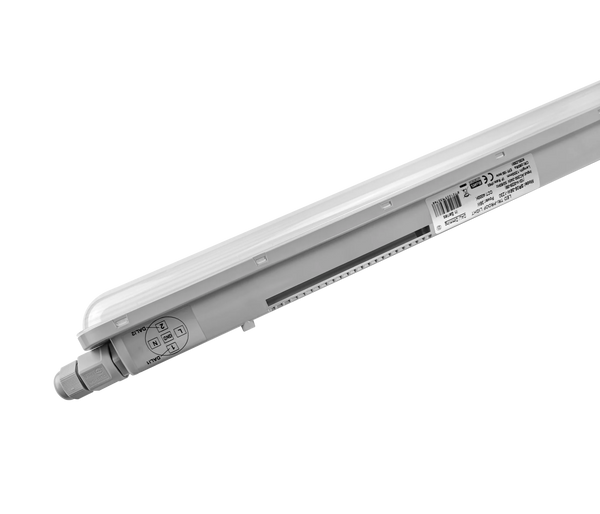
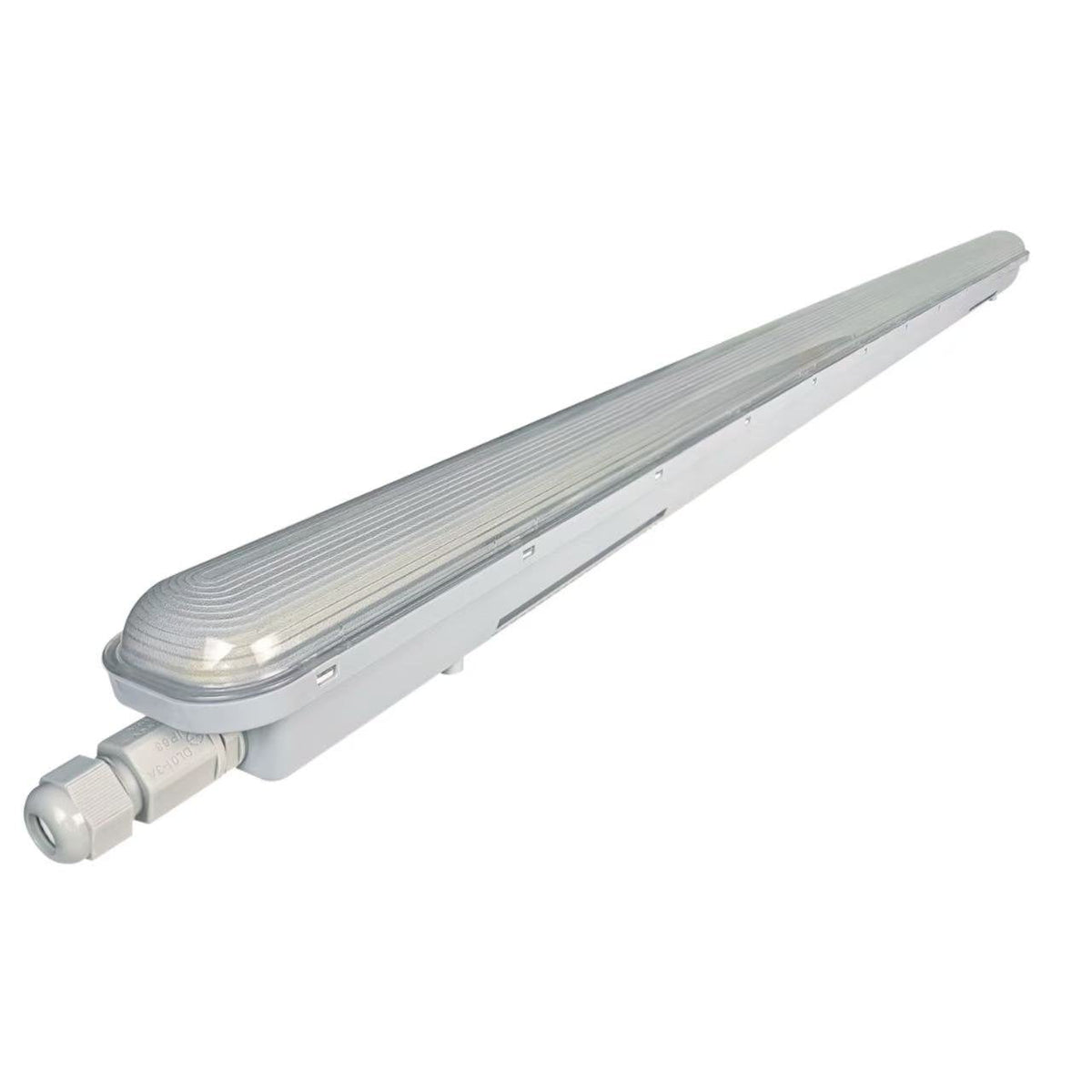
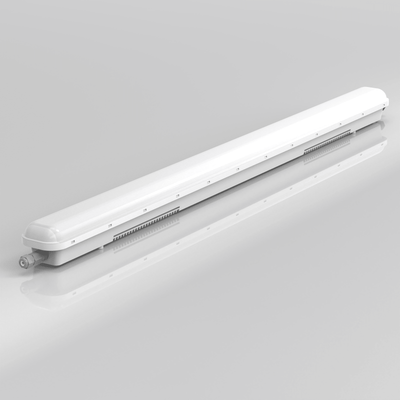
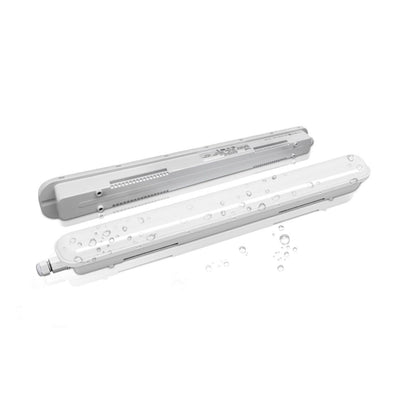
A tri-proof light is a sealed linear fitting with an LED board and driver behind a diffuser. The name refers to three protections: against water, against dust, and against impact or corrosion. In practice this means an IP rating of IP65 or IP66, an impact rating of at least IK08, and materials that withstand moisture and cleaning agents. Typical lengths are 60, 120 and 150 cm, so they line up with the old fluorescent fittings they replace.
The IP and IK codes only describe the test result of a new fitting. Whether it keeps that protection depends on the quality of the seals, the cable glands and the clips, and on correct installation. That is where cheap and good fittings differ.
Housing material and chemical resistance
| Material | Strengths | Watch out for |
|---|---|---|
| Polycarbonate (PC) housing and diffuser | Very impact-resistant, light, inexpensive, good IP sealing | Can yellow without UV stabilisation; sensitive to some solvents and strongly alkaline cleaners |
| Aluminium base with PC diffuser | Better heat dissipation, longer driver and LED life at high wattage | Corrosion in aggressive atmospheres without coating |
| PMMA (acrylic) diffuser | Higher light transmission, better UV resistance | Less impact-resistant; less suitable where objects can hit the fitting |
| Stainless steel clips | Do not rust in humid or corrosive rooms | Galvanised steel clips rust in stables, car washes and coastal areas |
For livestock barns with ammonia, food production with daily wet cleaning, and car washes, ask for the manufacturer’s chemical resistance declaration and choose fittings specifically released for that environment. More in barn and livestock lighting and food industry lighting.

Length, wattage and efficacy
| Length | Typical power | Typical luminous flux | Typical mounting height | Replaces |
|---|---|---|---|---|
| 60 cm | 15–20W | 2,000–3,000 lm | 2.5–3.5 m | 1×18W or 2×18W fluorescent |
| 120 cm | 25–40W | 4,000–7,000 lm | 3–5 m | 2×36W fluorescent |
| 150 cm | 45–60W | 6,000–9,000 lm | 4–8 m | 2×58W fluorescent |
Within the same length, efficacy can differ greatly: from about 120–140 lm/W for basic fittings to 190–200 lm/W for premium versions. A 200 lm/W fitting produces the same light with roughly 30% less power than a 140 lm/W fitting. With many operating hours, the higher purchase price usually pays for itself within a few years; see lumen vs lumen per watt and the payback calculator.
Mounting height and spacing
Tri-proof lights typically have a wide beam of about 120°. As a rough guide, the spacing between fittings can be about 1 to 1.5 times the mounting height for even lighting. Above roughly 6–8 m, the light spreads too much and a large share falls on walls and the upper racking; a high bay with a narrower beam then delivers more light on the floor per watt. In aisles with high racking, a continuous line of linked fittings along the aisle often gives better vertical illuminance on the shelves than individual high bays. Always confirm the layout with a light calculation; we prepare one free of charge.
Linking: through-wiring several fittings
Linkable fittings have an input and an output connection, so you can feed a row of fittings from one supply cable. That saves cabling and installation time, especially in long rows. Pay attention to three points:
- Maximum number per circuit. Every driver draws an inrush current when switched on. The datasheet states how many fittings may be connected per breaker type; exceeding this causes nuisance tripping. More in LED lighting trips the breaker or RCD.
- Current rating of the internal through-wiring. The total current of the whole row flows through the first fitting. Respect the maximum stated by the manufacturer.
- Sealing. Close unused cable entries with the supplied blind plugs and use connectors with the correct IP rating. An open gland makes an IP65 fitting an IP20 fitting.
For long continuous rows in large halls, a trunking light line system can be an alternative.
Options: dimming, sensor and emergency
Because tri-proof lights are sealed, options are hard to add afterwards. Decide before ordering:
- DALI or 1-10V dimming for daylight control, standby dimming or integration in a building management system.
- Integrated motion sensor for car parks, storerooms, stairwells and plant rooms. Which sensor type suits which room is explained in PIR or HF motion sensor.
- Emergency module with battery, so selected fittings also serve as emergency lighting along escape routes; see emergency lighting requirements.
Which tri-proof light for which application?
| Application | What to pay attention to |
|---|---|
| Workshops and vehicle garages | IP65, IK08, 4000–5000K, high CRI where colours matter; see vehicle workshop lighting |
| Underground car parks | IP65, integrated sensor or standby dimming, linkable rows; see underground car park lighting |
| Cold stores and freezers | Approved for low ambient temperatures, sealed against condensation; see cold store lighting |
| Food production | IP65/IP66, shatter-proof diffuser without glass, resistant to cleaning agents |
| Livestock barns | Ammonia-resistant housing, stainless clips, IP65 or higher |
| Basements, plant rooms, storerooms | 60 or 120 cm, sensor for short presence periods |
| Covered outdoor areas and loading bays | IP65 or IP66, UV-stabilised housing, suitable operating temperature range |
The five most common mistakes
- Leaving cable entries open or using the wrong cable diameter in the gland, so moisture gets in.
- Linking too many fittings on one circuit, causing the breaker to trip at switch-on.
- Using a standard PC fitting in an aggressive atmosphere such as a stable or car wash, where the housing becomes brittle.
- Hanging tri-proof lights too high, where a high bay would give more light on the floor.
- Forgetting options such as sensor, DALI or emergency module, which can no longer be added afterwards.
LED tri-proof lights from Clightstore – IP65, linkable, up to 200 lm/W, with DALI or sensor options, 3 to 5-year warranty:

Frequently asked questions
What does tri-proof mean?
Tri-proof means the fitting is protected against three things: water, dust and impact or corrosion. In practice this is a sealed linear fitting with at least IP65 and IK08, suitable for damp, dusty and demanding environments.
Is IP65 enough, or do I need IP66?
IP65 protects against water jets from any direction and is sufficient for most workshops, car parks and cold stores. Choose IP66 where fittings are cleaned with powerful water jets, as in food production and car washes.
How many tri-proof lights can I link on one circuit?
That depends on the inrush current of the driver, the breaker type and the current rating of the internal through-wiring. The maximum number per breaker is stated in the datasheet. Exceeding it causes the breaker to trip when switching on.
Can I use tri-proof lights outdoors?
Under a canopy or in covered loading bays, yes, provided the fitting is IP65 or higher, has a UV-stabilised housing and is rated for the local temperature range. For fully exposed facades and yards, floodlights or wall packs are usually a better choice.
Up to what height can I mount tri-proof lights?
Usually up to about 6–8 m with 150 cm fittings. Above that, high bays with a narrower beam deliver more light on the floor per watt. In aisles with high racking, continuous rows of linear fittings can still be the better choice.
Should I replace old fluorescent waterproof fittings or only swap the tubes?
In damp rooms, a complete new LED tri-proof light is usually the better choice: the old seals have often aged, and a new fitting is more efficient and comes with a new warranty. See replacing fluorescent tubes with LED for when a tube swap still makes sense.
Send us the room dimensions, mounting height and environment. We advise on the right fitting and options and prepare a free DIALux light plan. EU-wide delivery in 2–5 working days, up to 5 years’ warranty.
Request advice and a quote