

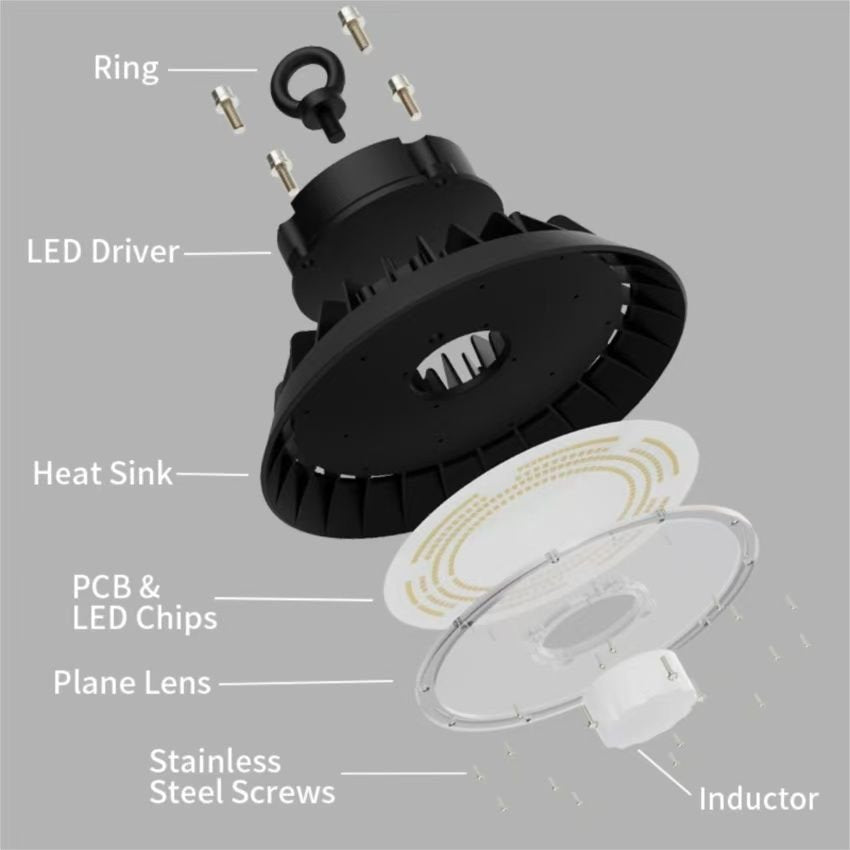
PIR or HF Motion Sensor? Choosing Occupancy Detection for Commercial LED Lighting
PIR or HF (microwave) motion sensor for LED lighting: how both work, where each one fails, detection range per mounting height, the right settings for hold time, lux threshold and standby dimming, and which sensor to ...
A motion sensor can cut the energy use of LED lighting in low-traffic areas by half or more. But the wrong sensor type causes exactly the complaints installers know too well: lights that switch off while someone is still working, lights that switch on because of a forklift in the next aisle, or a corridor that stays dark until you are halfway down it. This guide explains how PIR and HF (microwave) sensors work, where each one fails, and which one to choose for warehouses, offices, corridors, toilets, car parks and outdoor areas.
- PIR (passive infrared) detects changes in heat radiation. It reacts best to movement across its field of view, needs a clear line of sight and does not see through glass or walls.
- HF (high-frequency, microwave or radar) sends out radio waves and detects movement in every direction. It is more sensitive, can be built invisibly into a luminaire, but also sees through glass, thin walls and partitions.
- Rule of thumb: PIR for offices, outdoor areas and rooms with fixed boundaries; HF for corridors, stairwells, toilets, aisles and cold stores, with the range set carefully.
- Set three things correctly: detection range, hold time and lux threshold. In warehouses and car parks, add a standby dimming level instead of switching fully off.
- Frequent switching of many drivers adds inrush current. Sensors that dim via 1-10V or DALI, or relays rated for LED loads, prevent tripping breakers.
How a PIR sensor works
A PIR sensor is passive: it emits nothing. Behind a segmented lens sits a pyroelectric element that registers changes in infrared (heat) radiation. When a person moves from one lens zone into the next, the heat pattern changes and the sensor switches.
- Strong point: it only sees what is in its direct field of view. Movement behind a wall, a glass partition or in the next room is ignored, which makes it predictable.
- Weak point: it reacts much better to movement across the zones than to movement straight towards the sensor. Small movements, such as typing at a desk, are only picked up by sensitive presence detectors.
- Sensitive to: warm air flows from heaters or air conditioning, direct sunlight and sudden temperature changes. In very warm halls, where the ambient temperature approaches body temperature, sensitivity drops.
How an HF (microwave) sensor works
An HF sensor is active: it transmits a high-frequency radio signal, usually around 5.8 GHz, and measures the reflection. Any movement changes the frequency of the reflected signal (the Doppler effect), and the sensor switches.
- Strong point: it detects movement in all directions, including someone walking straight towards it, and reacts to small movements. It works through plastic, so it can be hidden inside a luminaire behind the diffuser, and it is not affected by temperature.
- Weak point: radio waves pass through glass, thin walls, plasterboard and partitions. An HF sensor in a corridor can react to someone in the office next door. The detection range must therefore be set carefully.
- Sensitive to: moving objects that are not people: fans, conveyor belts, swinging doors, and outdoors rain, trees and traffic behind a fence.

PIR versus HF at a glance
| Property | PIR | HF (microwave) |
|---|---|---|
| Principle | Passive, detects heat radiation | Active, radio waves and Doppler effect |
| Movement towards the sensor | Weak | Good |
| Small movements | Only presence detectors | Good |
| Through glass and thin walls | No | Yes, which can cause false triggers |
| Invisible integration in a luminaire | No, needs a visible lens | Yes, behind plastic |
| Temperature influence | Yes, less sensitive in warm halls | No |
| Outdoor use | Good choice | Risk of triggers from rain, trees, traffic |
| Setting the range | Via lens and mounting position | Via sensitivity setting, essential |
Which sensor for which application?
| Application | Recommended | Why |
|---|---|---|
| Warehouse aisles with high racking | HF integrated, or PIR with an aisle lens | Detects people and forklifts entering the aisle; range per aisle must be limited so neighbouring aisles do not trigger |
| Open-plan offices and meeting rooms | PIR presence detector | Detects seated work, does not react to movement in the corridor behind glass walls |
| Corridors and stairwells | HF | Detects people walking towards the sensor in time |
| Toilets and changing rooms | HF | Also detects through cubicle partitions, so the light does not switch off while a cubicle is occupied |
| Cold stores and freezers | HF integrated | Works independently of temperature and can be built into a sealed IP65 luminaire |
| Underground car parks | HF with standby dimming | Detects vehicles and pedestrians early; dimming instead of switching off keeps the area safe |
| Outdoor areas, facades, yards | PIR | Not triggered by rain, swaying branches or traffic behind a fence |
Detection range and mounting height
The detection area grows with mounting height, but sensitivity at floor level falls. As a guide for ceiling-mounted sensors:
| Mounting height | Typical detection diameter | Note |
|---|---|---|
| 2.5–3 m (office, corridor) | approx. 6–10 m | Standard ceiling sensors; presence detectors cover a smaller zone for seated work |
| 4–8 m (workshop, low hall) | approx. 8–14 m | Check the datasheet for the detection pattern at this height |
| 8–15 m (high-bay warehouse) | approx. 10–20 m | Use sensors designed for high bays; PIR needs a special high-bay or aisle lens |
These values are indicative. The detection pattern in the datasheet of the specific sensor is decisive, and with HF the actual range depends on the sensitivity setting. Plan the layout so that detection zones overlap slightly, otherwise people walk into dark spots between two sensors.
The three settings that decide whether users are happy
- Detection range (sensitivity). Set it no larger than necessary. With HF this is the most important setting: too high and the light reacts to movement behind walls or in the next aisle.
- Hold time. The time the light stays on after the last detected movement. Too short leads to complaints and needless switching; too long wastes energy. Typical values: 5–10 minutes in corridors and storerooms, 10–20 minutes in offices, 1–5 minutes in transit areas with standby dimming.
- Lux threshold (daylight sensor). Prevents the light from switching on when there is enough daylight. Set the threshold after installation, under real daylight conditions.
For warehouses, car parks and long corridors, a fourth setting is decisive: standby dimming, also called the corridor function. After the hold time the light does not switch off but dims to a standby level, for example 10–30%, and only switches off completely after a second, longer period, or not at all. This keeps escape routes and traffic areas visible and avoids the feeling of walking into darkness. Standby dimming does not replace emergency lighting; see emergency lighting requirements.

Switching, dimming and inrush current
Every time a sensor switches a group of luminaires on, all drivers draw their inrush current at once. With large groups this can trip a circuit breaker or weld relay contacts in cheap sensors. Two solutions:
- Dim instead of switching the mains. Sensors that control drivers via 1-10V or DALI leave the drivers powered and only change the light level. That avoids inrush peaks and allows standby dimming. See 0-10V, 1-10V and TRIAC dimming and DALI and sensors.
- Use relays rated for LED loads and respect the maximum number of drivers per sensor and per breaker. More in LED lighting trips the breaker or RCD.
Groups: one luminaire detects, the whole aisle lights up
In aisles and corridors it is usually not desirable for only the luminaire directly above a person to switch on. Group the luminaires so that one detection lights the whole aisle or corridor section: via a central sensor that switches or dims the group, via DALI, or via luminaires with integrated sensors that communicate wirelessly with each other. Without grouping, people walk through a moving pool of light, which feels unsafe in warehouses and car parks.
How much energy does a sensor save?
The saving depends entirely on how often the area is actually used. In rarely used storerooms, archives, toilets and back aisles, occupancy control typically saves 30–60% or more of lighting energy compared with lights that stay on all day. In areas with constant traffic, the saving is small. Use realistic occupancy hours in your calculation; the LED payback calculator shows the effect on the return. For warehouses specifically, see the warehouse lighting guide, and for car parks underground car park lighting.
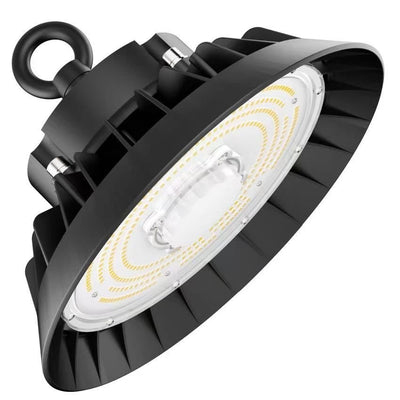
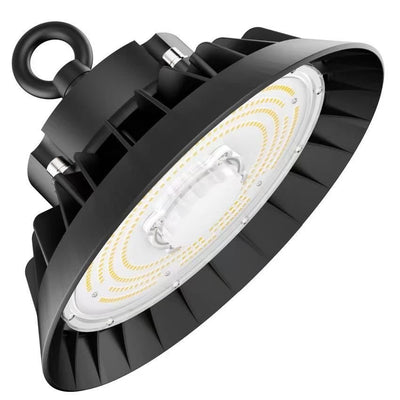
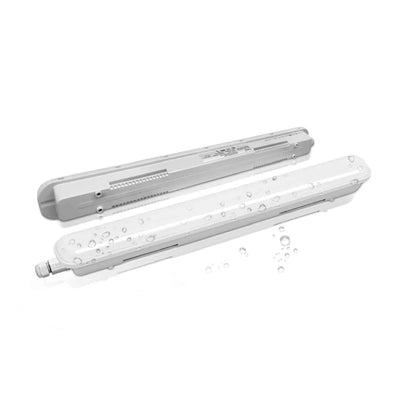
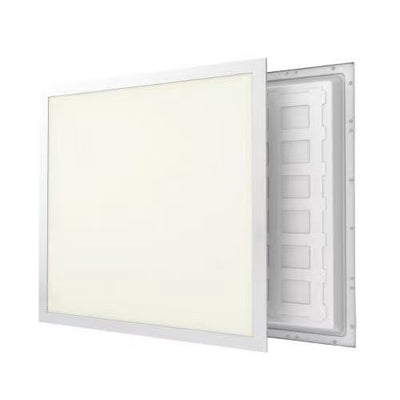
LED luminaires with integrated motion sensor – high bays, tri-proof fittings and panels, 3 to 5-year warranty:
Frequently asked questions
What is the difference between a PIR and an HF sensor?
A PIR sensor passively detects changes in heat radiation and needs a clear line of sight. An HF sensor actively sends out radio waves and detects movement through the Doppler effect. HF is more sensitive and works through plastic, glass and thin walls; PIR is more predictable because it only sees its direct field of view.
Why does my light switch off while I am still in the room?
Usually because a PIR motion sensor does not detect small movements such as typing, or because the hold time is too short. Use a PIR presence detector in offices, or an HF sensor in rooms with obstacles such as toilet cubicles, and increase the hold time.
Why does my light switch on when nobody is there?
With HF sensors this is usually movement behind a wall, a door or glass, or moving machinery and fans. Reduce the sensitivity. With PIR sensors, warm air flows from heating or sunlight are common causes; reposition the sensor or adjust its zone.
Which sensor is best for a warehouse with high racking?
An HF sensor integrated in the high bay, or a PIR sensor with a special aisle lens. Limit the range so that each aisle only reacts to its own traffic, group the luminaires per aisle and use standby dimming instead of switching fully off.
Can I use an HF sensor outdoors?
It is possible, but outdoors HF sensors are easily triggered by rain, swaying branches and traffic behind a fence. For outdoor areas and facades, a PIR sensor is usually the more reliable choice.
Does frequent switching shorten the life of LED luminaires?
LED chips tolerate frequent switching much better than fluorescent or metal halide lamps. The weak points are the switching contacts and the inrush current of the drivers. Dimming via 1-10V or DALI instead of switching the mains, and relays rated for LED loads, avoid both problems.
Send us your floor plan, mounting heights and how the spaces are used. We advise on sensor type, grouping and settings, and prepare a free DIALux light plan. EU-wide delivery in 2–5 working days, up to 5 years' warranty.
Request advice and a quoteMai multe ghiduri
 Iluminatul LED declanșează siguranța automată sau diferențialul? Curentul de pornire și curentul de scurgere explicate
 CE, ENEC, TÜV și GS pe corpurile de iluminat LED: ce înseamnă cu adevărat aceste marcaje
 Unghiul de radiație LED explicat: 60°, 90° sau 120° – pe care să-l alegeți pentru hală sau exterior?