Sports Field Lighting: Rugby, Handball, Baseball & Korfball
Illuminance values, mast counts and LED light planning for rugby, handball, baseball and korfball to EN 12193 – the complete B2B planning guide.
Sports field lighting for rugby, handball (outdoor), baseball and korfball is governed by EN 12193 – yet the four sports differ considerably in field geometry, mast positioning and association requirements. This guide provides sport-specific illuminance tables, mast concepts and the technical parameters you need for a standards-compliant LED light planning.
- The governing standard for all four sports: EN 12193 with three lighting classes (I–III) covering training through to competition.
- Rugby and handball (outdoor) require GR < 50 and Ra ≥ 60; baseball additionally differentiates between infield and outfield.
- Korfball has no dedicated standard – the general classes of EN 12193 apply, supplemented by association guidelines.
- Outdoor installations require a minimum of IP65; IP66 is recommended for competition venues; the maintenance factor for LED is 0.8 with annual cleaning.
- All installation and connection work on 230V/400V systems must be carried out exclusively by qualified electricians in accordance with national wiring regulations.
Why Four Niche Sports Need Their Own Light Planning
Football dominates the technical literature on sports field lighting – rugby, outdoor handball, baseball and korfball are barely mentioned in planning guides. Yet the field dimensions, direction of play and ball flight paths of these sports differ considerably, with direct implications for mast locations, beam angles and the required vertical illuminance.
Association-specific requirements add further complexity: the Rugby Football Union (RFU), the International Handball Federation (IHF), World Baseball Softball Confederation (WBSC) and national korfball associations define their own minimum values that may exceed those of EN 12193. Understanding these requirements enables accurate planning – and avoids costly remedial work.
For a general overview of illuminance values across different applications, we recommend our guide How much lux do you need? Illuminance values for all areas.
EN 12193: The Foundation for All Four Sports
EN 12193 "Light and Lighting – Sports Lighting" is the central European standard for indoor and outdoor facilities. It defines three lighting classes based on intensity of use and competition level.
| Lighting Class | Typical Use | Horizontal Illuminance (Eh) | Uniformity Uo | GR Value (Outdoor) | Ra (Colour Rendering) |
|---|---|---|---|---|---|
| Class III | Training, leisure, school sport | 75–200 lx (sport-dependent) | ≥ 0.5 | ≤ 55 | ≥ 60 |
| Class II | Local/regional competition | 200–500 lx (sport-dependent) | ≥ 0.6–0.7 | ≤ 50 | ≥ 65 |
| Class I | National/international competition level | 500–750 lx (sport-dependent) | ≥ 0.7 | ≤ 50 | ≥ 65 |
The GR value (Glare Rating to CIE 112) assesses glare from outdoor luminaires on a scale from 10 (imperceptible) to 90 (unbearable). TV broadcasts are subject to stricter requirements that go beyond Class I. The standard colour temperature for sports facilities is 4,000K; 5,000K is recommended for TV broadcasts. For guidance on selecting the correct colour temperature, see our guide LED Colour Temperature: 2700K to 6000K.
Rugby Field Lighting: Illuminance Values, Masts and RFU Requirements
A rugby field measures 100 × 70 m (playing area) plus two dead-ball zones of 10–22 m each. Masts are typically positioned outside the dead-ball line to protect players from collisions. The number of masts and luminaire configuration depends on the lighting class.
Rugby Illuminance Table to EN 12193 and RFU
| Class / RFU Level | Eh (Match) | Eh (Training) | Uo | GR | Ra | Recommended Mast Count | Luminaires per Mast |
|---|---|---|---|---|---|---|---|
| Class III / RFU Levels 6–12 | 100 lx | 75 lx | ≥ 0.5 | ≤ 55 | ≥ 60 | 4 | 2–3 |
| Class II / RFU Levels 2–5 | 200 lx | 200 lx | ≥ 0.6 | ≤ 50 | ≥ 65 | 4–6 | 4–6 |
| Class I / National Level | 500 lx | 300 lx | ≥ 0.7 | ≤ 50 | ≥ 65 | 6–8 | 9+ |
Mast locations for rugby: four corner masts (height 15–18 m) are sufficient for Class III. For Class II and I, additional side masts at the halfway line are recommended to achieve the required uniformity across the entire playing surface including the in-goal zones. Asymmetric optics (e.g. 20° or 40°) reduce spill light towards spectator areas and neighbouring properties.
For light distribution on sports fields and the planning logic behind mast positioning, see our guide Light Distribution on Sports Fields: Standards & Planning.
Outdoor Handball Lighting: Indoor vs. Outdoor – An Underestimated Difference
EN 12193 does not formally distinguish between indoor and outdoor handball. In practice, however, outdoor installations are considerably more demanding: spill light, wind loading on luminaires and the absence of ceiling and wall reflections all require higher installed power to achieve the same illuminance values.
Characteristics of Outdoor Handball Facilities
An outdoor handball field measures 40 × 20 m. Vertical illuminance (Ev) is critical for ball tracking – particularly during high throws and shots on goal. For Class II and I, Ev should be at least 50 % of Eh. Four corner masts (height 8–12 m) with 2–4 luminaires each are sufficient for Class III; for Class II, six masts with asymmetric optics are recommended.
The GR value is more critical outdoors than indoors, as there is no ceiling to contain the light. Luminaires with narrow beam angles (20°–40°) and precision optics minimise glare for players and neighbouring residents. For competition facilities to IHF guidelines, Ra ≥ 65 is required; for TV broadcasts, Ra ≥ 80.
Our LED Sports Field Lighting includes luminaires with IP66 protection and selectable beam angles suitable for outdoor handball facilities of all classes.

Baseball Lighting: Infield, Outfield and Mast Positioning
Baseball presents the most complex light planning challenge of the four sports: the playing field is asymmetric (diamond-shaped infield, open outfield), and lighting requirements differ by field zone. EN 12193 defines separate values for the infield and outfield.
Baseball Illuminance Values to EN 12193
| Class | Infield Eh | Outfield Eh | Uo Infield | Uo Outfield | GR |
|---|---|---|---|---|---|
| Class III (Leisure/Training) | 300 lx | 200 lx | ≥ 0.5 | ≥ 0.3 | ≤ 55 |
| Class II (Regional Competition) | 500 lx | 300 lx | ≥ 0.7 | ≥ 0.5 | ≤ 50 |
| Class I (National Level) | 750 lx | 500 lx | ≥ 0.7 | ≥ 0.5 | ≤ 50 |
| Professional / TV (International) | 1,500 lx | 1,000 lx | ≥ 0.7 | ≥ 0.6 | ≤ 45 |
Mast Concept for Baseball Fields
Typical mast positioning for a Class I baseball field: 6 masts (height 20–30 m) along the outfield boundary, plus 2 further masts behind the backstop. The backstop masts illuminate the infield primarily using narrow beam angles (20°). The outfield masts use wider optics (40°–60°) to cover the entire outfield area uniformly.
Critical consideration: the pitcher and batter must be able to see the ball clearly at all times. Glare from mast directions must therefore be avoided – GR values below 45 are advisable for competition facilities. For TV broadcasts, the vertical illuminance in camera direction (Ev,cam) must also be calculated.
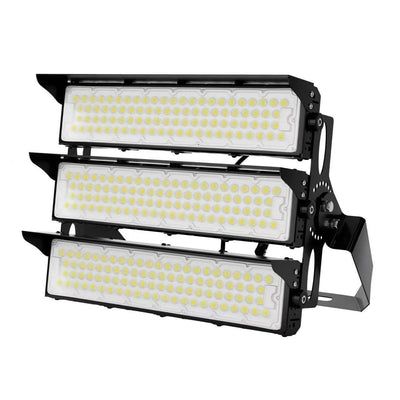
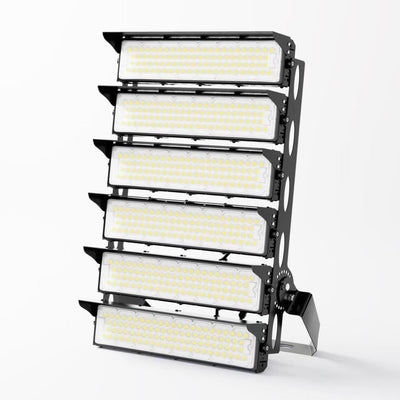
For Class I baseball facilities and professional competition venues, high-output LED floodlights with precision beam angles and Philips drivers are recommended:


Korfball Lighting: The Planning Gap with a Standards Basis
Korfball is a niche sport in the UK, though it is widely played in the Netherlands and Belgium. An outdoor korfball field measures 60 × 30 m; the indoor field measures 40 × 20 m. No standalone standard exists for korfball; the general classes of EN 12193 apply.
Recommended Illuminance Values for Korfball
For training and leisure use (Class III), 200 lx with Uo ≥ 0.5 is sufficient. For competition use to KNKV or IKF guidelines (Class II), 300–500 lx with Uo ≥ 0.6 is recommended. Particular attention should be paid to uniformity: dark patches on the playing area significantly impair ball tracking in the characteristic korfball throwing game.
Four corner masts (height 8–10 m) with 2–3 luminaires each cover Class III. For Class II, six masts with asymmetric optics are recommended, analogous to an outdoor handball facility. As korfball has no goal wall, the illumination of the post zones (each 2.5 m from the end line) requires particular consideration.
For similarly dimensioned outdoor sports facilities, suitable luminaires can also be found in our Basketball Court Lighting and Padel Court Lighting categories.
Technical Requirements for Outdoor Facilities: IP, IK, GR and Maintenance
All four sports are played predominantly outdoors. The minimum technical requirements for luminaires are therefore identical and should be specified as binding in tender documents.
Protection Classes and Robustness
A minimum of IP65 is recommended for outdoor sports facilities; IP66 is advisable for competition venues – this protection rating ensures a watertight seal even against powerful water jets from any direction. The IK impact rating should be at least IK08 to withstand ball impacts and mechanical stress. Our guide IP Ratings Explained covers IP ratings in detail; the IK impact rating is explained in IK Impact Rating Explained: Meaning & Application.
Maintenance Factor and Burn-In Period
The maintenance factor (MF) for LED luminaires in sports facilities is 0.8 with annual cleaning. This value must be taken into account in the DIALux calculation to ensure the installation still meets the standard illuminance values at the end of the maintenance interval. Prior to formal acceptance, LED luminaires must be operated for at least 100 hours to stabilise lumen output.
Dimming and Controls
LED sports floodlights are typically dimmable via 1-10V or DALI. For sports facilities with different usage scenarios (training/competition/TV), DALI is recommended as it enables individual luminaire control and scene management. Further information on dimming protocols is available in our guide 0-10V, 1-10V & TRIAC Dimming: Differences Explained.

Planning Checklist: Technical Parameters at a Glance
| Parameter | Minimum Value – Outdoor Facility | Recommendation – Competition |
|---|---|---|
| Protection rating | IP65 | IP66 |
| Impact resistance | IK07 | IK08–IK10 |
| GR value (outdoor) | ≤ 55 | ≤ 50 (TV: ≤ 45) |
| Colour rendering Ra | ≥ 60 | ≥ 65 (TV: ≥ 80) |
| Colour temperature | 4,000K | 5,000K (TV) |
| Maintenance factor MF | 0.8 | 0.8 |
| Burn-in period before acceptance | 100 h | 100 h |
| Uniformity Uo | ≥ 0.5 (Class III) | ≥ 0.7 (Class I) |
| Dimming protocol | 1-10V | DALI |
B2B Procurement: Project Scope, Funding and Planning Support
LED floodlight installations for sports fields vary considerably in investment volume depending on size, class and mast structure. Compared with metal halide lamps, LED typically saves 40–60 % in electricity costs; the payback period is 4–7 years depending on the project. Our guide Calculating LED Payback Period: ROI & Savings shows you how to calculate the ROI.
Funding Options for Sports Clubs and Local Authorities
Funding for LED retrofits of sports facilities differs by country and region – from national energy-efficiency schemes to municipal and sports-federation grants. Clubs are advised to check current programmes with their regional sports federation or local authority at an early stage. For Germany, our guide BAFA LED Funding in Germany 2026 explains what has changed and how to finance LED now.
Clightstore Advantage for B2B Projects
As an LED wholesaler with direct import, Clightstore delivers EU-wide within 2–5 working days. Luminaires are supplied with Philips or MOSO drivers and up to 5 years' warranty. Volume pricing and framework agreements are available for projects of 10 or more luminaires. Free DIALux light planning is included – standards-compliant calculations for all four sports are available on request.
Our LED Floodlights Premium Series and Football Pitch Lighting offer comparable luminaire types that are equally suitable for rugby, handball, baseball and korfball.
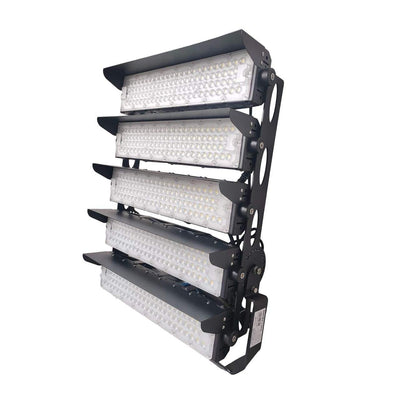
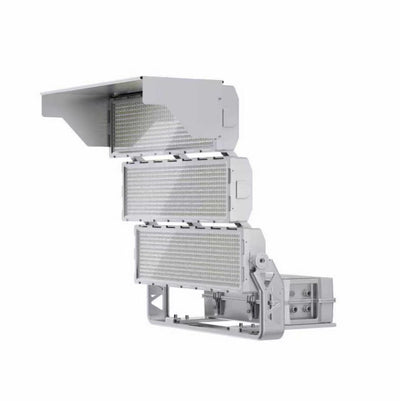
For Class I competition facilities and TV-ready installations – LED floodlights at 1,250W and 1,500W, DALI-dimmable, IP66, 5-year warranty:


Frequently Asked Questions
How much lux do I need for a rugby field during training?
For training and leisure use (Class III to EN 12193), 75–100 lx with uniformity Uo ≥ 0.5 is sufficient. RFU Levels 6–12 require a minimum of 100 lx for matches. For regional competition (RFU Levels 2–5), 200 lx with Uo ≥ 0.6 and GR ≤ 50 is required.
Which standard applies to the outdoor lighting of a handball field?
The governing standard is EN 12193 "Sports Lighting". The same lighting classes apply to outdoor facilities as to indoor facilities, though the GR value and vertical illuminance are more critical outdoors. IHF competition facilities require Ra ≥ 65; for TV broadcasts, Ra ≥ 80.
How many masts do I need for a Class I baseball field?
For Class I (750 lx infield, 500 lx outfield), typically 6–8 masts at a height of 20–30 m are required. Two masts behind the backstop illuminate the infield with narrow optics (20°); the outfield masts use 40°–60° optics. The exact number depends on field size and mast location – a DIALux calculation is essential.
Do I need a dedicated light planning for korfball?
Yes, an individual light planning is necessary for korfball facilities too, as field geometry, mast locations and usage scenarios vary. EN 12193 applies with its general lighting classes. For competition use to KNKV or IKF guidelines, 300–500 lx with Uo ≥ 0.6 is recommended.
What does the GR value mean and how is it limited?
The GR value (Glare Rating to CIE 112) assesses glare from outdoor luminaires on a scale from 10 (imperceptible) to 90 (unbearable). For outdoor sports facilities, GR ≤ 50 is the limiting value; for TV broadcasts, ≤ 45. Narrow beam angles, precision optics and correct mast positioning are the most important measures for reducing the GR value. Further information on glare limitation is available in our guide UGR Value Explained: Glare Limitation in Practice.
What IP protection rating do outdoor luminaires require?
A minimum of IP65 is recommended for outdoor sports facilities; IP66 is advisable for all competition venues. IP66 protects against powerful water jets from any direction and is suitable for cleaning with pressure washers. The IK impact rating should additionally be at least IK08.
How do I avoid light pollution at outdoor facilities?
Asymmetric optics direct light precisely onto the playing surface and minimise spill light into the sky and onto neighbouring properties. Luminaires with full cut-off characteristics (no light output above the horizontal) are recommended for facilities in residential areas. Dimming to 0 % after closing time or automatic switch-off via a time switch further reduces light emissions.
Are clubs permitted to carry out mast installation themselves?
No. All connection and installation work on 230V/400V systems must be carried out exclusively by qualified electricians. This is a binding requirement under national wiring regulations and the five safety rules of electrical engineering. Non-compliance may result in the loss of insurance cover and operating licences.
Our light planning team will provide you with a free, standards-compliant DIALux calculation – including illuminance values, mast positioning and luminaire selection to EN 12193. EU-wide delivery within 2–5 working days, up to 5 years' warranty, volume pricing from 10 luminaires.
Request a free light planning