LED Workshop Lighting: Lux per Trade, Fixtures per Height, Number per 100 m² and Cost
LED lighting for workshops: lux per trade, which fixture at which height, number per 100 m², flicker at rotating machines, colour rendering, legal minimums, cost and payback.
Short answer: a workshop needs 300 lux for rough work, 500 lux for medium and fine work, and 750 to 1,000 lux at inspection and precision stations. Up to 4.5 m ceiling height, IP65 LED battens of 120 or 150 cm are the right fixture; between 4.5 and 8 m, linear LED high bays. Count on 3 battens of 55W per 100 m² at 4 m, or 3 linear high bays of 150W per 100 m² at 6 m. Below: the lux values per trade, the fixture per height, the number per 100 m², flicker and colour rendering, legal minimums and what it costs.
- EN 12464-1: 300 lux rough work, 500 lux medium and fine work, 750–1,000 lux inspection; Ra ≥ 80, Ra 90 where colours are judged.
- Fixture per height: up to 4.5 m IP65 battens, 4.5–8 m linear high bays, above 8 m round high bays.
- Rotating machines need flicker-free drivers to avoid the stroboscopic effect.
- French Labour Code minimums (Art. R4223-4) are far below the standard: 120 lux in work rooms, 200 lux in windowless rooms with permanent work.
- Fixtures cost roughly € 2 to € 3 per m²; a retrofit of fluorescent battens pays back in about one year.
How many lux does a workshop need?
EN 12464-1 sets maintained values per visual task. The trade matters more than the room size: a joinery with a planer needs different light from an electronics bench.
| Workshop or task | Lux | UGR max. | Ra min. |
|---|---|---|---|
| Metalwork, welding, rough assembly | 300 | 25 | 80 |
| Joinery, machine work, medium assembly | 500 | 22 | 80 |
| Mechanics, tool making, fine assembly | 500–750 | 19–22 | 80 |
| Electronics, precision work, inspection | 750–1,000 | 16–19 | 80–90 |
| Painting, colour checking | 750–1,000 | 19 | 90 |
| Storage of materials in the workshop | 150–200 | 25 | 60 |
| Traffic routes | 100–150 | 28 | 40 |
These are maintained values: plan new with a maintenance factor of 0.7 to 0.8 so they are still reached after years with dust on the fixtures. All values in How Much Lux Do You Need?
The French Labour Code (Art. R4223-4) sets legal minimums that are far lower: 40 lux on indoor traffic routes, 60 lux in stairs and storage, 120 lux in work rooms and 200 lux in windowless rooms with permanent work. Those are floors, not design targets; labour inspectors refer to EN 12464-1 in practice.

Which fixture at which height?
| Height | Fixture | Power | From (incl. VAT) |
|---|---|---|---|
| 2.5–3.5 m | IP65 LED batten 120 cm or LED tubes in existing fittings | 18–40W | approx. € 12–25 |
| 3.5–4.5 m | IP65 LED batten 150 cm, linkable in rows | 45–60W | approx. € 25–35 |
| 4.5–6 m | Linear LED high bay | 100–150W | approx. € 60–80 |
| 6–8 m | Linear or round LED high bay | 150W | approx. € 60–80 |
| Above 8 m (truck workshop) | Round LED high bay | 150–200W | approx. € 60–75 |
IP65 is the standard in workshops: oil mist, dust and cleaning water get into open fittings. How to choose a batten is explained in Choosing LED Tri-Proof Lights; old fluorescent fittings can often continue with LED tubes (see Replacing Fluorescent Tubes with LED).
How many fixtures per 100 m²?
Number = (lux × m²) ÷ (lumen per fixture × 0.8 × 0.6):
| Workshop | Target | Fixture | Per 100 m² | Fixtures per m² |
|---|---|---|---|---|
| Metalwork at 4 m | 300 lux | Batten 150 cm 55W, 7,700 lm | 8 | approx. € 2.40 |
| Joinery at 4 m | 500 lux | Batten 150 cm 55W, 7,700 lm | 14 | approx. € 4.00 |
| Mechanics at 6 m | 500 lux | Linear high bay 150W, 22,500 lm | 4.6 | approx. € 3.50 |
| Assembly at 7 m | 300 lux | High bay 150W, 22,500 lm | 2.8 | approx. € 1.70 |
Place rows across the workbenches or on both sides of machines, not directly above them, so the worker does not stand in his own shadow. Detailed calculation with spacing: Lighting Calculation for Halls.
Most chosen workshop fixtures
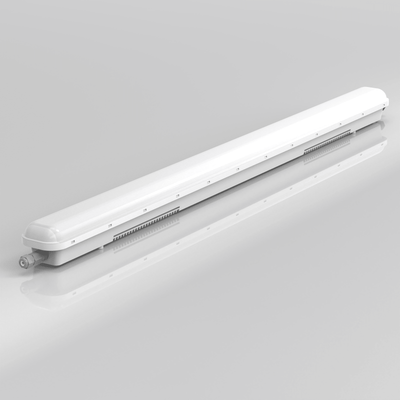


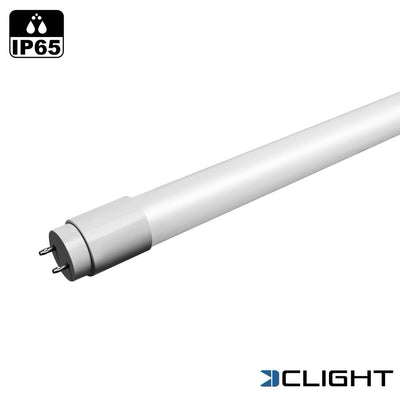
Three things that matter more in a workshop than elsewhere
Flicker and rotating machines
A lathe, drill or saw turning at the mains frequency can appear to stand still under flickering light. That stroboscopic effect is a real accident risk. Choose fixtures with a flicker-free driver (low ripple); cheap drivers fail here. See LED Drivers Explained.
Colour rendering
Ra 80 is the minimum. For painting, upholstery, wood finishing and any colour checking take Ra 90 and 5000K to 6500K, so what you see in the workshop matches daylight. See CRI and Colour Rendering.
Glare at the workbench
At benches and machines UGR 22 or lower is required. Battens with an opal diffuser and linear high bays score better here than bare UFO high bays at low height. See UGR Value Explained.

What it costs and what it saves
A 400 m² metal workshop at 4 m with 40 fluorescent fittings 2×58W (approx. 140W each), 2,200 hours a year, € 0.25/kWh: 12,320 kWh or € 3,080 a year. Replaced by 32 IP65 battens of 55W: 3,870 kWh or € 970. Saving € 2,110 a year for roughly € 1,000 of fixtures; including installation the payback is around one year. In France, CEE energy-saving certificates can finance part of the works if the operation matches a standard sheet; apply before signing the quote. Run your own figures in LED Payback Period Calculator and see product prices in What Does LED Lighting Cost?
Common mistakes
- UFO high bays at 3.5 m: too bright, dazzling, dark zones between them. Use battens.
- Rows above the benches: the worker shadows his own work. Rows beside or across the benches.
- Open fittings in a dusty workshop: after a year the output has dropped 30 %. IP65 and cleaning once a year.
- Cheap drivers at rotating machines: stroboscopic effect. Flicker-free drivers only.
- Paint booth without ATEX check: solvent vapours can make it an explosion zone (see ATEX Lighting).
Frequently asked questions
How many lux does a workshop need?
300 lux for rough work, 500 lux for medium and fine work, 750 to 1,000 lux for precision work and inspection, according to EN 12464-1.
What is the best LED lighting for a workshop?
Up to 4.5 m IP65 LED battens of 120 or 150 cm, linked in rows; from 4.5 m linear LED high bays; above 8 m round high bays. 4000K, Ra 80 or more, flicker-free driver.
How many LED battens for a 100 m² workshop?
About 8 battens of 55W (150 cm) for 300 lux, 14 for 500 lux, at 4 m ceiling height. A lighting study gives the exact number.
Can I keep my fluorescent fittings and only change the tubes?
If the fittings and sockets are in good condition and the room is dry, yes. In a dusty or damp workshop a new IP65 batten is usually the better investment.
Which colour temperature for a workshop?
4000K for general work; 5000K to 6500K for painting, colour checking and precision work.
Is there financial support for LED in a workshop?
In France, CEE certificates can cover part of the works; in Belgium regional premiums and the increased investment deduction. Conditions change; check before ordering.
Send us the floor plan, the height and the machines or benches. You get a free DIALux lighting study and a no-obligation quote at direct-import prices, 2 to 4 times below comparable branded products. 5-year warranty, delivery in 2–5 working days.
Request a free lighting study