We deliver across the EU. Pick the language you prefer; you can change it later at the top of the page.
Neu: clightstore.de ist jetzt Teil von clightstore.com.
Gleiche Produkte, gleiche Preise, gleiches Team. Bestellungen aus unserem bisherigen Shop werden wie gewohnt bearbeitet. Kundenkonten und Bestellhistorie des alten Shops sind vorübergehend nicht verfügbar. Bei Fragen erreichen Sie uns unter sales@clightstore.com.
Účet
How Much Lux Do You Need? Lux Values for All Areas
All standard lux values for offices, industry, warehouses, car parks and sports facilities – with UGR, Ra, maintenance factor and a free lux calculator for practical use.
11 min readBy Clightstore lighting plannersUpdated 21.10.2026
The required illuminance depends on the visual task, the area and the applicable standard. For an office workstation, DIN EN 12464-1 recommends a minimum maintained illuminance (Em) of 500 lux; the legally binding ASR A3.4 prescribes the same value. A warehouse requires 100–300 lux depending on the activity, and an outdoor car park 5–20 lux. This guide provides standard values for all commercial areas – including UGR, Ra and maintenance factor.
In Brief
Office and screen workstation: Em 500 lux (DIN EN 12464-1 / ASR A3.4), UGR ≤ 19, Ra ≥ 80.
Warehouse and production: 100–750 lux depending on the activity; always plan for UGR and Ra as well.
Outdoor car park: 5–20 lux per DIN EN 12464-2, depending on traffic volume.
Sports facilities: 75–750 lux per DIN EN 12193, graded by competition class and sport.
Plan for the maintenance factor: In dusty environments, calculate with a maintenance factor of 0.67–0.70 to ensure the target value is still achieved after several years.
Lux, Lumen, Candela – What Does Each Mean?
Before standard values can be applied meaningfully, the basic terms must be clear. Lumen (lm) describes the total luminous flux of a luminaire – i.e. how much light it emits in total. Lux (lx) is the illuminance on a surface: 1 lux = 1 lumen per square metre. Candela (cd) describes the luminous intensity in a specific direction.
For light planning, lux is the decisive quantity, as it indicates how much light actually reaches the working surface. Two luminaires with identical luminous flux can produce completely different lux values on a surface – depending on mounting height, beam angle and room geometry.
UGR and Ra: Two Further Planning Parameters
In addition to illuminance, DIN EN 12464-1 defines two further key parameters. The UGR value (Unified Glare Rating) describes glare limitation: the lower the value, the less glare the luminaire produces. For offices, UGR ≤ 19 is the threshold for fatigue-free working. The Ra value (CRI) describes colour rendering: Ra ≥ 80 is the minimum value for work areas per DIN EN 12464-1; Ra ≥ 90 is recommended for quality control and colour inspection.
Normative Basis: DIN EN 12464-1, ASR A3.4 and Others
In Germany, two parallel sets of regulations apply that are frequently confused. DIN EN 12464-1:2021-11 is the European light planning standard for lighting in workplaces (interiors). It contains recommended values and forms the basis for all professional light planning. ASR A3.4 (Technical Rule for Workplaces) is, by contrast, legally binding: employers must comply with its minimum values.
In many areas, the DIN recommended values exceed the ASR minimum values. For corridors without vehicle traffic, ASR A3.4 requires only 50 lux, whereas DIN EN 12464-1 recommends 100 lux. For office workstations, both agree: 500 lux. Planning to DIN EN 12464-1 will, as a rule, also satisfy the requirements of ASR A3.4.
Lux Table: Outdoor Areas – Car Parks, Construction Sites, Façades
For outdoor workplaces, DIN EN 12464-2 applies. In addition, ASR A3.4 prescribes minimum values for operational outdoor areas. Car parks are differentiated by traffic volume; construction sites by activity.
Area / Activity
Em (Lux)
Uniformity U₀ ≥
Ra ≥
Standard / Source
Car park – low traffic volume
5
0.25
20
DIN EN 12464-2
Car park – medium traffic volume
10
0.40
20
DIN EN 12464-2 / ASR A3.4
Car park – high traffic volume
20
0.40
20
DIN EN 12464-2
Outdoor workplace (permanently occupied)
200
0.40
40
DIN EN 12464-2 / ASR A3.4
Construction site – coarse work
50
0.25
40
DIN EN 12464-2
Construction site – medium work
100
0.25
40
DIN EN 12464-2
Construction site – fine work
200
0.40
60
DIN EN 12464-2
Escape route / emergency lighting
1
–
–
DIN EN 1838
Outdoor workplace (ASR minimum)
5
–
–
ASR A3.4
For car parks and outdoor areas, LED floodlights with IP66 protection are ideal. For roads and pathways on commercial premises, LED street lights are the appropriate choice.
Outdoor premises with LED floodlights: for operational car parks with medium traffic volume, DIN EN 12464-2 recommends a minimum of 10 lux.
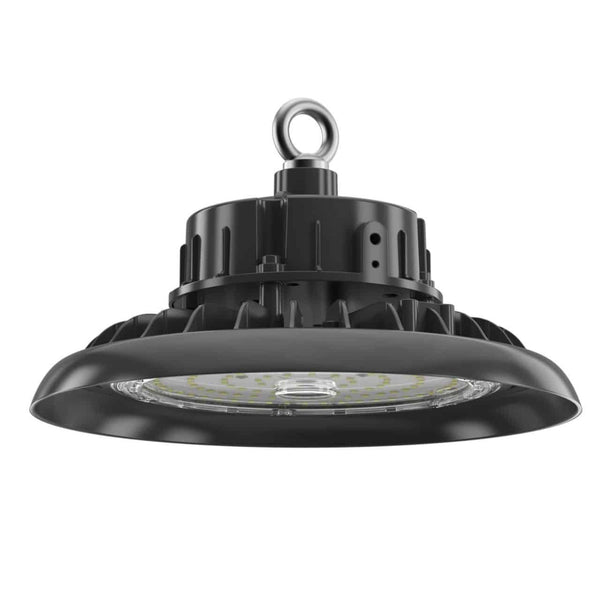
LED floodlights for outdoor areas, car parks and façades – IP66, 170 lm/W, 5-year warranty:
DIN EN 12193 governs the lighting of sports facilities and distinguishes three classes by performance level. Class III applies to training, school and recreational sport; Class II to local and regional competition; Class I to supra-regional and national competitions.
What matters is not only the horizontal but also the vertical illuminance – particularly for fast ball sports with small balls such as badminton or table tennis. When planning LED sports field lighting, you should therefore always take both values into account.
Use the calculator below to determine the number of luminaires required based on floor area, mounting height and target lux value. Please note: the result is a guide figure. For a standards-compliant light plan with a uniformity verification, we recommend our free DIALux light planning service.
Maintenance Factor: Why You Should Always Plan with a Reserve
An often underestimated planning parameter is the maintenance factor (MF). It accounts for the fact that luminaires lose illuminance over time due to soiling, LED lumen depreciation and reflection losses from walls and ceilings. The maintenance factor is applied as a divisor in planning: target lux ÷ maintenance factor = initial value actually required in the design.
In clean office environments, a maintenance factor of 0.80 is sufficient (equivalent to an oversizing of 25%). In dusty workshops, warehouses or production facilities, you should calculate with a maintenance factor of 0.67–0.70 – equivalent to an oversizing of approximately 40–50%. Anyone who ignores this factor will fall below the standard values after a few years.
Mounting Height and Light Distribution
In industrial buildings, it is not only the target lux value that matters, but whether the light from the mounting height actually reaches the working surface. A high bay with a 90° beam angle produces a different light pool at 8 m height than the same luminaire with a 120° angle. Luminaire spacing, uniformity (U₀ ≥ 0.6 for work areas per DIN EN 12464-1) and the visual task must all be considered together. For LED high bays from 6 m mounting height, beam angles of 60–90° are recommended; for lower mounting heights, 90–120°.
In wet areas such as wash bays, cold stores or production areas with cleaning requirements, use LED tri-proof lights with at least IP65 per IEC 60529. Further information on protection ratings can be found in our guide to IP protection ratings.
Office Lighting: Implementing Lux Values to Standard
For offices and screen workstations, Em 500 lux, UGR ≤ 19 and Ra ≥ 80 are the three decisive parameters per DIN EN 12464-1. The UGR value in particular is frequently overlooked in practice: a luminaire with UGR 25 can cause fatigue and headaches despite providing sufficient lux. Always check the data sheet when purchasing.
Colour temperature influences the effect of the lighting: for concentrated work, 4,000 K (neutral white) to 5,000 K is recommended. More on this in our guide to LED colour temperature.
Safety Notice: Electrical Installation by Qualified Electricians Only
You may carry out the light planning and selection of the correct luminaires yourself. However, the electrical installation of luminaires on 230 V or 400 V mains must be carried out exclusively by a qualified electrician. DIN VDE 0100, DGUV Regulation 3 and the 5 safety rules apply. Further guidance can be found in our guide to connecting LED luminaires.
Frequently Asked Questions
What is the difference between lux and lumen?
Lumen (lm) is the total luminous flux of a luminaire – i.e. how much light it emits in total. Lux (lx) is the illuminance on a surface: 1 lux = 1 lumen per square metre. A luminaire with 10,000 lm produces exactly 1,000 lux on 10 m² – but only 100 lux on 100 m². For light planning, lux is the decisive quantity.
How much lux do I need in an office?
For writing, reading and screen work, both DIN EN 12464-1 and the legally binding ASR A3.4 recommend a minimum maintained illuminance of 500 lux. In addition, UGR ≤ 19 (glare limitation) and Ra ≥ 80 (colour rendering) apply. For filing activities, 300 lux is sufficient.
How much lux is required in a car park?
Per DIN EN 12464-2, car parks with low traffic volume require a minimum of 5 lux (U₀ ≥ 0.25), medium traffic volume 10 lux (U₀ ≥ 0.40), and high traffic volume 20 lux (U₀ ≥ 0.40). ASR A3.4 specifies a guideline value of 10 lux for operational car parks.
How much lux does a warehouse require?
This depends on the activity. General storage areas require 100 lux (UGR ≤ 25, Ra ≥ 60). Racking aisles require 200 lux (UGR ≤ 28), and order picking and goods inward each require 300 lux (UGR ≤ 25) – all values per DIN EN 12464-1. In dusty warehouses, plan with a maintenance factor of 0.67–0.70.
What does UGR mean, and why is it important?
UGR stands for Unified Glare Rating and describes the glare limitation of a luminaire. The lower the value, the less glare the luminaire produces. For offices, UGR ≤ 19 is the threshold for fatigue-free working. For workshops, UGR ≤ 22–25 is permissible. The UGR value is stated in the data sheet of every standards-compliant luminaire.
Is DIN EN 12464-1 legally required?
DIN EN 12464-1 itself is a light planning standard, not a statutory regulation. ASR A3.4 (Technical Rule for Workplaces) is legally binding. Since DIN EN 12464-1 is referenced in ASR A3.4 as a recognised technical rule, the following applies: planning to DIN EN 12464-1 will, as a rule, also satisfy ASR A3.4.
How do I calculate the number of luminaires for my area?
The basic formula is: number of luminaires = (target lux × area in m²) ÷ (luminous flux per luminaire in lm × maintenance factor × room utilisation factor). In practice, we recommend using our lux calculator for an initial estimate, followed by a DIALux simulation for the uniformity verification.
How much lux does a sports hall or football pitch require?
Per DIN EN 12193, sports halls (e.g. basketball, handball) require a minimum horizontal illuminance of 200 lux for training and recreational use (Class III), 500 lux for local competition (Class II) and 750 lux for supra-regional competitions (Class I). For outdoor football, the values are 75 lux (training), 200 lux (local match play) and 500 lux (higher-level competitions).
Do you have a specific lighting project – warehouse, industrial building, car park or sports facility?
Our team will provide you with a free DIALux light plan including an illuminance verification, uniformity calculation and standards-compliant luminaire selection. EU-wide delivery in 2–5 working days, direct import prices 2–4× below branded products, up to 5 years' warranty.
Nezbytné cookies zajišťují správné fungování obchodu. S vaším souhlasem používáme také cookies pro statistiky a relevantní reklamu. Svůj výběr můžete kdykoli změnit. Zásady ochrany osobních údajů
Objednáváte jako firma?
Ceny jsou uvedeny s DPH. Firmy z EU s platným DIČ platí 0% DPH (přenesená daňová povinnost). Belgické firmy platí 21 % a následně si DPH nárokují zpět.
Při pokladně zadejte název své společnosti do pole “Společnost”.
Pod ním se poté zobrazí pole “DIČ”: zadejte své daňové identifikační číslo (např. NL123456789B01).
DPH bude automaticky odečteno a na faktuře bude uveden údaj o přenesené daňové povinnosti.