We deliver across the EU. Pick the language you prefer; you can change it later at the top of the page.
Neu: clightstore.de ist jetzt Teil von clightstore.com.
Gleiche Produkte, gleiche Preise, gleiches Team. Bestellungen aus unserem bisherigen Shop werden wie gewohnt bearbeitet. Kundenkonten und Bestellhistorie des alten Shops sind vorübergehend nicht verfügbar. Bei Fragen erreichen Sie uns unter sales@clightstore.com.
Účet
Lumen vs. Lumen per Watt: Difference Simply Explained
Lumen measures the quantity of light; lm/W measures efficiency – knowing both values enables compliant light planning and delivers lasting energy savings.
11 min readBy Clightstore lighting plannersUpdated 21.10.2026
Lumen describes how much light a luminaire emits in total. Lumens per watt (lm/W) shows how efficiently it converts electricity into light. Anyone who understands both figures and combines them with lux and beam angle can make purchasing decisions that meet standards and reduce operating costs permanently.
In Brief
Lumen (lm) = absolute quantity of light emitted by a luminaire – regardless of area or power consumption.
Lumens per watt (lm/W) = efficiency figure: the higher the value, the less electricity is required for the same brightness.
Lux (lx) = actual illuminance on the working plane; dependent on lumens, beam angle and mounting height.
Beam angle concentrates or distributes the luminous flux – identical lumens but different lux depending on the angle.
BS EN 12464-1 and BS EN 12193 define minimum requirements for illuminance, glare limitation and colour rendering for industrial, warehouse and sports applications.
What Is Lumen? The Absolute Quantity of Light
Lumen (unit symbol: lm) is the SI unit of luminous flux. It describes the total quantity of light emitted by a light source in all directions – regardless of the size of the illuminated area or the power consumed by the luminaire.
A traditional 60 W incandescent lamp produced approximately 806 lumens – a value established as a reference benchmark in Commission Delegated Regulation (EU) 2019/2015. A modern LED achieves the same luminous flux with just 6–8 W. Wattage alone therefore says nothing about brightness.
For buyers and facilities managers: lumen is the first figure to check on a datasheet. It determines whether a luminaire can fundamentally deliver enough light for the intended area.
What Is Lumens per Watt? The Efficiency Figure
Lumens per watt (lm/W) – also known as luminous efficacy – indicates how much luminous flux a luminaire produces per watt consumed. The formula is:
A luminaire producing 20,000 lm at 150 W therefore achieves 133 lm/W. A comparable luminaire also producing 20,000 lm but consuming 200 W achieves only 100 lm/W – and costs significantly more to run continuously.
Reference Values for LED Efficacy (2025/2026)
Efficacy Class
Luminous Efficacy (lm/W)
Rating
Typical Application
Premium LED
150–210 lm/W
Excellent
Industrial, high bay, outdoor
Standard LED
110–149 lm/W
Very good
Office, retail, warehouse
Entry-level LED
80–109 lm/W
Acceptable
Ancillary rooms, external walls
Budget LED
60–79 lm/W
Adequate
Non-critical areas only
Halogen / Fluorescent
15–90 lm/W
Obsolete
Replacement recommended
LED efficacy has improved considerably over the past 15 years: in 2010, 60 lm/W was considered standard; by 2020 the benchmark had risen to around 100 lm/W. Current laboratory LEDs exceed 200 lm/W; the theoretical maximum for white light is approximately 250–350 lm/W depending on the spectrum.
Lumen vs. Lux: Why Identical Lumens Can Produce Different Brightness Levels
Lux (lx) is the illuminance on a surface: 1 lx = 1 lm/m². Two luminaires with identical luminous flux can produce very different lux values on the working plane – because beam angle and mounting height determine how the luminous flux is distributed.
Consider a luminaire producing 10,000 lm: with a narrow beam angle of 30° it concentrates all the light onto a small area – the lux value there is very high. With a wide angle of 120° the same light is spread across a much larger area – and the lux value falls accordingly.
For compliant light planning, lux is the critical target figure, not lumens. Lumen is the starting value on the datasheet; lux is the result on the working plane. Detailed reference values for all areas can be found in our guide How Much Lux Do You Need?
Uniform light distribution in a logistics warehouse: the beam angle of the high bays determines how much lux reaches the picking floor.
Beam Angle: How It Affects Lux and Light Planning
The beam angle (half-angle) describes the light cone within which the luminous intensity is at least 50 % of its maximum value. The outer zone in which approximately 10 % of maximum luminous intensity is still present is referred to as the field angle.
Beam Angle by Application
Beam Angle
Light Cone
Typical Use
Mounting Height
15–30°
Narrow / Spot
Accent lighting, shelf lighting, high-bay racking
8–15 m
45–60°
Medium
Production areas, workshops
5–10 m
90°
Wide
Storage halls, logistics, uniform illumination
4–8 m
120°
Very wide
Low-ceiling halls, offices, car parks
3–6 m
Asymmetric
Directed
Sports pitches, façades, roads
6–20 m
A high bay with a 90° beam angle produces a wider light cone and reduces shadow areas between racking aisles – suitable for storage halls and logistics centres. For high-bay racking from 10 m mounting height upwards, a narrower angle (60–90°) is recommended to achieve sufficient lux at floor level.
Installation note: the installation of high bay systems on 230 V/400 V supplies must be carried out exclusively by a qualified electrician (BS 7671, IET Wiring Regulations, Electricity at Work Regulations 1989). Our guide Connecting an LED Luminaire provides an overview of the correct procedure.
Standards Table: Minimum Lux Requirements per BS EN 12464-1 and BS EN 12193
BS EN 12464-1 (2021 edition) defines minimum requirements for illuminance (maintained illuminance Em), glare limitation (UGR) and colour rendering (Ra) for a wide range of room types as an accepted technical standard. BS EN 12193 applies additionally for sports facilities.
Area / Task
Standard
Maintained Illuminance Em
UGR max.
Ra min.
Storage hall / Logistics
BS EN 12464-1
200 lx
25
60
Coarse assembly / Manufacturing
BS EN 12464-1
300 lx
25
80
Fine assembly / Workshop
BS EN 12464-1
500 lx
22
80
Quality control
BS EN 12464-1
750–1,000 lx
16
90
Sports hall Class III (school sport)
BS EN 12193
200 lx, Uo ≥ 0.4
–
65
Sports hall Class II (regional competition)
BS EN 12193
300–500 lx, Uo ≥ 0.6
–
65
Sports hall Class I (national / TV)
BS EN 12193
500–750 lx, Uo ≥ 0.7
–
65
For outdoor sports facilities – football, tennis, padel – LED sports floodlights with IP66, asymmetric optics and DALI dimming are recommended. For street lighting, BS EN 13201 applies additionally.
TCO Calculation: Why lm/W Is the Most Important Purchasing Metric
Two luminaires with identical wattage can produce very different quantities of light. The luminaire with higher luminous efficacy delivers more lumens at the same power consumption – enabling either a reduction in the number of luminaires or a lower wattage at the same lux level.
Example Calculation: 50 High Bays, 4,000 Operating Hours per Year
Alternatively: Luminaire B achieves 20,000 lm at approximately 133 W – roughly 67 W less per luminaire. With 50 luminaires, 4,000 hours per year and an electricity rate of £0.25/kWh, this yields an annual saving of approximately £3,350 – with no reduction in illuminance.
Over a five-year service life this amounts to over £16,000 – a figure that carries considerably more weight in an investment decision than the unit price of an individual luminaire.
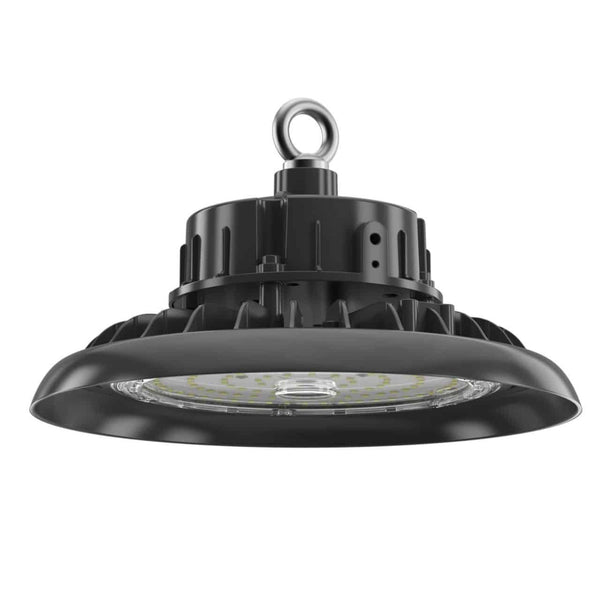
High-efficacy LED high bays for industrial and warehouse use – up to 210 lm/W, IP65, 5-year warranty:
Product Selection by Application: Combining Lumen, lm/W and Beam Angle
The right luminaire results from the interplay of all three figures. Below you will find practical recommendations for the most common B2B applications.
Storage Halls and Logistics
Target: maintained illuminance Em 200 lx per BS EN 12464-1, uniform illumination, low maintenance costs. Recommendation: LED high bays with 90–120° beam angle, ≥ 150 lm/W, IP65, 4000 K, 1–10 V or DALI dimmable. For high-bay racking from 10 m upwards: select a narrower angle (60–90°) and higher wattage.
Production and Manufacturing
Target: Em 300–500 lx, UGR ≤ 22, Ra ≥ 80. Recommendation: linear LED high bays or LED tri-proof lights (where dust or moisture is present), 4000–5000 K, ≥ 130 lm/W, IP65.
Office and Administration
Target: Em 500 lx, UGR ≤ 19, Ra ≥ 80. Recommendation: LED panels with UGR<19 optics, 4000 K, ≥ 120 lm/W. For display screen workstations, glare limitation (UGR) is at least as important as luminous flux.
Outdoor Areas and Sports Facilities
Target: Em 200–750 lx depending on class per BS EN 12193, IP66, asymmetric optics. Recommendation: LED floodlights or LED sports floodlights with ≥ 170 lm/W, DALI dimmable, Meanwell or Sosen driver.
LED floodlights on a business premises: high lm/W values and IP66 protection are critical for outdoor installations.
LED floodlights for outdoor areas, sports facilities and commercial use – IP66, up to 180 lm/W, 5-year warranty:
From Datasheet to Compliant Installation: The Light Planning Logic
Professional light planning follows a clear sequence: first establish the standard requirements (Em, UGR, Ra), then calculate the required lumen output, then select the luminaire with the appropriate beam angle and the highest possible lm/W value.
Rule of thumb for the number of luminaires: Number of luminaires = (Area m² × Minimum lux) ÷ (Luminous flux per luminaire lm × Maintenance factor). For LED luminaires the maintenance factor typically lies between 0.7 and 0.8, accounting for lumen depreciation and soiling over the service life.
For complex projects – halls with obstructions, sports facilities with broadcast camera requirements, or hazardous areas (ATEX luminaires) – a professional DIALux simulation is recommended. Clightstore produces these free of charge for your project.
Watt describes the power consumption of a luminaire; lumen describes the luminous flux produced. A high wattage does not automatically mean a lot of light – what matters is the luminous efficacy (lm/W). A modern LED at 100 W and 150 lm/W produces 15,000 lm; an inefficient luminaire at 100 W and 80 lm/W produces only 8,000 lm.
What is the difference between lumen and lux?
Lumen is the total quantity of light emitted by a luminaire. Lux is the illuminance arriving on a given surface: 1 lx = 1 lm/m². The same luminaire produces high lux values over a small area and low lux values over a large area – beam angle and mounting height are the determining factors.
How do I convert lumen to watt?
The conversion depends on the luminous efficacy. As a rule of thumb: Watts ≈ Lumens ÷ Luminous efficacy (lm/W). For a luminaire with 150 lm/W and 15,000 lm: 15,000 ÷ 150 = 100 W. For modern premium LEDs you can broadly estimate 130–180 lm/W.
How many lm/W is good for industrial luminaires?
For industrial and warehouse applications, luminaires with at least 130 lm/W are recommended. Premium high bays today achieve 150–210 lm/W. Values below 100 lm/W are generally no longer economical for new installations.
Which beam angle is correct for a storage hall?
For storage halls with mounting heights of 4–8 m, a beam angle of 90–120° is recommended to achieve uniform illumination without shadow areas. For high-bay racking from 10 m mounting height upwards, a narrower angle of 60–90° is advisable to achieve sufficient lux at floor level.
Which standard applies to the lighting of workplaces?
BS EN 12464-1 (2021 edition) is the accepted technical standard for the lighting of indoor workplaces. It defines maintained illuminance values (Em), UGR limits and Ra requirements for a wide range of room types. BS EN 12193 applies additionally for sports facilities, and BS EN 13201 for street lighting.
Can I simply replace luminaires with high lm/W values using fewer units?
In principle yes – higher luminous efficacy makes it possible to achieve the same lux level with fewer luminaires or lower wattage. The precise number depends, however, on beam angle, mounting height, room geometry and the required maintenance factor. A DIALux simulation provides standards-compliant planning certainty.
May I connect high bays myself?
No. All work on 230 V/400 V installations must be carried out exclusively by a qualified electrician. This is a binding requirement under BS 7671 (IET Wiring Regulations) and the Electricity at Work Regulations 1989. Unqualified persons must not carry out any electrical connection work.
Are you planning a warehouse, industrial unit or sports facility and would like to know how many luminaires you need to achieve compliant lux levels?
Clightstore will produce a free DIALux light plan for you – standards-compliant to BS EN 12464-1 or BS EN 12193, including luminaire selection, lux simulation and cost-benefit analysis. EU-wide delivery in 2–5 working days, up to 5 years' warranty.
Nezbytné cookies zajišťují správné fungování obchodu. S vaším souhlasem používáme také cookies pro statistiky a relevantní reklamu. Svůj výběr můžete kdykoli změnit. Zásady ochrany osobních údajů
Objednáváte jako firma?
Ceny jsou uvedeny s DPH. Firmy z EU s platným DIČ platí 0% DPH (přenesená daňová povinnost). Belgické firmy platí 21 % a následně si DPH nárokují zpět.
Při pokladně zadejte název své společnosti do pole “Společnost”.
Pod ním se poté zobrazí pole “DIČ”: zadejte své daňové identifikační číslo (např. NL123456789B01).
DPH bude automaticky odečteno a na faktuře bude uveden údaj o přenesené daňové povinnosti.