LED Beam Angle Explained: 60°, 90° or 120° – Which One for Your Hall or Yard?
What the beam angle of an LED luminaire means, how it relates to mounting height and spacing, and which angle to choose for halls, warehouses, yards and sports facilities – with calculation table and examples.
Two LED high bays with the same wattage and the same lumen output can light a hall completely differently. The reason is the beam angle: it decides whether the light lands on the floor as a bright, concentrated pool or spreads wide across the racking and walls. Choosing the wrong angle gives you dark aisles, glare or wasted light – and no amount of extra wattage fixes it. This guide explains what the beam angle really means, how it relates to mounting height, and which angle to choose for halls, warehouses, outdoor areas and sports facilities.
- The beam angle is the angle within which a luminaire's light intensity is at least 50% of its maximum (FWHM). Outside it, light still falls, but much weaker.
- Same lumens, narrower beam = higher lux directly below, smaller lit area. Wider beam = lower peak lux, larger area, better overlap between luminaires.
- Rule of thumb for high bays: up to about 6 m mounting height 120°, 6–10 m 90°, above 10 m 60–90°. High racking aisles often need narrow or asymmetric aisle optics.
- The lit diameter on the floor is roughly 2 × height × tan(beam angle ÷ 2): at 8 m, a 90° beam lights a circle of about 16 m.
- For outdoor areas and sports fields, asymmetric optics usually beat a wide symmetric beam: more light on the target, less glare and spill.
What the beam angle actually measures
An LED luminaire does not emit an even cone of light with a sharp edge. Its intensity (measured in candela) is highest straight ahead and drops gradually towards the sides. The beam angle is defined as the full angle between the two directions where the intensity has fallen to 50% of the maximum. Photometric standards call this FWHM (full width at half maximum).
Some data sheets also give a field angle: the angle at which intensity drops to 10%. The field angle is always wider than the beam angle and shows how far useful spill light reaches. For a high bay labelled 90°, the field angle is often 110–130°.
Beam angles are created by the optics in front of the LEDs:
- Lenses (PC or PMMA) over each LED or LED group – common for 60°, 90° and 120° high bays. Precise, compact, available in narrow and asymmetric versions.
- Reflectors (aluminium) around the LED module – classic for UFO high bays. A reflector narrows the beam and shields the light source from view, which reduces glare.
- Diffusers (opal covers) – used in panels and battens. They give a very wide, soft distribution of roughly 110–120° with low glare.
Why the same lumens give different lux
The lumen value tells you how much light a luminaire emits in total. The beam angle tells you how much space that light is spread over. Concentrate the same lumens into a narrower cone and the intensity – and therefore the illuminance (lux) on the floor – goes up, while the lit area shrinks.
The simplified example below shows one 15,000 lm high bay at 8 m mounting height. It ignores reflections from walls and overlap with neighbouring luminaires, so it only shows the principle:
| Beam angle | Lit diameter on the floor | Approx. lux directly below | Typical effect |
|---|---|---|---|
| 60° | about 9 m | about 280 lx | Bright pool, dark zones between luminaires unless they are closer together |
| 90° | about 16 m | about 130 lx | Balanced: good overlap at normal spacing |
| 120° | about 28 m | about 75 lx | Very even, but a lot of light on walls and racking at this height |
In a real installation, the luminaires overlap and the target is an average illuminance with a minimum uniformity, not the peak value under one fitting. That is why the right beam angle depends on mounting height and spacing together – see How much lux do you need? for the target values per area and Lumen vs. lumen per watt for the efficiency side.
Calculating the lit area
For a quick estimate of the diameter lit within the beam angle:
Diameter ≈ 2 × mounting height × tan(beam angle ÷ 2)
| Mounting height | 60° | 90° | 120° |
|---|---|---|---|
| 4 m | 4.6 m | 8 m | 13.9 m |
| 6 m | 6.9 m | 12 m | 20.8 m |
| 8 m | 9.2 m | 16 m | 27.7 m |
| 10 m | 11.5 m | 20 m | 34.6 m |
| 12 m | 13.9 m | 24 m | 41.6 m |
Mounting height here means the distance from the luminaire to the working plane (often the floor, or 0.75–0.85 m above it for workbenches), not the height of the roof.

Which beam angle for which application?
| Application | Recommended beam angle | Why |
|---|---|---|
| Workshops, low halls up to about 6 m | 120° | Wide overlap, even light, few shadows on workbenches |
| Production and storage halls 6–10 m | 90° | Best balance between uniformity and light on the floor |
| High halls above 10 m | 60° or 90° | Gets enough light to the floor without losing it on walls and roof |
| Narrow aisles between high racks | Narrow (30–60°) or asymmetric aisle optics | Puts light on the rack faces and the aisle, not on top of the racks |
| Sports halls | 60–90°, often with anti-glare reflector | Vertical light for ball sports, glare control for players looking up |
| Yards, loading zones, car parks | Asymmetric or wide (90–120°) floodlights | Large area from few poles, limited spill towards neighbours |
| Sports fields | Narrow and asymmetric floodlight optics | Long throw from the mast to the centre of the field with controlled glare |
| Offices and classrooms | Diffuse (panels, about 110–120°) | Soft, low-glare light at low ceiling heights |
For the full planning of halls and warehouses, see our LED high bay guide and warehouse lighting guide.
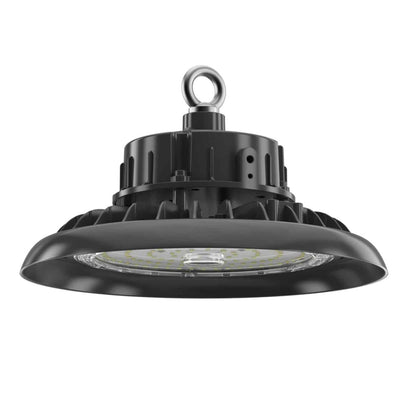
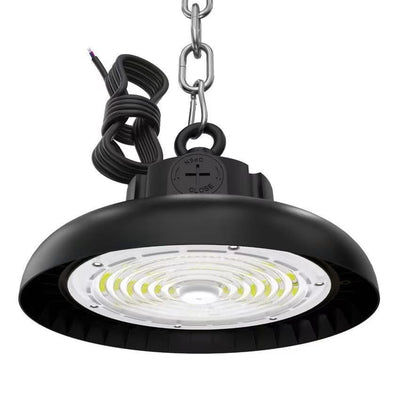
LED high bays with 90° and 120° optics – Philips or Sosen drivers, IP65:


Spacing and uniformity: the angle and the grid belong together
Uniformity (U0) is the ratio between the lowest and the average illuminance. EN 12464-1 typically asks for U0 ≥ 0.4 in storage areas and ≥ 0.6 at workplaces. Whether you reach that depends on how far apart the luminaires are compared with their mounting height – the spacing-to-height ratio.
- With narrow beams (60°), keep the spacing at or below roughly the mounting height. Wider spacing creates visible dark bands.
- With 90° beams, spacing of about 1 to 1.3 times the mounting height usually gives good uniformity.
- With 120° beams, spacing up to about 1.5 times the mounting height is possible – useful in low halls, but at greater heights much of the light hits walls and racking.
These are starting points. Racking, mezzanines, wall reflectance and the exact light distribution curve change the result, which is why a light calculation with the real photometric file (LDT or IES) is the only reliable check.
Beam angle and glare
A wide beam sends more light at low angles – the directions in which people look when they glance up or across a hall. That increases the risk of glare, expressed as UGR. Narrower lenses and especially reflectors cut off light at low angles and make a luminaire more comfortable to work under. In halls with workplaces, forklift traffic or ball sports, the optics are therefore just as important as the lumen output. More in UGR value explained.
Outdoor areas: symmetric or asymmetric?
A floodlight with a symmetric 120° beam aimed straight down lights a circle. Mounted on a facade or pole and tilted, it throws a large part of its light into the sky or towards neighbours. Asymmetric optics direct the light forward and downward, so the luminaire can stay horizontal: more light on the yard, less glare for drivers and less light pollution.

For yards and loading zones, see Outdoor lighting for business premises; for pitches and courts, Light distribution on sports fields.
Common mistakes
- Choosing by wattage only. A 200W luminaire with the wrong optics lights the hall worse than a 150W luminaire with the right ones.
- 120° in high halls. At 10–12 m, a large share of the light lands on the upper racking and walls instead of the floor.
- 60° in low halls. At 4–5 m, narrow beams create hot spots and dark zones unless you add many more luminaires.
- Ignoring the racking. In narrow-aisle warehouses, light on top of the racks is wasted; use aisle optics and place luminaires above the aisles.
- No photometric file. Without LDT or IES data, the beam angle on the box is the only information – and it says nothing about the shape of the curve.
Frequently asked questions
What does a beam angle of 90° mean?
Within a cone of 90° (45° either side of the centre line), the light intensity is at least half of its maximum. At 8 m height, that cone covers a circle of about 16 m on the floor. Outside it, the luminaire still emits light, but at lower intensity.
Is a wider beam angle better?
Not by definition. A wider beam gives more even light and allows larger spacing at low heights, but at greater mounting heights more light is lost on walls and racking and the risk of glare increases. The right angle depends on height, spacing and what needs to be lit.
Which beam angle for a warehouse with 8 m mounting height?
Usually 90° for open storage areas. For narrow aisles between high racks, narrow or asymmetric aisle optics mounted above the aisles work better.
What is the difference between beam angle and field angle?
The beam angle is measured at 50% of maximum intensity, the field angle at 10%. The field angle is always wider and shows how far useful spill light reaches.
Does a narrower beam make a luminaire brighter?
The total light output (lumens) stays the same, but it is concentrated on a smaller area, so the lux directly below is higher. Overall, the hall does not get more light – it is just distributed differently.
How do I calculate how many luminaires I need?
Start from the required average lux and uniformity, the room size and the mounting height, then use the photometric file of the chosen luminaire in a light calculation such as DIALux. We prepare these calculations for free.
Send us the dimensions and mounting height. We prepare a free DIALux light plan with the right optics, the number of luminaires and the expected lux values and uniformity. EU-wide delivery in 2–5 working days, up to 5 years' warranty.
Request a free light plan