We deliver across the EU. Pick the language you prefer; you can change it later at the top of the page.
Neu: clightstore.de ist jetzt Teil von clightstore.com.
Gleiche Produkte, gleiche Preise, gleiches Team. Bestellungen aus unserem bisherigen Shop werden wie gewohnt bearbeitet. Kundenkonten und Bestellhistorie des alten Shops sind vorübergehend nicht verfügbar. Bei Fragen erreichen Sie uns unter sales@clightstore.com.
Cuenta
How Many Lux Does a Football Pitch Need? Standards & Planning
All lux requirements for football pitches to DIN EN 12193, DFB, UEFA and FIFA – with GR value, uniformity, ROI calculator and funding guidance.
14 min readBy Clightstore lighting plannersUpdated 21.10.2026
A football pitch requires between 75 lux (recreational training) and 2,500 lux (FIFA world-class with TV broadcast) depending on its use. The governing standard is DIN EN 12193:2019-07, supplemented by the licensing conditions of the DFB, UEFA and FIFA. Planning the wrong illuminance class risks licence withdrawal, glare problems and unnecessarily high operating costs.
In brief
DIN EN 12193 defines three illuminance classes (I–III) with 75, 200 and 500 lux as minimum values for horizontal illuminance.
From the 3rd Division upwards, association requirements apply: 1,200 lux (3rd Division), 1,400 lux (Bundesliga), 1,500–2,500 lux (UEFA/FIFA).
In addition to lux, uniformity (Uo) and GR value (glare) are normatively prescribed – both are frequently underestimated.
LED floodlighting typically saves 50–60 % in electricity costs compared with HQI for a comparable light output; payback depends heavily on the funding rate.
Through the BMWK Municipal Directive and state sports federation programmes, up to 80 % funding can be combined – the application must be submitted before construction begins.
Lux table: all classes at a glance
DIN EN 12193:2019-07 is the binding European standard for the lighting of sports facilities. It distinguishes three illuminance classes and sets minimum values for each class covering mean horizontal illuminance (Eh,av), the uniformity coefficient (Uo) and the glare rating (GR).
For competition levels above the DIN standard, the licensing conditions of the associations additionally apply. These are not contained in the standard but are legally binding for match operations.
Class / Level
Typical use
Eh,av (lux)
Uniformity Uo
GR (max.)
CRI / Ra (min.)
DIN Class III
Recreational, school, training
75
≥ 0.5
55
20
DIN Class II
District/county league, regional match play
200
≥ 0.6
50
20
DIN Class I
National / international (amateur level)
500
≥ 0.7
50
65
DFB 3rd Division
Professional play, licence required
1,200
≥ 0.7
50
65
DFB Bundesliga
Professional play, licence required
1,400
≥ 0.7
50
65
UEFA competitions
Europa League, Champions League
1,500 (HDTV: 2,000)
≥ 0.7
50
65
FIFA world-class
World Cup, Olympics, 4K TV production
2,500
≥ 0.7
50
80
For most club and municipal projects in Germany, Classes II and III as well as the DFB range up to 1,200 lux are relevant. A complete overview of all lux reference values for various applications can be found in our guide How many lux do you need?.
TSV Aubstadt: football pitch with 400 lux to illuminance Class I – realised with LED floodlights on 18 m masts.
What lux alone does not tell you: uniformity, GR value and vertical illuminance
Uniformity coefficient Uo
The value Uo describes the ratio of the minimum to the mean illuminance across the playing surface. A Uo of 0.6 means the darkest point on the pitch has at least 60 % of the mean illuminance. Poor uniformity creates bright patches and dark zones – a safety issue for players and referees, and a technical exclusion criterion for TV cameras.
Typical planning errors arise when too few luminaires are used on too few masts. A DIALux simulation demonstrates during the planning phase whether Uo will be met.
GR value: glare rating to CIE 112
The GR value (Glare Rating) assesses the glare effect of exterior lighting installations to CIE 112. The scale runs from 10 (virtually no glare) to 90 (intolerable glare). DIN EN 12193 prescribes GR ≤ 50 for football – a value that is quickly exceeded with incorrectly aimed or too-low-mounted luminaires.
The key factors for a low GR value are: sufficient mounting height, asymmetric light distribution of the luminaires and correct aiming angles. Luminaires with narrow beam angles (20°–40°) on tall masts achieve significantly better GR values than wide-beam luminaires on low masts.
Vertical illuminance Ev
For TV broadcasts, not only horizontal but also vertical illuminance is critical. Cameras require sufficient light on vertical surfaces – that is, on players, balls and goals. UEFA and FIFA prescribe minimum values for Ev for broadcast installations, which must be demonstrated separately in the DIALux light planning.
LED technology: what B2B buyers need to consider
Luminous efficacy (lm/W)
Modern LED sports floodlights achieve 160–180 lm/W. Older HQI luminaires deliver 80–100 lm/W. This means that for the same light output you need approximately half the connected load with LED. For a club pitch at Class II (200 lux), the installed load is reduced from a typical 8 × 2,000W (HQI) to 8 × 400W (LED) – at equal or better light quality. Further reading on efficiency is available in our guide Lumens vs. lumens per watt.
IP rating and IK rating
For outdoor installations, a minimum of IP65 to IEC 60529 is required; for exposed locations subject to spray water or pressure washing, IP66 is recommended. The IK rating should be at least IK08 to withstand mechanical impacts from balls or maintenance work. Detailed explanations are available in our guides on IP ratings and IK ratings.
Colour temperature and CRI
For match play and TV broadcasts, 5,000K (daylight white) is recommended – cameras require a neutral colour rendering. For training only, 4,000K (neutral white) is sufficient. The CRI value (Ra) should be at least 65 from Class I upwards; for TV productions Ra ≥ 80 is required. Further reading on choosing colour temperature is available in our guide LED colour temperature.
Service life and warranty
Look for L80 values of at least 50,000 operating hours – at 500 hours per year this equates to a calculated service life of 100 years; the L80 value is the practically relevant figure that reputable manufacturers publish for high-performance luminaires. A manufacturer's warranty of at least 5 years is frequently required for tenders and funding applications.
Mast planning and standards: height, quantity, structural integrity
Recommended mounting heights
The mounting height of the luminaires is the single most important factor for the GR value and uniformity. DIN EN 12193 recommends a minimum of 16 m for training installations and 18–20 m for competition installations. Lower masts force steeper beam angles, which increases glare and reduces uniformity.
Number of masts and layout
Typical configurations for a standard pitch (105 × 68 m):
Class III (75 lux): 4 masts at 16 m, each with 2–3 luminaires at 150–200W
Class II (200 lux): 4–6 masts at 16–18 m, each with 3–4 luminaires at 240–400W
Class I (500 lux): 6–8 masts at 18–20 m, each with 4–6 luminaires at 400W
DFB 3rd Division (1,200 lux): 8–12 masts at 20–25 m, each with 6–10 luminaires at 1,000–1,500W
Structural integrity and DIN 4131
From a mast height of 12 m, DIN 4131 (steel antenna structures) applies. For existing masts, a structural stability assessment by an approved inspection engineer must be obtained before retrofitting to LED. Although LED luminaires are lighter than HQI fittings, the altered wind-load surfaces resulting from new housing geometries can affect structural integrity.
Important safety notice: All connection and installation work on 230V/400V systems may only be carried out by approved qualified electricians (DIN VDE 0100, DGUV Regulation 3, 5 safety rules). This applies in particular to work on floodlight masts, which additionally requires fall protection measures.
Professional mast installation at TSV Aubstadt: structural stability assessment and electrical installation by certified specialist contractors are mandatory.
Cost-effectiveness and ROI: worked examples by class
LED replacement: 16 × 400W (or 12 × 1,000W for taller masts)
LED electricity costs/year (16 × 400W): 16 × 0.4 kW × 600 h × 0.22 € = 845 €
LED electricity costs/year (12 × 1,000W): 12 × 1.0 kW × 600 h × 0.22 € = 1,584 €
Annual saving: approx. 2,640–3,379 €
Investment costs: approx. 45,000–68,000 €
Payback with 40 % funding: approx. 8–15 years
We will produce a detailed calculation for your project free of charge using DIALux. Further reading on the methodology is available in our guide Calculating LED payback period.
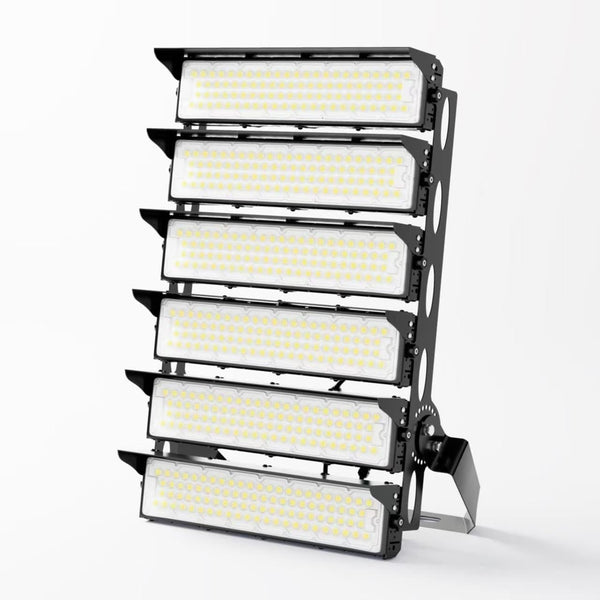
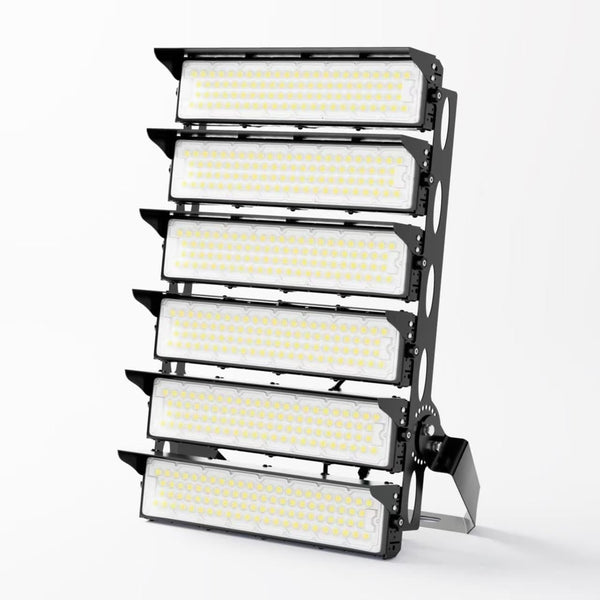
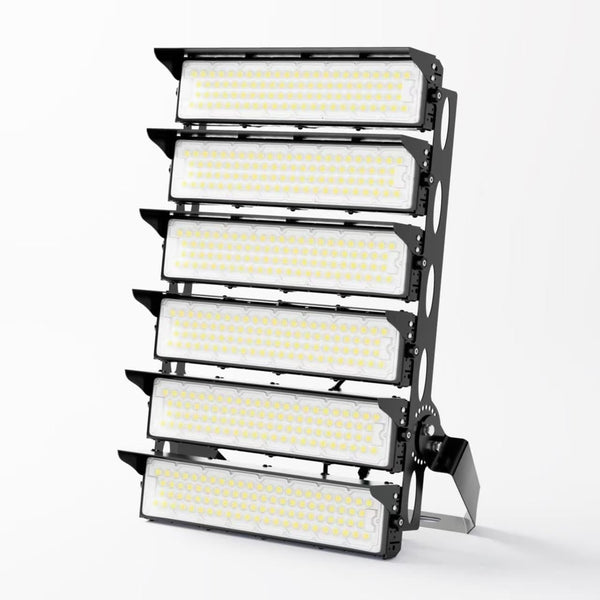
LED floodlights for professional stadiums and Class I installations – 1,500W, DALI/MOSO, Philips driver:
The Municipal Directive of the Federal Ministry for Economic Affairs and Climate Action (BMWK) funds LED retrofits in municipal sports facilities at 25–40 % of eligible investment costs. Financially disadvantaged municipalities can receive up to 55 %. Applications are submitted to the Projektträger Jülich (PtJ) before construction begins – retrospective applications are excluded.
State sports federation programmes
Most German federal states offer supplementary investment grants for sports facilities through their state sports federations (LSB). These can be combined with the Municipal Directive. In favourable combinations, total funding rates of up to 80 % are achievable.
Step-by-step process
Needs analysis: determine the illuminance class and commission DIALux light planning.
Funding advice: review the Municipal Directive and LSB programme, clarify combinability.
Submit funding application (before construction begins and before contracts are signed with suppliers).
Await the approval notice – only then place orders.
Tender and award in accordance with VOB/A (for public contracting authorities).
Installation by a qualified electrical contractor, acceptance inspection and documentation.
Submit proof of use, call down funding.
Typical planning errors and checklist
The most common mistakes
Funding application submitted after construction begins: results in complete loss of funding – no exceptions apply.
Illuminance class chosen too conservatively: if the club advances to a higher division, a costly upgrade will be necessary. Recommendation: plan one class higher as a buffer.
No structural assessment for existing masts: altered wind-load surfaces from new luminaire housings can compromise structural stability.
GR value not simulated: without a DIALux verification you risk glare problems that are virtually impossible to correct retrospectively.
Wrong colour temperature: 3,000K luminaires are unsuitable for sports installations; 4,000K or 5,000K are standard.
IP rating underestimated: IP65 is the minimum; IP66 is recommended for installations with regular cleaning intervals.
No dimming infrastructure planned: DALI control enables training and match modes – typically saving 20–40 % electricity during training operations.
Planning checklist for B2B buyers
Check point
Done
Illuminance class determined in accordance with DIN EN 12193 and association requirements
DIALux simulation commissioned with verification of Eh,av, Uo and GR
Funding application (Municipal Directive + LSB) submitted before construction begins
Structural assessment for existing masts obtained (DIN 4131)
IP rating ≥ IP66 specified for all exterior luminaires
CRI/Ra requirement per class included in tender specification
Dimming protocol (DALI/0–10V) and control concept defined
Qualified electrical contractor engaged for installation and connection
Warranty period ≥ 5 years secured contractually
Acceptance protocol with lux measurement after commissioning planned
For pure training use without match play, 75 lux to illuminance Class III of DIN EN 12193 is sufficient. As soon as league matches are played on the pitch, at least Class II with 200 lux is required. It is advisable to plan directly to Class II in order to avoid costly upgrades later.
Which illuminance class applies to district and county leagues?
District and county leagues generally fall under illuminance Class II of DIN EN 12193 with 200 lux mean horizontal illuminance and a uniformity coefficient Uo ≥ 0.6. Additionally check the current requirements of your regional association, as these may deviate from the DIN standard.
What does the GR value mean and why is it important?
The GR value (Glare Rating) assesses the glare effect of exterior lighting installations to CIE 112. The scale runs from 10 (no glare) to 90 (intolerable glare). DIN EN 12193 prescribes GR ≤ 50 for football. An excessively high GR value impairs players, can lead to accidents and is a ground for exclusion at association inspections.
Can I use existing floodlight masts for the LED retrofit?
In principle yes – but only after a structural stability assessment by an approved inspection engineer. New LED luminaires have different wind-load surfaces from the original HQI fittings. For masts of 12 m or more, DIN 4131 applies. Existing masts from the 1980s and 1990s frequently no longer meet the current state of the art.
Is there funding for LED floodlighting on sports pitches?
Yes. Through the BMWK Municipal Directive, 25–55 % of eligible costs are fundable. In combination with state sports federation programmes, total funding rates of up to 80 % are achievable. The key point: the funding application must be submitted before construction begins and before contracts are signed with suppliers.
How long does the payback period for an LED retrofit take?
Without funding, the payback period for a Class II club pitch is typically 13–20 years. With 40 % funding this period shortens to 8–12 years, and with 60 % funding to 5–7 years. Saved maintenance costs from the elimination of lamp replacements are additional. Our guide Calculating LED payback period explains the methodology in detail.
What is the difference between horizontal and vertical illuminance?
Horizontal illuminance (Eh) measures the light on the playing surface – relevant for players and referees. Vertical illuminance (Ev) measures the light on vertical surfaces – relevant for TV cameras filming players, balls and goals. For broadcast installations, UEFA and FIFA prescribe minimum values for Ev that must be demonstrated separately in the DIALux light planning.
How tall do floodlight masts need to be for a football pitch?
DIN EN 12193 recommends a minimum mounting height of 16 m for training installations and 18–20 m for competition installations. Taller masts allow shallower beam angles, better uniformity and lower GR values. From a mast height of 12 m, DIN 4131 applies and a structural stability assessment must be obtained.
Are you planning football pitch lighting and need a standards-compliant verification?
Clightstore will produce a complete DIALux light planning free of charge, with verification of lux values, uniformity Uo and GR value – as a basis for funding applications and association inspections. EU-wide delivery in 2–5 working days, up to 5 years' warranty.
Las cookies necesarias mantienen el funcionamiento de la tienda. Con su permiso, también utilizamos cookies para estadísticas y anuncios relevantes. Puede cambiar su elección en cualquier momento. Política de privacidad
¿Realiza el pedido como empresa?
Los precios incluyen IVA. Las empresas de la UE con un número de IVA válido pagan un 0 % de IVA (inversión del sujeto pasivo). Las empresas belgas pagan el 21 % y lo recuperan posteriormente.
En el proceso de pago, introduzca el nombre de su empresa en el campo «Empresa».
A continuación aparecerá el campo «Número de IVA»: introduzca su número de IVA (p. ej., NL123456789B01).
El IVA se deduce automáticamente y su factura incluye la mención de inversión del sujeto pasivo.