Vehicle Workshop Lighting: Lux Levels, Lifts, Spray Booths and Showrooms
How to light a vehicle workshop and car dealership: lux levels for servicing, body work and painting, light at the lift, IP65 luminaires, spray booths and showroom lighting.
In a vehicle workshop, lighting decides whether a scratch, an oil leak or a colour difference is spotted. At the same time, mechanics work under vehicles, at lifts and in spray booths, where shadows and glare quickly become a problem. This guide shows the right lux levels per area, the right choice of luminaire and what matters in a car showroom.
- General workshop, servicing and repair: around 300 lux, colour rendering Ra ≥ 80.
- Body work: around 500 lux; painting and colour matching: 750 to 1,000 lux with Ra ≥ 90.
- Vehicle lifts need light from the side, otherwise you work in the vehicle's shadow.
- IP65 tri-proof lights are standard: oil mist, cleaning water and dust are part of everyday life.
- In spray booths with solvent vapours, ATEX luminaires may be required.
Lux levels per workshop area
| Area | Illuminance | Colour rendering | Note |
|---|---|---|---|
| General workshop floor, traffic routes | approx. 300 lux | Ra ≥ 80 | Even across the whole hall |
| Servicing, repair, tyre service | approx. 300 lux | Ra ≥ 80 | Extra light at the lift |
| Body work, welding | approx. 500 lux | Ra ≥ 80 | Robust luminaires, consider sparks |
| Paint preparation, painting | approx. 750 lux | Ra ≥ 90 | Even, without colour cast |
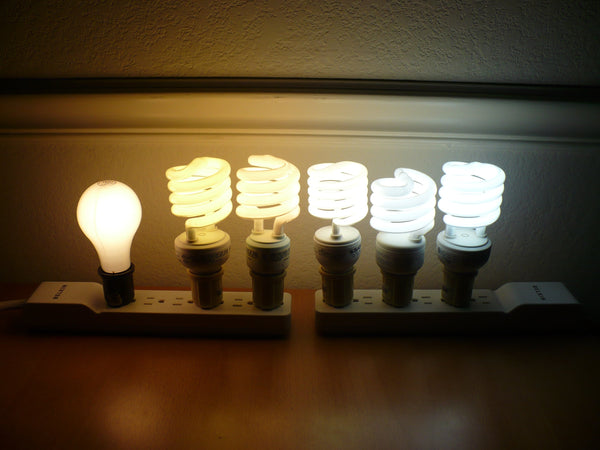
| Colour matching, final inspection | approx. 1,000 lux | Ra ≥ 90 | Daylight-like light, 5000K to 6500K |
| Showroom (car dealership) | approx. 500 lux | Ra ≥ 80, ideally 90 | Accent light on vehicles |
The values are based on EN 12464-1 and are maintained values. General lux reference values for all areas can be found under How Much Lux Do You Need?

Light at the vehicle lift
When a vehicle is on the lift, it blocks the ceiling light exactly where work is done. Two solutions have proven themselves:
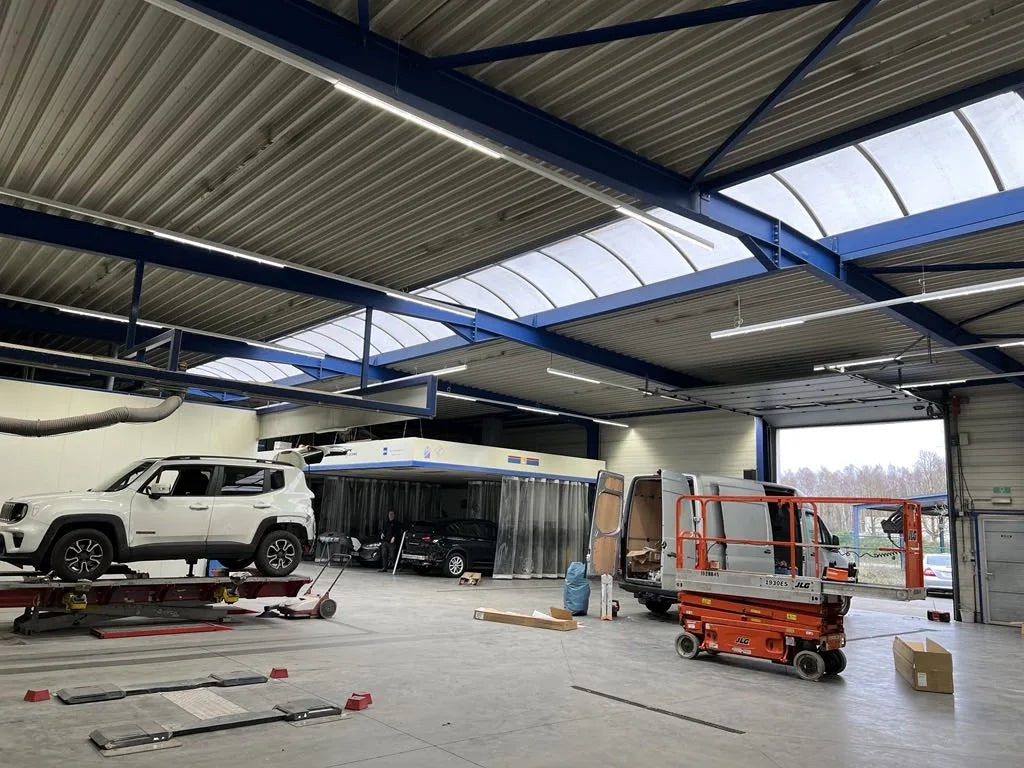
- Light lines beside the lifts: Rows of luminaires to the left and right of each lift instead of one row in the middle, so light falls obliquely under the vehicle.
- Wall or column luminaires: Additional tri-proof lights at 1.5 to 2 m height on the wall or lift columns.
Hand lamps remain necessary, but the general lighting should be good enough that you don't need one for every task.
Which luminaires for the workshop?
| Ceiling height | Recommended luminaire | Why |
|---|---|---|
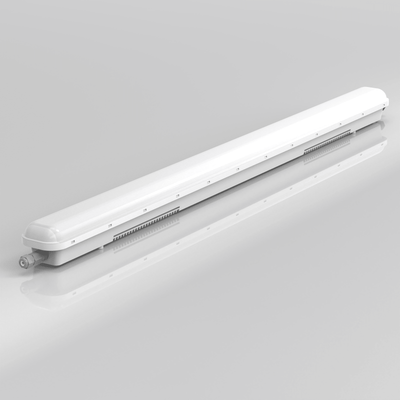
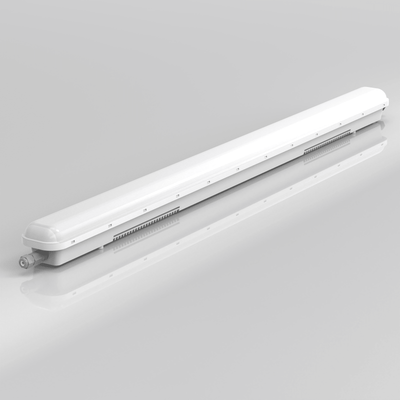
| 3–5 m | Tri-proof light or trunking | Even, robust, IP65 |
| 5–8 m | Linear high bays | More luminous flux, wide distribution |
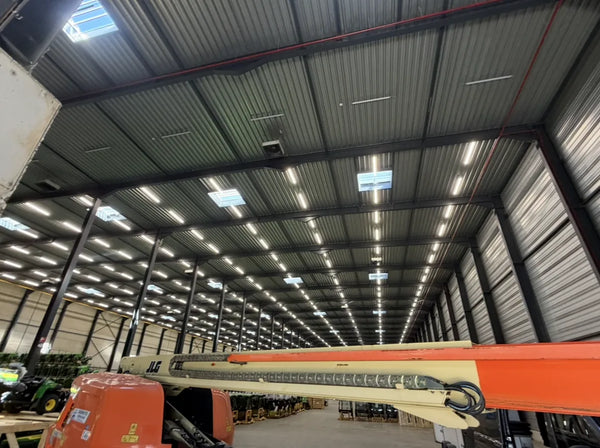
| above 8 m (truck workshop) | High bays 150–200W | High output, large mounting height |
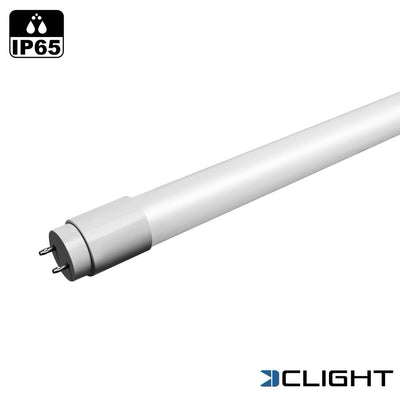
IP65 is standard in workshops because oil mist, cleaning water and brake dust would otherwise get into the housing (see IP Ratings Explained). If you still have fluorescent battens, you can often keep them running with LED tubes (see Replacing Fluorescent Tubes with LED).
Luminaires for workshops

Spray booth and explosion protection
Painting produces solvent vapours. Depending on the installation and risk assessment, the booth or its surroundings is a hazardous zone. Only luminaires with ATEX certification for that zone may be used there. How zones are classified is explained in our guide ATEX and Ex-Proof Lighting.
Car dealership and showroom
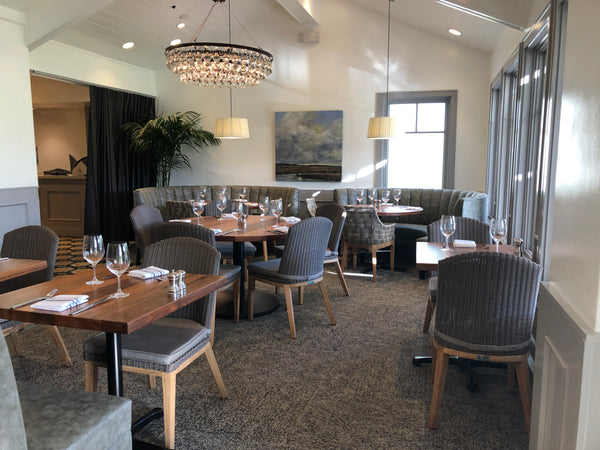
In the showroom, light helps sell. Even general lighting of around 500 lux provides orientation, while directional spotlights on the vehicles bring paint and lines to life. High colour rendering (Ra 90) matters, so paint colours look the same inside as outside. 3-phase track spotlights are ideal, because the vehicles change regularly and the spotlights can simply be moved.
Worked example
A workshop with 30 fluorescent fittings 2 × 58W (approx. 140W each) is replaced by 30 LED tri-proof lights of 55W, 2,500 operating hours a year, €0.28/kWh: saving 30 × 85W × 2,500 h = 6,375 kWh, around €1,785 a year. More in our guide LED Payback Period Calculator.
Frequently asked questions
How many lux does a vehicle workshop need?
Around 300 lux for general work and servicing, around 500 lux for body work, and 750 to 1,000 lux for painting and colour matching.
Which colour temperature is best for a workshop?
4000K for general areas, 5000K to 6500K for painting and final inspection, because daylight-like light makes colour deviations easier to see.
Why does colour rendering matter in a workshop?
With poor colour rendering, paint colours look different than in daylight. For painting and colour matching, Ra 90 or higher is needed.
Do I need ATEX luminaires in the spray booth?
That depends on the zone classification resulting from the risk assessment. In hazardous zones only certified Ex luminaires are allowed.
How do I light the area under a vehicle lift?
With rows of luminaires beside the lift rather than above its centre, plus additional wall luminaires at 1.5 to 2 m height.
Send us your floor plan, ceiling height and number of lifts. We prepare a free DIALux lighting plan and a no-obligation quote at direct-import prices 2–4× below comparable branded products. 5-year warranty.
Request a quote