Underground Car Park Lighting: Lux Levels, Layout and Sensors
How to light underground and multi-storey car parks: lux for lanes, bays and entrances, luminaire layout, IP65/IK08 tri-proof lights, sensors and a savings example.
Underground car parks and multi-storey car parks are often lit around the clock, which is exactly why they are among the areas where LED pays back fastest. At the same time, good lighting decides whether users feel safe, whether cameras can see anything and whether drivers at the entrance are dazzled as they drive into the dark.
- Traffic lanes and parking bays: around 75 lux; entrances and exits around 300 lux by day, around 75 lux at night.
- The entrance needs a transition zone so the eye can adapt from daylight to the car park.
- IP65 tri-proof lights with IK08 or higher are standard: moisture, exhaust fumes and occasional impacts.
- Sensors save the most: luminaires dim to 10–30% until someone arrives.
- Light walls and ceilings improve the feeling of safety more than extra lux on the floor.
How many lux does an underground car park need?
| Area | Illuminance | Note |
|---|---|---|
| Traffic lanes | approx. 75 lux | Even, without dark islands |
| Parking bays | approx. 75 lux | Light between the vehicles too |
| Entrance and exit (day) | approx. 300 lux | Transition from daylight |
| Entrance and exit (night) | approx. 75 lux | No glare outwards |
| Pay stations, stairwells, lift lobbies | approx. 150–300 lux | People spend time here |
The values are based on EN 12464-1. Escape routes also require safety lighting (see Emergency Lighting: Requirements and Testing).

Luminaire layout
- Rows along the lanes: Linear luminaires across or along the direction of travel, so parking bays between vehicles also get light.
- Not just above the roadway: Lighting only the lane leaves pedestrians between parked cars in the dark.
- Entrance brighter in steps: By day a bright zone right behind the entrance, then decreasing.
- Include columns and walls: Light walls reflect light and make faces recognisable.
Which luminaires?
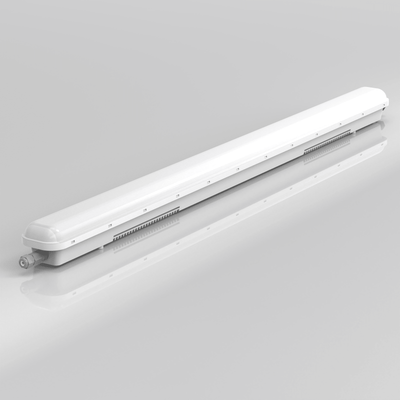
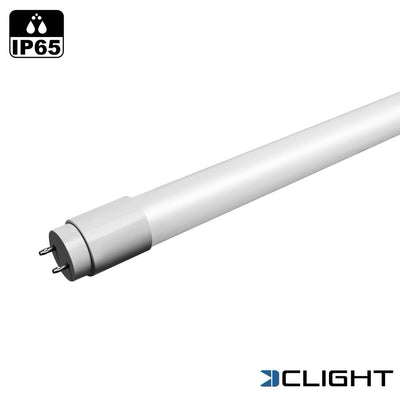
LED tri-proof lights with IP65 and at least IK08 have proven themselves: condensation, exhaust fumes, cleaning with water and occasional knocks from vehicles or ladders are everyday occurrences. Old fluorescent tri-proof fittings with a starter can often keep running with LED tubes (see Replacing Fluorescent Tubes with LED). More on impact ratings in IK Protection Rating Explained.
Luminaires for underground car parks
Sensors: the biggest lever
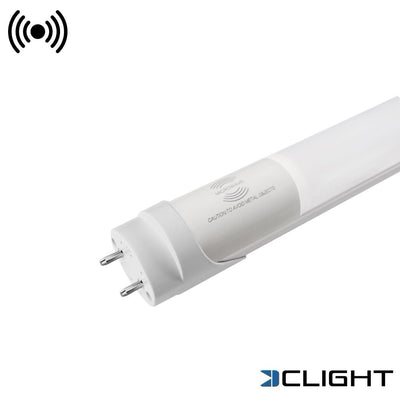
In many car parks nobody passes for hours, day and night. With motion or radar sensors, luminaires run dimmed at 10–30% and switch to 100% on movement, individually or as a group along the lane. Compared with constant light, that often saves a further 50–70% on top of the LED saving, without it ever going dark. LED tubes with an integrated sensor are the simplest retrofit.
Worked example
Underground car park with 80 fluorescent fittings 1 × 58W (approx. 70W with magnetic ballast), running 24/7 (8,760 h), €0.28/kWh. Replaced by 80 LED luminaires of 40W with sensor, averaging 40% output:
- Before: 80 × 70W × 8,760 h = 49,056 kWh, around €13,700 a year
- After: 80 × 40W × 0.4 × 8,760 h = 11,213 kWh, around €3,140 a year
- Saving around €10,600 a year
With your own values: LED Payback Period Calculator.
Frequently asked questions
How many lux does an underground car park need?
Around 75 lux for lanes and parking bays, around 300 lux for entrances and exits by day, and 150–300 lux at pay stations and lift lobbies.
What protection rating do car park luminaires need?
IP65 against moisture and cleaning water, and at least IK08 against impacts. IK10 in areas at risk of vandalism.
Are motion sensors worthwhile in a car park?
Yes, more than almost anywhere. Dimmed base light with full output on movement often saves more than half the consumption.
Which colour temperature suits underground car parks?
4000K neutral white: good visibility for people and cameras, looks clean and bright.
Does an underground car park need emergency lighting?
Yes. In most building regulations, car parks are among the areas requiring safety lighting for escape routes and exits.
Send us the floor plan, number of luminaires and operating hours. We prepare a free DIALux lighting plan with a sensor concept and a no-obligation quote at direct-import prices 2–4× below comparable branded products.
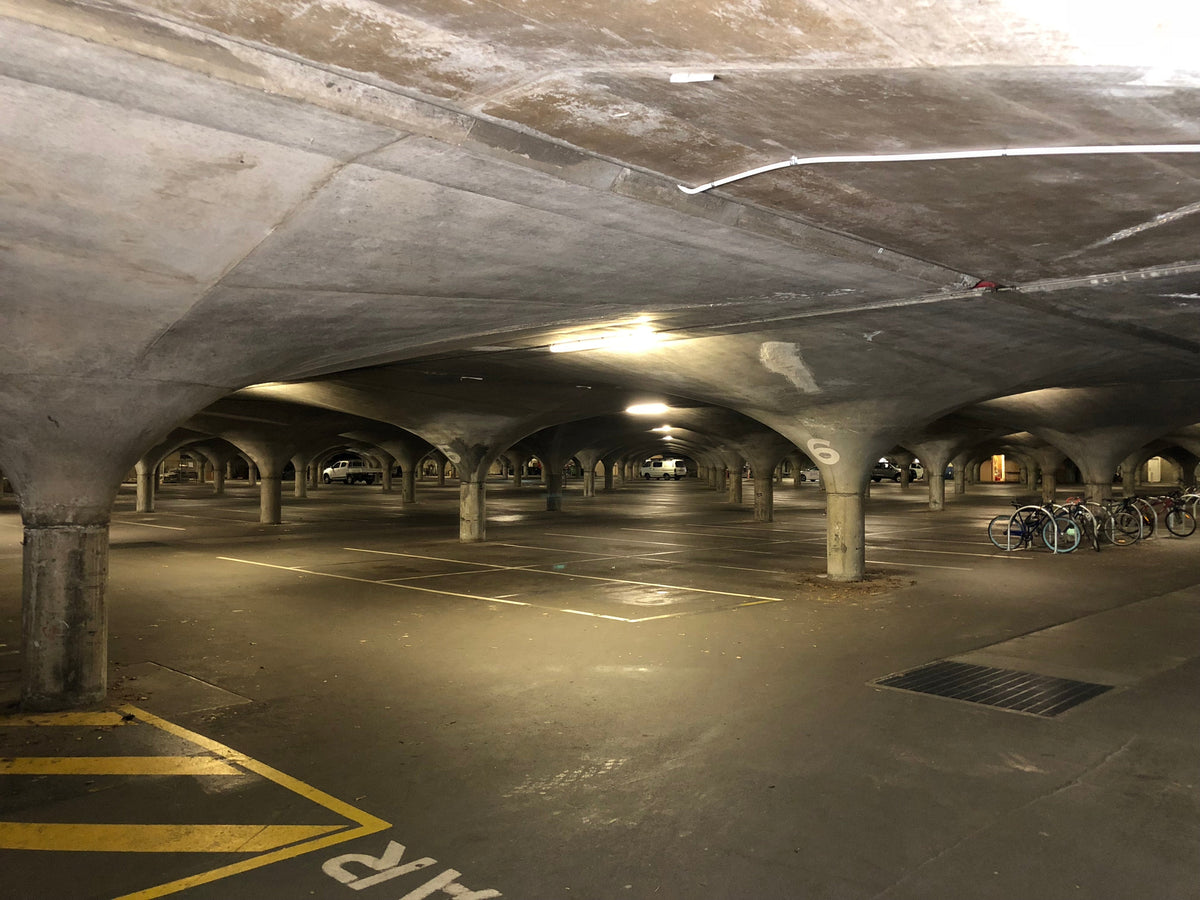
Request a lighting planCover photo: Canley, Wikimedia Commons, licence CC BY-SA 4.0.