Production and Food Industry Lighting: Lux Levels, Hygiene and Protection Ratings
How to light production halls and food plants: lux levels by task, hygiene rules without glass, IP65 to IP69K for cleaning, flicker at machines and a savings example.
In production, the quality of the light is directly linked to the quality of the product: defects are spotted or missed, staff tire or stay focused. In the food industry, hygiene, wet cleaning and avoiding foreign bodies come on top. This guide shows lux levels by task, the right protection rating and what IFS and HACCP audits look for.
- Rough work approx. 200 lux, general production and assembly approx. 300 lux, fine assembly approx. 500–750 lux, inspection up to 1,000 lux.
- Food processing: approx. 300–500 lux, quality control and sorting higher, with good colour rendering (Ra ≥ 80, ideally 90).
- No glass covers in food areas: shatter protection with polycarbonate is essential for IFS and HACCP.
- Wet cleaning requires IP65; high-pressure or foam cleaning IP66 to IP69K.
- Rotating machinery: flicker-free drivers prevent stroboscopic effects.
Lux levels by task
| Task | Illuminance | Colour rendering |
|---|---|---|
| Rough work, material storage in production | approx. 200 lux | Ra ≥ 60–80 |
| General production, machine operation, rough assembly | approx. 300 lux | Ra ≥ 80 |
| Medium-fine assembly, switchboards | approx. 500 lux | Ra ≥ 80 |
| Fine assembly, electronics | approx. 750 lux | Ra ≥ 80 |
| Inspection, colour control | approx. 1,000 lux | Ra ≥ 90 |
| Food processing, general | approx. 300 lux | Ra ≥ 80 |
| Sorting, food quality control | approx. 500 lux | Ra ≥ 80–90 |
| Bakery: preparation and baking | approx. 300 lux | Ra ≥ 80 |
The values are based on EN 12464-1 and are maintained values. Where individual workstations need more light, task lighting is often more economical than making the whole hall brighter. Hall planning basics are covered in LED High Bay Lighting.

Food industry: hygiene before brightness
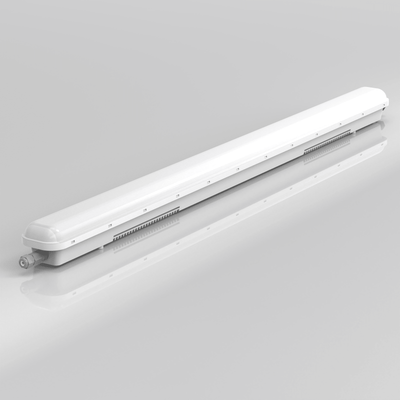
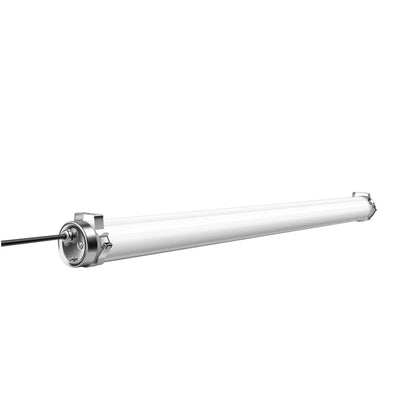
- No glass: If a glass cover breaks, a whole day's production can be quarantined. Luminaires with polycarbonate covers or shatter-proof tubes are standard in IFS and BRC audits.
- Smooth surfaces: No open cooling fins or corners where dirt and germs collect.
- Cleaning: IP65 for wiping and hosing, IP66 to IP69K for high-pressure, hot-water or foam cleaning (see IP Ratings Explained).
- Chemicals and ammonia: In cold areas and livestock buildings, ammonia and cleaning agents attack unsuitable plastics. Ammonia-resistant tri-proof lights are made for this.
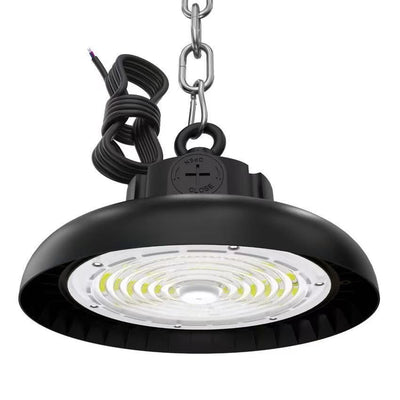
Luminaires for production and food

Flicker and the stroboscopic effect at machines
Rotating shafts, saw blades or drills can appear to stand still under flickering light. That is a serious accident risk. Luminaires with high-quality drivers (low ripple) avoid this effect. In machine halls, check the flicker specification in the data sheet.
Colour temperature and controls
4000K is standard for production and food. 5000K to 6500K helps at inspection points where colour defects must be detected. Dimmable luminaires with daylight and presence sensors cut consumption in areas with windows or changing occupancy (see 0-10V, 1-10V and TRIAC).
Worked example
Production hall with 60 fluorescent fittings 2 × 58W (approx. 140W), two-shift operation of 4,500 hours, €0.28/kWh. Replaced by 60 LED tri-proof lights of 55W: saving 60 × 85W × 4,500 h = 22,950 kWh, around €6,400 a year. See LED Payback Period Calculator.
Frequently asked questions
How many lux does a production hall need?
Around 300 lux for general production, 500–750 lux for finer assembly and up to 1,000 lux for inspection.
Which luminaires are suitable for the food industry?
Shatter-proof covers without glass, easy-to-clean surfaces and a protection rating suited to the cleaning method. The exact requirements follow from the hygiene concept or audit standard (IFS, BRC).
Which protection rating do I need for wet cleaning?
IP65 for normal hosing, IP66 for powerful water jets and IP69K for high-pressure and steam cleaning.
Why does flicker matter at machines?
Flickering light can make rotating parts appear to stand still. Flicker-free drivers prevent this dangerous stroboscopic effect.
Which colour temperature suits inspection points?
Daylight white between 5000K and 6500K with colour rendering of Ra 90 or higher.
Send us your floor plan, tasks and cleaning method. We prepare a free DIALux lighting plan and a no-obligation quote at direct-import prices 2–4× below comparable branded products. 5-year warranty.
Request a lighting plan