We deliver across the EU. Pick the language you prefer; you can change it later at the top of the page.
Neu: clightstore.de ist jetzt Teil von clightstore.com.
Gleiche Produkte, gleiche Preise, gleiches Team. Bestellungen aus unserem bisherigen Shop werden wie gewohnt bearbeitet. Kundenkonten und Bestellhistorie des alten Shops sind vorübergehend nicht verfügbar. Bei Fragen erreichen Sie uns unter sales@clightstore.com.
Account
Warehouse Lighting: LED Guide for Storage & Logistics
Which LED luminaires, lux levels and control technology does your warehouse need? This guide explains standards, zone planning and payback periods concisely.
12 min readBy Clightstore lighting plannersUpdated 21.10.2026
A standards-compliant LED lighting installation in warehouses and logistics centres reduces energy costs, lowers picking errors and protects employees from accidents. This guide explains which lux levels, luminaire types and control concepts apply to each zone – from the loading bay to high-bay racking over ten metres in height.
In brief
DIN EN 12464-1 prescribes 100 to 300 lux depending on the zone; ASR A3.4 requires 500 lux at permanent workstations.
Luminaire type and beam angle are determined by ceiling height: linear lights up to 6 m, high bay fittings from 6 m upwards.
High-bay racking requires particularly high vertical illuminance so that labels and location numbers can be read safely.
Presence-controlled lighting (PIR or DALI) saves 30–50 % energy in warehouses with variable occupancy compared with unregulated continuous lighting.
The BAFA subsidy for LED interior lighting in commercial buildings was abolished on 21 July 2026; payback is nevertheless typically achieved within two to four years.
Why warehouse lighting is more than a box-ticking exercise
Lighting in warehouse and logistics environments is often treated purely as a safety matter. In reality, lighting quality directly affects how quickly employees can read labels, identify storage locations and inspect goods for damage. Picking errors cost time and money – poor lighting is frequently an underestimated factor.
At the same time, warehouses often operate 16 to 24 hours a day, have little or no natural daylight and feature large ceiling areas with high installation effort. A well-considered LED light planning scheme therefore pays off doubly: lower operating costs and less maintenance over the entire service life.
Standards and regulations: what applies to warehouses?
Two sets of rules are decisive for planning. DIN EN 12464-1:2021 defines maintained illuminance values and quality parameters for workplaces. ASR A3.4 (Technical Rule for Workplaces) gives concrete form to the requirements of the Workplace Ordinance and is binding on employers.
Zone / Activity
Ēm (lux, maintained value)
UGR max.
Ra min.
Standard / Source
General storage area
100 lx
25
60
DIN EN 12464-1
Order picking
200 lx
25
80
DIN EN 12464-1
Packing / despatch
300 lx
25
80
DIN EN 12464-1
Permanent workstation
500 lx
19
80
ASR A3.4
Immediate surrounding area
300 lx
–
–
ASR A3.4
Traffic routes / forklift aisles
200 lx
–
–
ASR A3.4
Important: The standardised 100 lux for general storage areas is often insufficient in practice. As soon as employees are reading labels or inspecting goods, licht.de recommends at least 200 lux – and in high-bay racking the vertical illuminance on the rack faces is decisive, not merely the horizontal measurement on the floor. Further background on lux levels can be found in our guide How much lux do you need?
Zone planning: five areas with different requirements
A warehouse is not a homogeneous space. Fitting every zone with the same luminaire either wastes energy or fails to meet standard requirements. The overview below shows which parameters are relevant for each zone.
Zone 1: High-bay racking (from 8 m upwards)
Here, LED high bays with a narrow beam angle (60°) are the first choice. The light cone must reach deep into the aisle without over-illuminating the rack faces. Asymmetric light distribution is an often underestimated advantage: it illuminates the vertical rack surfaces in a targeted manner and significantly improves the legibility of location numbers.
Zone 2: Standard storage (4–8 m height)
LED high bays with a 90° beam angle or linkable LED tri-proof lights cover this area efficiently. At ceiling heights between 4 and 6 metres, LED tri-proof lights arranged as a linear light system are also a cost-effective alternative.
Zone 3: Order picking and packing
Higher lux requirements apply here (200–300 lx) along with UGR ≤ 25. Glare causes rapid fatigue and increases error rates. Linear LED high bays or linear lights directly above the work benches are the right choice.
Zone 4: Loading bay and external transition
Loading bays are transition zones between indoors and outdoors. Temperature fluctuations, moisture and occasional ingress of spray water make IP65 the recommended minimum protection rating. A motion-sensor control system is also advisable, as bays are often only used briefly.
Zone 5: Cold store
Cold stores impose special requirements: temperatures from −25 °C to +5 °C, high humidity and condensation. Luminaires with IP65 or higher, cold-stable drivers and a specified start-up performance down to −40 °C are required. For areas with ammonia refrigeration plant, ammonia-resistant versions are recommended.
LED high bays with a narrow beam angle provide adequate vertical illuminance on the rack faces in high-bay warehouses.
Luminaire selection by ceiling height: the decision matrix
Ceiling height
Recommended luminaire type
Beam angle
Typical wattage
IP rating
Up to 4 m
LED tri-proof light / linear light
120°
30–60W
IP65
4–6 m
LED tri-proof light / linear high bay
90–120°
60–100W
IP65
6–8 m
LED high bay
90°
100–150W
IP65
8–12 m
LED high bay
60–90°
150–200W
IP65
Over 12 m
LED high bay, high efficiency
60°
200–240W
IP65
For IP protection classification in accordance with IEC 60529 and what the individual digits mean, please read our guide IP protection ratings explained. For areas with potentially explosive atmospheres (e.g. paint stores), ATEX-certified luminaires in accordance with Directive 2014/34/EU are mandatory – more on this in our article ATEX & Ex-protection LED lighting.
Calculating the number of luminaires: the planning formula
The following formula is sufficient for an initial rough calculation:
Number of luminaires = (Area in m² × Target lux) ÷ (Luminous flux per luminaire in lm × Maintenance factor)
Use a maintenance factor of 0.70 for clean warehouses and 0.55 for dusty environments. Example: an order-picking zone of 500 m² is to achieve 200 lux. You are planning with a 150W LED high bay delivering 22,500 lm and a maintenance factor of 0.65.
This formula provides a guide figure. For a standards-compliant light planning scheme with uniformity verification and UGR calculation, we recommend a free DIALux light planning service – please get in touch.
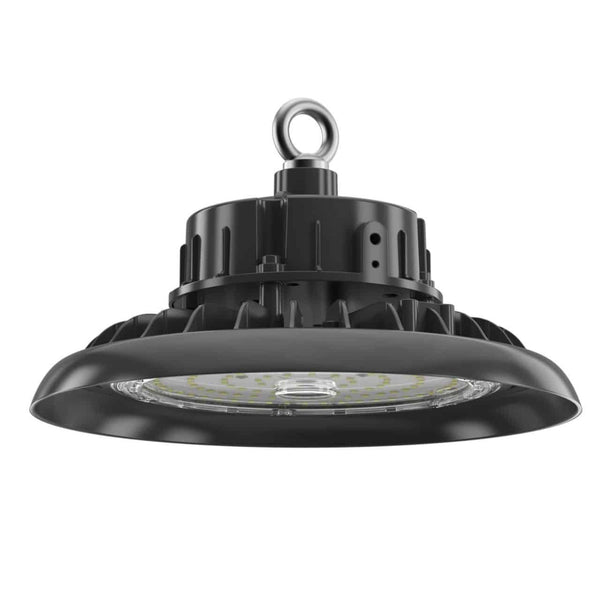
LED high bays for warehouses from 6 to 12 metres in height – with up to 5 years' warranty and 1-10V dimmable driver included:
Control technology: how to save an additional 30–50 %
Warehouses rarely have uniform occupancy. Aisles that are not currently in use do not need to be illuminated at full power. Presence-controlled systems (PIR sensors) dim luminaires in unoccupied zones to a standby level of typically 20 % – and switch to 100 % within seconds when someone approaches.
PIR control
Passive infrared sensors are the simplest and most cost-effective solution. They are suitable for standard warehouses with clearly defined aisles. Many LED high bays with a 0-10V or 1-10V interface can be combined directly with standard PIR controllers.
DALI control
DALI (Digital Addressable Lighting Interface) enables individual control of every single luminaire via a digital bus system. For large logistics centres with varying shift patterns, daylight compensation and central building automation, DALI is the professional choice. More on dimming protocols can be found in our guide 0-10V, 1-10V & TRIAC dimming.
Daylight compensation
Warehouses often have little or no natural daylight. Where rooflights or linear light strips are present, a daylight-dependent dimmer is worthwhile: it automatically reduces artificial lighting when natural light is sufficient – and increases it when it is overcast or at dusk.
Linear LED lights above the racking aisles improve vertical illuminance and make it easier to read labels and location numbers.
ROI calculation: when does the retrofit pay for itself?
Payback period depends on three factors: energy savings, maintenance savings and capital investment. The following example shows a typical calculation for a medium-sized warehouse.
Starting position: 40 sodium vapour luminaires at 400W each, 16 hours per day, 250 operating days per year, electricity price €0.22/kWh.
Previous energy costs: 40 × 0.4 kW × 16 h × 250 days × €0.22/kWh = €14,080/year
After LED retrofit: 40 LED high bays at 150W: 40 × 0.15 kW × 16 h × 250 × €0.22 = €5,280/year
Energy saving: €8,800/year (approx. 63 % compared with 400W sodium vapour). Added to this is the maintenance saving from the elimination of lamp replacements (sodium vapour lamps: approx. 16,000–24,000 h rated life vs. 50,000+ h for LED). The actual payback period depends on the capital investment and should be calculated on a project-specific basis.
The BAFA subsidy for LED interior lighting in commercial buildings was abolished without replacement on 21 July 2026. Projects already approved are unaffected. There is currently no direct federal funding programme for a straightforward LED retrofit without additional building refurbishment.
Nevertheless, the investment is worthwhile: energy savings alone justify the retrofit in most cases within two to four years – without any subsidy. Also check regional funding programmes and KfW energy efficiency loans, which may still be available depending on the federal state and overall project scope.
Safety notice: electrical installation by qualified personnel only
All connection and installation work on 230V and 400V systems must be carried out exclusively by approved electrical engineers. DIN VDE 0100, DGUV Regulation 3 and the five safety rules apply. This guide does not replace professional light planning or electrical installation by qualified personnel.
For warehouses with potentially explosive areas (e.g. paint stores, chemical stores), the ATEX Directive 2014/34/EU and the Industrial Safety Regulation (BetrSichV) must additionally be observed. Suitable luminaires can be found in our category Explosion-proof LED luminaires (ATEX).
LED tri-proof lights for low-level storage areas and cold stores
For warehouses up to 6 metres in height, cold stores and loading bays – IP65 tri-proof lights with Tridonic or Osram driver and up to 5 years' warranty:
Frequently asked questions about warehouse lighting
How much lux does a warehouse need?
According to DIN EN 12464-1, the maintained illuminance value for general storage areas is 100 lux. 200 lux applies to order picking, and 300 lux to packing and despatch. At permanent workstations, ASR A3.4 requires a minimum of 500 lux. In practice, at least 200 lux is recommended for racking areas, as labels and location numbers are otherwise difficult to read.
Which luminaire type is suitable for which ceiling height?
Up to 6 metres, LED tri-proof lights and linear light systems are appropriate. From 6 metres upwards, LED high bays are used. From 10 metres upwards, high-output high bays of 200–240W with a narrow beam angle (60°) are required to achieve adequate illuminance on the floor and on the rack faces.
Which beam angle is correct for high-bay racking?
For high-bay racking from 8 metres upwards, a beam angle of 60° is recommended in order to direct the luminous flux precisely into the aisle. For standard storage between 6 and 8 metres, 90° is universally suitable. Low-level areas up to 6 metres benefit from 120° to achieve uniform area illumination.
Which IP rating is recommended for warehouses?
For dry standard storage areas, IP44 is generally sufficient. In dusty environments, cold stores or at loading bays with spray water ingress, IP65 is the recommended minimum rating. For cold stores with high-pressure cleaning or ammonia environments, IP69K is recommended. Details on protection classes in accordance with IEC 60529 can be found in our guide on IP protection ratings.
Is presence control worthwhile in a warehouse?
Yes, significantly so in most cases. In warehouses with variable occupancy and long operating hours, PIR or DALI control reduces energy consumption by 30–50 % compared with unregulated continuous lighting. The additional cost of the control technology typically pays back within one to two years.
Is there still government funding for LED retrofits?
The BAFA subsidy for LED interior lighting in commercial buildings was abolished on 21 July 2026. There is currently no direct federal funding programme for a straightforward LED retrofit without additional refurbishment measures. Also check regional funding programmes and KfW energy efficiency loans, which may still be applicable depending on the project scope.
What are L and B values, and why are they important for tenders?
L values (e.g. L80) indicate to what percentage of its original luminous flux a luminaire has depreciated after a defined number of operating hours. B values (e.g. B10) describe the proportion of luminaires in a batch that fall below this value. For B2B tenders and maintenance contracts, these parameters are indispensable for making lifetime claims comparable.
How do I calculate the number of luminaires required?
Use the following formula: Number = (Area in m² × Target lux) ÷ (Luminous flux per luminaire in lm × Maintenance factor). Use 0.70 as the maintenance factor for clean environments and 0.55 for dusty ones. For a standards-compliant light planning scheme with uniformity verification, we recommend a free DIALux light planning service from our team.
Are you planning a warehouse or logistics centre and need a standards-compliant light planning scheme?
Clightstore will prepare a free DIALux light planning scheme for you, including lux verification, UGR calculation and luminaire recommendations – tailored to your ceiling height, zone structure and operating hours. EU-wide delivery in 2–5 working days, up to 5 years' warranty, prices 2–4× below branded equivalents.
I cookie necessari garantiscono il corretto funzionamento del negozio. Con il suo consenso utilizziamo i cookie anche per statistiche e annunci pertinenti. Può modificare la sua scelta in qualsiasi momento. Informativa sulla privacy
Ordina come azienda?
I prezzi includono l'IVA. Le aziende UE con partita IVA valida pagano il 0% di IVA (inversione contabile). Le aziende belghe pagano il 21% e lo recuperano.
Al momento del pagamento, inserisca il nome della sua azienda nel campo “Ragione sociale”.
Il campo “Partita IVA” apparirà subito sotto: inserisca la sua partita IVA (es. IT12345678901).
L'IVA viene dedotta automaticamente e la fattura riporta la dicitura di inversione contabile.