LED High Bay Lighting: Guide for Industry & Commerce
Everything on LED high bay lighting: standard values, luminaire selection, cost calculator and segment comparison for industry, warehouses, workshops and sports halls.
The right LED high bay lighting reduces energy costs compared to conventional HQL/HID systems by typically 50–70%, meets the requirements of EN 12464-1 and pays for itself in under four years in typical industrial projects, often much faster in shift operation. This guide shows you which luminaire types, illuminance values and light planning parameters are decisive for your facility – from the small workshop to the production hall spanning several thousand square metres.
- Planning basis: EN 12464-1:2021 defines minimum illuminance values (Em), UGR limits and minimum Ra values for each work area – from 20 lux on traffic routes without pedestrians to 1,000 lux in precision assembly.
- Luminaire type by ceiling height: up to 5 m, LED linear lights or tri-proof lights; from 5 m, UFO high bays or linear high bays.
- Efficiency: modern LED high bays achieve 150–210 lm/W – compared to 60–80 lm/W for HQL/HID luminaires.
- Protection ratings: IP65 and IK08 are the industrial standard for dusty, damp or mechanically stressed environments.
- Payback: typical projects pay back in 3–4 years, faster with shift work – even without funding, as German BAFA funding for interior lighting ended on 21 July 2026.
Why LED in the hall? Economic efficiency at a glance
Conventional hall lighting using mercury vapour (HQL) or sodium vapour lamps consumes two to three times more electricity than modern LED systems. Add to this long warm-up times, frequent lamp replacements and high maintenance costs due to difficult mounting heights. Which LED wattage replaces which old lamp is shown in Replacing HQL, HQI and Sodium Lamps with LED.
LED high bays start instantly, are widely dimmable and achieve service lives of 50,000 to 100,000 operating hours. At 16 hours of operation per day, 50,000 hours equates to over 8 years without a lamp change.
The Ecodesign Regulation (EU) 2019/2020 (in force since September 2021) also tightens minimum requirements for luminous efficacy and service life – a further reason to replace outdated systems now.

Normative basis: EN 12464-1 and more
EN 12464-1:2021 is the central standard for lighting at indoor workplaces. It specifies maintained illuminance values (Em), maximum glare values (UGR) and colour rendering indices (Ra) for all typical work areas. In Germany, the workplace rule ASR A3.4 is aligned with it. For areas at risk of explosion, ATEX directives apply – see ATEX & Ex-Proof LED Lighting.
Standard values by work area (selection)
| Area | Em (Lux) | UGR max. | Ra min. |
|---|---|---|---|
| Traffic routes without pedestrians | 20 | 28 | 40 |
| Traffic routes with pedestrians | 150 | 25 | 60 |
| Loading bays | 150 | 25 | 60 |
| High-bay racking face | 200 | 25 | 60 |
| Packing / order picking | 300 | 25 | 80 |
| General production | 300–500 | 22 | 80 |
| Precision assembly / quality control | 500–1,000 | 19 | 90 |
| Sports halls (EN 12193, Class III) | 200 | 22 | 65 |
UGR and glare-free working are explained in UGR Value Explained. General lux reference values for all areas can be found under How Much Lux Do You Need?
Segment matrix: which luminaire for which hall?
| Segment | Ceiling height | Recommended luminaire type | Protection rating | Lux target |
|---|---|---|---|---|
| Small workshop / automotive | 3–5 m | LED linear light, tri-proof light | IP65 | 300–500 lux |
| Warehouse (low-bay racking) | 4–7 m | UFO high bay 100–150W | IP65 | 200–300 lux |
| Warehouse (high-bay racking) | 8–14 m | Linear high bay 200–240W | IP65, IK08 | 200–300 lux (racking face) |
| Production hall | 6–12 m | UFO or linear high bay 150–240W | IP65, IK08 | 300–500 lux |
| Precision assembly / quality | 4–8 m | High bay UGR<19, Ra ≥ 90 | IP54–IP65 | 500–1,000 lux |
| Sports hall | 7–14 m | Linear high bay, UGR<22 | IP65, IK10 | 200–750 lux (EN 12193) |
| Outdoor area / yard | Mast 6–12 m | LED floodlight 150–400W | IP66 | 20–100 lux |
Dedicated guides per hall type: Warehouse Lighting, Production and Food Industry, Workshop Lighting and Sports Hall Lighting.
High bay vs. linear light: the key differences
UFO high bays are round individual luminaires with symmetrical or asymmetrical light distribution, suited to individual mounting on steel beams from 5 m. The beam angle (typically 60°, 90° or 120°) determines the light cone on the floor.
Linear high bays produce more uniform area illumination and are ideal for racking aisles, assembly lines and areas where glare from directed light must be avoided. They can be linked into continuous lines of light.
LED tri-proof lights are the economical choice for workshops, garages and ancillary rooms up to 5 m. Our LED Tri-Proof Lights are available from IP65 and designed for continuous operation.
Planning parameters: how to calculate the number of luminaires
Number of luminaires = (Em × area) ÷ (luminous flux per luminaire × maintenance factor × room utilisation factor)
Typical maintenance factors are 0.70–0.80 depending on dust and cleaning interval. The room utilisation factor (depending on reflectances of ceiling, walls and floor) has a significant influence – light surfaces can noticeably reduce the number of luminaires.
Calculation example: warehouse 1,000 m²
Target: 300 lux, ceiling height 8 m, maintenance factor 0.75, luminous flux 30,000 lm per luminaire (200W LED high bay, 150 lm/W).
Number = (300 × 1,000) ÷ (30,000 × 0.75) = approx. 13–14 luminaires (with a utilisation factor close to 1; in practice more like 15–18). For a compliant plan with uniformity verification we offer a free DIALux simulation.
Ceiling height and beam angle
Below 6 m, a 120° beam angle gives broad area illumination. From 8 m mounting height, 60°–90° is more appropriate. Where overhead cranes or moving plant are present, position luminaires so crane operators are not dazzled and luminaires are mechanically protected (IK08 or higher).
Protection ratings and ambient conditions
Dust, moisture, oil mist and mechanical impact quickly damage unsuitable luminaires. See IP Ratings Explained and IK Protection Rating Explained. For explosive atmospheres (e.g. spray booths, chemical stores), only ATEX explosion-proof LED luminaires are permitted.
- Dry production hall: IP54, IK07
- Dusty manufacturing hall / woodworking: IP65, IK08
- Food production / laundry: IP66–IP69K
- Outdoor yard / loading bay: IP66, IK08
- Sports hall (ball-impact resistance): IP65, IK10
Product recommendations
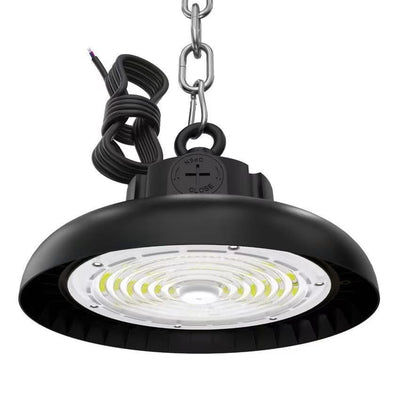
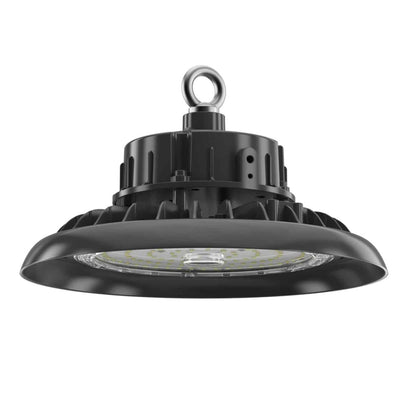
For ceiling heights of 5 to 10 m: efficient UFO high bays with up to 210 lm/W, IP65 and a 5-year guarantee – from our LED High Bays range.
TCO calculation: what does LED high bay lighting really cost?
What matters is the Total Cost of Ownership (TCO) over 10 years – investment, energy and maintenance combined. We calculate with the old luminaire's system wattage including ballast (400W HQL ≈ 430W).
Example 1: warehouse 2,000 m²
- 60 LED high bays 200W (replacing 400W HQL, approx. 430W system)
- Operation: 16 h/day, 250 days/year = 4,000 h/year
- Power saved: 60 × (430W − 200W) = 13.8 kW
- Energy saving: 13.8 kW × 4,000 h = 55,200 kWh/year; at €0.22/kWh approx. €12,140/year
- Investment including installation: approx. €45,000
- Payback: approx. 3.7 years (excluding maintenance savings)
Example 2: production hall 5,000 m², 3-shift operation
- 160 LED high bays 240W (replacing 400W HQL, approx. 430W system)
- Operation: 24 h/day, 330 days/year = 7,920 h/year
- Power saved: 160 × (430W − 240W) = 30.4 kW
- Energy saving: 30.4 kW × 7,920 h = approx. 240,770 kWh/year; at €0.22/kWh approx. €52,970/year
- Investment including installation: approx. €160,000
- Payback: approx. 3 years (excluding maintenance savings)
Add the maintenance savings: lamp replacements at 10 m height with a cherry picker cost €150–300 per luminaire. With 60 luminaires and a 2-year cycle, that is €4,500–9,000 per cycle – eliminated with LED. Full methodology: LED Payback Period Calculator.
Funding 2026
In Germany, BAFA funding for energy-efficient interior lighting in non-residential buildings ended on 21 July 2026; there is currently no direct federal programme for a pure LED retrofit in commercial halls. Local authorities and non-profit sports clubs can still receive 50–65% via the Municipal Directive for sports facilities. Companies should check regional programmes, investment deductions, leasing or contracting. Overview: BAFA LED Funding 2026.

Controls and dimming
Dimmable LED high bays reduce consumption during breaks or with daylight by a further 20–40%. Common interfaces are 0-10V, 1-10V, DALI and TRIAC; see 0-10V, 1-10V & TRIAC Dimming and DALI and Lighting Control. Presence detectors and daylight sensors pay back particularly quickly in warehouses with irregular traffic.
Outdoor areas: yards, loading bays and facades
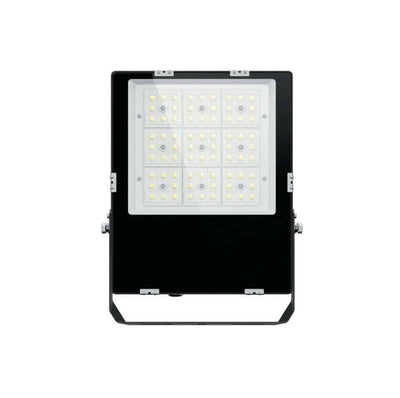
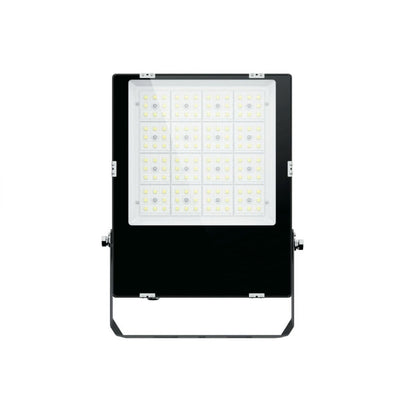
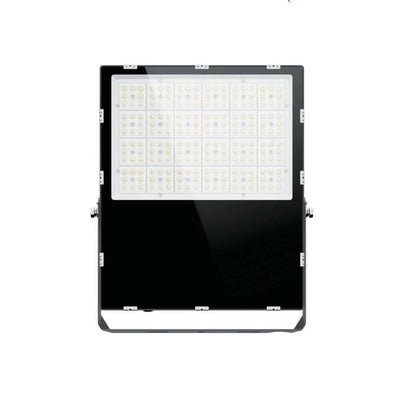
Yards, loading bays and outdoor storage need robust LED floodlights with at least IP66. Lux values and floodlight selection are covered in Outdoor Lighting for Business Premises.
For yards, loading bays and facades: high-performance LED floodlights with IP66, up to 180 lm/W and a 5-year guarantee.

Safety notes on installation
All connection and installation work on 230V/400V systems must be carried out by qualified electricians, following the five safety rules (isolate, secure against re-energisation, verify absence of voltage, earth and short-circuit, cover adjacent live parts). Work at height requires fall protection. Notes on connecting LED luminaires for qualified personnel: Connecting an LED Light Fitting.
Frequently asked questions
How many high bays do I need for my floor area?
It depends on target lux, ceiling height, beam angle and surface reflectances. Approximation: Number = (Em × area) ÷ (luminous flux × maintenance factor × room utilisation factor). For a compliant plan we recommend a free DIALux simulation by our team.
Can I simply replace old HQL or HID luminaires with LED?
In most cases yes, but a direct lamp retrofit is not always possible; many fittings need a ballast bypass or full replacement. Have the existing installation checked by a qualified electrician. More in Replacing HQL, HQI and Sodium Lamps.
What minimum luminous efficacy should modern LED high bays achieve?
At least 130 lm/W, preferably 150 lm/W or more. Our high bays achieve 150–210 lm/W depending on the model. More in Lumens vs. Lumens per Watt.
Are LED high bays dimmable?
Yes, if the driver has a dimming interface (0-10V, 1-10V or DALI). Check driver and control compatibility in the data sheet before purchasing.
Do LED high bays work in dusty or misty production halls?
Yes, with the right protection rating: IP65 minimum for dusty environments, IP66 or higher with oil mist or aggressive vapours, plus corrosion-resistant housings.
Which colour temperature is recommended for industrial halls?
4000K for general production and warehouses; 5000K with Ra ≥ 90 for quality control and precision assembly. See LED Colour Temperature.
Is there funding for LED retrofitting in commerce and industry?
German BAFA funding for interior lighting ended on 21 July 2026. For commercial halls there is currently no direct federal programme for a pure LED retrofit; check regional programmes, investment deductions, leasing or contracting. Local authorities and sports clubs can use the Municipal Directive. In most cases the retrofit pays off without funding.
How long do LED high bays last, and what does L80B10 mean?
High-quality LED high bays achieve 50,000–100,000 operating hours. L80B10 means that after the stated hours at least 90% of luminaires still deliver 80% of their original luminous flux. See LED Lifetime Explained.
Our team prepares a free DIALux light plan including illuminance verification, luminaire selection and economic calculation – tailored to your project. As a B2B direct importer we deliver throughout the EU within 2–5 working days at prices 2–4× below branded products, with up to 5 years' guarantee.
Request free light planning