Port and Container Terminal Lighting: Lux Levels, High Masts and LED
Lux levels per port zone, high masts vs poles, corrosion-proof luminaire specs, keeping light off the water, and what converting sodium high masts to LED saves.
Ports, quays and container terminals work around the clock, often in rain, wind and salt spray. Their lighting has to cover very large areas from tall masts, stay readable for crane and straddle-carrier drivers, survive a corrosive marine climate and must not confuse ships on the water. This guide covers lux levels per port zone, high-mast layouts, the luminaire specifications that matter at the coast, and the savings of switching from sodium high masts to LED.
- EN 12464-2 (outdoor workplaces) is the basis: roughly 10–20 lux for traffic and pedestrian areas, 20–30 lux for container stacks and storage, 30–50 lux for loading and handling, and more at quay cranes and inspection points.
- Large terminals are lit from high masts of 25–40 m with clusters of narrow-beam floodlights; quays and smaller ports from 10–20 m poles.
- Corrosion is the main enemy: marine-grade aluminium, stainless fixings, a coating for salt-spray environments and IP66/IP67.
- Light must stay on land: no glare towards the water, no light that could be confused with navigation lights, and controlled spill towards nearby housing.
- Replacing 1,000W sodium floodlights with 400–600W LED typically halves energy use; instant restart and dimming add further savings.
Lux levels per port zone
EN 12464-2 (lighting of outdoor workplaces) gives requirements for ports and docks. The values below summarise the typical ranges; the applicable class depends on traffic intensity and the activity, and the terminal operator's own safety rules may set higher levels.
| Zone | Em (lux, typical) | Uniformity U₀ (min.) | Notes |
|---|---|---|---|
| Pedestrian walkways, waiting quays | 10–20 | 0.25 | Safe walking routes, separate from vehicle traffic where possible |
| Terminal roads and vehicle traffic | 20 | 0.25–0.40 | Trucks, straddle carriers, reach stackers |
| Container stacks and storage yards | 20–30 | 0.25–0.40 | Readable container numbers; vertical light between stacks |
| Loading and unloading, cargo handling | 30–50 | 0.40 | Quay apron, under quay cranes, bulk handling |
| Lashing, inspection, reefer areas | 50–100 | 0.40 | Detail work on containers and connections |
| Passenger and ferry terminals (outdoor) | 50 | 0.40 | Higher colour rendering for public areas |
Container numbers and markings must be readable from vehicles and cranes, so vertical illuminance between the stacks matters as much as the horizontal value. For general outdoor areas see Outdoor lighting for business premises.

High masts or poles?
| Layout | Height | Typical use | Pros and cons |
|---|---|---|---|
| High mast with luminaire ring | 25–40 m | Container yards, large storage and parking areas | Few obstacles in the yard and wide coverage; needs narrow optics and a lowering system or platform for maintenance |
| Poles with floodlights | 12–20 m | Quays, smaller terminals, inland ports, roads | Easier maintenance; more poles in the operating area |
| Building- or crane-mounted | Varies | Warehouses on the quay, crane aprons, gates | Uses existing structures; check vibration and access |
On high masts, narrow (10–30°) and asymmetric optics put the light far out on the yard while keeping glare low for drivers. Mixing beam angles on one mast – narrow for the far area, wider for the area around the mast – gives the best uniformity. The same principle is used for stadium masts; see Light distribution on sports fields.
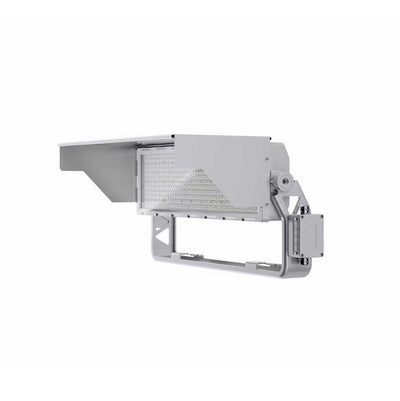
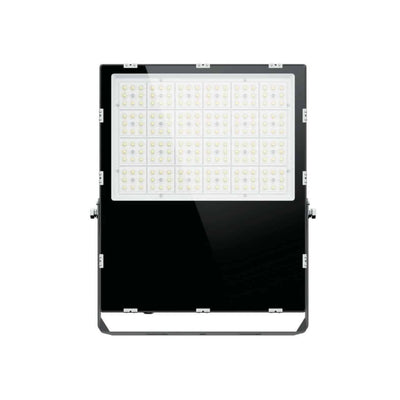
High-output LED floodlights for high masts and large yards – narrow beams, IP66, Philips or MOSO driver, 5-year warranty:


Luminaire specifications for the coast
| Requirement | Recommendation | Why |
|---|---|---|
| Corrosion protection | Marine-grade aluminium, powder coating suited to salt-spray environments, stainless steel (A4) fixings | Salt spray destroys standard housings and brackets within a few years |
| Ingress protection | IP66, IP67 in exposed spots | Driving rain, spray and high-pressure cleaning |
| Impact resistance | IK08 or higher | Vibration, wind-borne debris, contact with equipment |
| Vibration and wind | Robust brackets with locking, low wind area | Masts and cranes move; high wind loads at the coast |
| Surge protection | 10 kV or more, extra protection on masts | Lightning and switching surges on long cable runs |
| Efficacy | ≥ 150 lm/W | Very long operating hours (often 4,000+ h/year) |
| Colour temperature | 4000K, 5000K for inspection areas | Good visibility and colour recognition; check local limits near housing |
Areas where fuels, chemicals or dusty bulk goods (grain, coal) are handled may be classified as explosive atmospheres. Those zones need ATEX-certified luminaires; see ATEX LED lighting and our ATEX luminaires. More on ingress and impact ratings in IP ratings and IK ratings.
Keep the light on land
Port lighting has a constraint that most outdoor sites do not: the water. Badly aimed floodlights can dazzle ship crews and pilots, and coloured or flashing lights near the water can be confused with navigation lights. In practice:
- Aim floodlights away from the waterway and fairway; use asymmetric optics mounted flat along the quay edge.
- Use white light only; avoid coloured or flashing lighting that could be mistaken for navigation marks.
- Agree the lighting design with the port authority or harbour master, especially near fairways and locks.
- Limit spill towards residential areas, which are often close to urban ports; see Light pollution and outdoor lighting.

From sodium to LED: savings and control
Many ports still use 1,000W high-pressure sodium floodlights on their masts. Example for one high mast with 12 floodlights, 4,200 operating hours a year, €0.22/kWh:
- Sodium: 12 × 1,000W (about 1,080W with ballast) = 13 kW → about 54,400 kWh → about €12,000 a year.
- LED: 12 × 500W = 6 kW → about 25,200 kWh → about €5,500 a year.
- With dimming to 50% in quiet hours and in blocks that are not in use: often below €4,000 a year.
Per mast that is €6,000–8,000 saved every year. LED also restarts instantly after a power dip, where sodium lamps need several minutes, and maintenance at 30 m height drops sharply because there are no lamps to replace. The payback method is in Calculating LED payback period; which LED replaces which lamp is in Replacing HQL, HQI and sodium lamps.
With DALI or another control system, yard blocks can be dimmed when no equipment is working there and brought to full level automatically when a crane or vehicle enters. See DALI and lighting control.
Installation and maintenance
- Check the mast's structural capacity and wind load (Eurocode EN 1991-1-4) when replacing luminaires; LED floodlights have a different weight and wind area.
- Use a lowering system or a work platform with fall protection for maintenance at height.
- All electrical work on 230V/400V must be carried out by a qualified electrician in line with HD 60364 and the national rules (see Connecting an LED light fitting).
- Inspect coatings, fixings and seals annually in salt-spray environments.
Frequently asked questions
How many lux does a container terminal need?
Typically 20–30 lux for container stacks and storage, about 20 lux for terminal roads, 30–50 lux for loading and handling, and 50–100 lux for lashing and inspection areas, following EN 12464-2 and the operator's own rules.
How high are port lighting masts?
High masts in container yards are usually 25–40 m; quays and smaller ports use poles of 12–20 m.
Which luminaires withstand salt air?
Luminaires with marine-grade aluminium housings, a coating designed for salt-spray environments, stainless steel fixings and IP66 or IP67 sealing.
Can port lighting disturb shipping?
Yes, if floodlights shine towards the water or if coloured or flashing lights resemble navigation lights. Aim luminaires away from the fairway, use white light and agree the design with the port authority.
How much can LED save compared with sodium high masts?
Typically about half the energy at the same lighting level, more with dimming. A high mast with 12 × 1,000W sodium floodlights can save €6,000–8,000 a year when converted to LED.
Do I need ATEX luminaires in a port?
Only in areas classified as explosive atmospheres, for example at fuel and chemical terminals or where dusty bulk goods are handled. The zone classification of the site determines this.
Can existing high masts be reused for LED?
Usually yes, after checking the mast's capacity, the wind load of the new floodlights and the condition of the lowering system. The LED layout must be planned photometrically from scratch.
Send us the site plan with mast positions. We prepare a free DIALux light plan with lux levels per zone, uniformity and glare, and propose floodlights and beam angles per mast. EU-wide delivery in 2–5 working days, up to 5 years' warranty.
Request a free light plan