Light Pollution and Outdoor LED Lighting: Limits and Planning
Sky glow, light trespass and glare explained, with CIE 150 environmental zones, national rules and six practical steps to plan outdoor LED lighting that gets permits approved.
Outdoor lighting on business premises, car parks, sports fields and streets is increasingly regulated – not only for how much light falls on the ground, but also for how much ends up where it is not wanted: in the sky, in neighbours' windows and in nature. This guide explains what counts as light pollution, which limits apply in practice, and how to plan outdoor LED lighting that gets permits approved and keeps neighbours on side, without losing safety.
- Light pollution has three forms: sky glow (light emitted upwards), light trespass (light on neighbouring windows and gardens) and glare (bright luminaires in view).
- Most limits follow CIE 150 environmental zones E0–E4: the darker the area, the stricter the limits on upward light, light on windows and luminaire intensity, especially after a curfew time.
- Several countries have their own rules; France, for example, limits colour temperature to 3000K and requires business lighting to switch off at night.
- The biggest gains come from the luminaire and its aiming: flat-mounted, fully shielded optics with no upward light, asymmetric floodlights and shields towards homes.
- Warmer light (3000K or lower), dimming and switch-off after closing time cut both nuisance and energy costs.
Three forms of light pollution
| Form | What it is | Typical cause |
|---|---|---|
| Sky glow | Light emitted or reflected upwards, brightening the night sky | Luminaires that emit light above the horizontal, floodlights tilted too steeply, over-lit surfaces |
| Light trespass | Light falling where it is not needed: windows, gardens, nature areas | Floodlights aimed towards the boundary, symmetric optics on the edge of a site |
| Glare | Very bright luminaires in the field of view of neighbours, drivers or players | High tilt angles, unshielded floodlights, luminaires mounted too low |
All three waste energy: light that ends up in the sky or in a neighbour's bedroom is light you pay for and do not use.

Environmental zones and limits
The international reference is CIE 150 (guide on the limitation of the effects of obtrusive light from outdoor lighting installations). It divides areas into environmental zones and recommends maximum values, with stricter limits after a curfew (often 23:00). Many permits, municipal rules and the outdoor-workplace standard EN 12464-2 refer to these zones.
| Zone | Type of area | Light on windows before / after curfew (lux) | Upward light ratio ULR (max.) |
|---|---|---|---|
| E0 | Protected dark areas (dark-sky parks, observatories) | 0 / 0 | 0% |
| E1 | Intrinsically dark areas (national parks, open countryside) | 2 / 0 | 0% |
| E2 | Low district brightness (rural villages, outskirts) | 5 / 1 | 5% |
| E3 | Medium district brightness (suburbs, small towns, industrial estates) | 10 / 2 | 15% |
| E4 | High district brightness (city centres, busy commercial areas) | 25 / 5 | 25% |
CIE 150 also limits the luminous intensity of each luminaire in the direction of neighbouring windows and the brightness of illuminated facades and signs. The values above are a guide; always check the rules in your permit or municipal regulations, which may be stricter.
National rules: examples
- France: a national order (2018) limits colour temperature to 3000K for most outdoor lighting, restricts upward light and requires lighting of business premises, car parks and shop windows to be switched off at night, within set times after closing.
- Italy: most regions have their own light pollution laws, typically requiring fully shielded luminaires with practically no light above the horizontal.
- Netherlands and Belgium: guidelines for obtrusive light (based on CIE 150) are used in permits and municipal policy, especially for sports fields and business parks.
- Other countries and many municipalities set conditions per permit, often for sports lighting, logistics sites and advertising.
How to plan outdoor lighting with little light pollution
1. Light only what needs light
Start with the task: which areas need which level? EN 12464-2 gives values for outdoor workplaces (for example 20 lux for traffic areas, 50–150 lux for loading and handling), EN 12193 for sports and EN 13201 for roads. Over-lighting is the most common and most expensive source of light pollution. Values per area are listed in Outdoor lighting for business premises and Car park lighting.
2. Choose fully shielded optics
- Street and area lights with a flat lens, mounted horizontally, emit no light above the horizontal.
- Floodlights with asymmetric optics can be mounted flat (tilt 0–15°) and still reach far, instead of being tilted up.
- Avoid symmetric floodlights tilted at 30–45°: a large part of the light goes beyond the target area and into the sky.
3. Aim away from homes and add shields
On the boundary of a site, aim floodlights inwards, towards the yard or field. Shields, visors or louvres on the side facing homes reduce both trespass and glare. Mount high enough to allow flat aiming; mounting too low forces steep angles.
4. Use warmer light where it matters
Light with less blue content scatters less in the atmosphere and disturbs insects, bats and birds less. 3000K is the common choice near homes and nature, and increasingly required; 2700K or amber in sensitive areas. In the middle of an industrial estate, 4000K remains common. More in LED colour temperature.
5. Dim and switch off
- Timers and twilight switches with a fixed switch-off after closing time.
- Motion sensors on car parks and yards: low base level, full light when someone arrives.
- Dimming profiles in street and area lights (for example 50% after midnight).
These measures often save 40–70% energy on outdoor lighting on top of the LED saving itself.
6. Calculate it before you build
A light plan in DIALux can show not only the lux on the ground but also the vertical illuminance on neighbouring windows, the upward light ratio and the luminous intensity towards homes. Most permit applications for sports fields and larger sites ask for exactly that.
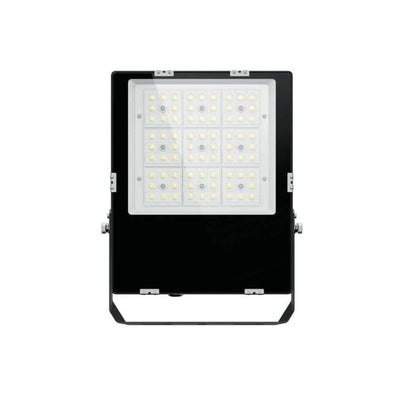
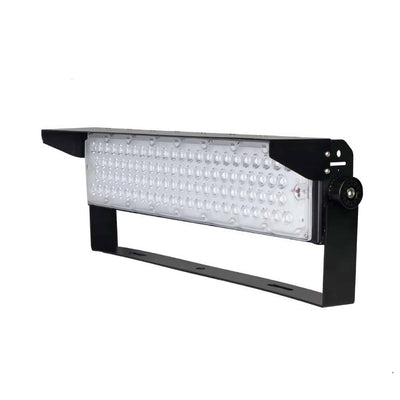
Outdoor LED luminaires with controlled light distribution – IP66, high efficacy, 5-year warranty:

Special cases
Sports fields
Sports lighting is the most common cause of complaints because of the high lux levels and tall masts. Asymmetric floodlights mounted flat on sufficiently high masts, shields on the side of homes and fixed switch-off times usually solve it. See Light distribution on sports fields and Outdoor basketball court lighting.
Facades and advertising
Uplighting of facades sends much of the light past the building into the sky. Light facades from above where possible, aim narrowly and switch off at night. Illuminated signs and screens should be dimmed after dark; many municipalities set luminance limits.
Streets and private roads
Modern LED street lights with flat optics and dimming profiles are among the best solutions against sky glow. See LED street lighting. Our LED street lights are mounted horizontally and emit no light upwards.
Frequently asked questions
What is light pollution?
Artificial light that ends up where it is not needed or wanted: in the night sky (sky glow), on neighbouring properties (light trespass) or in people's eyes (glare).
Are there legal limits for outdoor lighting?
Many countries, regions and municipalities set limits, often based on CIE 150 environmental zones. France and most Italian regions have national or regional laws; elsewhere limits are usually set in permits and municipal rules. Check the local rules before planning.
How much light may fall on a neighbour's window?
CIE 150 recommends maximum vertical illuminance on windows from 2 lux (dark rural areas) to 25 lux (city centres) before the curfew, and 0–5 lux after it. Local rules may differ.
Does LED cause more light pollution than old lamps?
Not by nature. LED luminaires direct light much more precisely than old lamps, so they can reduce light pollution considerably. Problems arise with over-lighting, poor aiming and very cool colour temperatures.
Which colour temperature is best against light pollution?
3000K or warmer near homes and nature; 2700K or amber in sensitive areas. Warmer light scatters less and affects wildlife less.
How do I prevent complaints about my car park or yard lighting?
Use flat-mounted luminaires with no upward light, aim floodlights inwards, add shields towards homes, use 3000K near housing, and dim or switch off outside working hours.
Can you calculate light trespass before installation?
Yes. A DIALux light plan can calculate the illuminance on neighbouring windows, the upward light ratio and the luminous intensity towards homes, which is what permit authorities usually ask for.
We prepare a free DIALux light plan with lux on the ground, light on neighbouring windows and upward light ratio, and propose luminaires and aiming that meet local limits. EU-wide delivery in 2–5 working days, up to 5 years' warranty.
Request a free light plan