Riding Arena Lighting: Lux Levels, Poles and LED for Riding Halls
How to light outdoor arenas and indoor riding halls: lux for training and competition, poles and floodlights per arena size, dust protection and horse-friendly light.
Whether an outdoor arena or an indoor riding hall: horses are sensitive to harsh shadows and sudden changes in light, and riders must clearly see the surface, obstacles and the horse's movement. This guide shows the usual illuminance for training and competition, how many poles an arena needs and which luminaires work well in a dusty riding hall.
- Outdoor arena: training approx. 100 lux, club competitions approx. 200 lux, major events 500 lux and more.
- Indoor riding hall: training approx. 200 lux, competitions approx. 300–500 lux.
- Uniformity matters more than brightness for horses: harsh shadows and pools of light can spook them.
- Poles along the long sides, not behind fences or in the line of approach.
- Dust and moisture: luminaires with IP65 and a closed housing.
Illuminance for equestrian facilities
| Use | Outdoor arena | Indoor riding hall |
|---|---|---|
| Leisure, training, exercising | approx. 100 lux | approx. 200 lux |
| Club competition, lessons | approx. 200 lux | approx. 300 lux |
| Regional and national competitions | approx. 500 lux | approx. 500 lux |
The values are based on the EN 12193 classes for equestrian sport. How uniformity on sports surfaces is planned is explained in Light Distribution on Sports Fields.

Outdoor arena: poles and floodlights
| Arena size | Poles | Pole height | Floodlights (training, approx. 100 lux) |
|---|---|---|---|
| 20 × 40 m (small dressage arena) | 4–6 | 8 m | 6–8 × 200–250W |
| 20 × 60 m (large dressage arena) | 6 | 8–10 m | 8–10 × 250W |
| 40 × 60 m (jumping arena) | 6–8 | 10 m | 10–12 × 250–500W |
Poles stand along the long sides so the light doesn't dazzle in the direction of approach. Asymmetric floodlights with a horizontal housing put the light on the ground and keep spill away from neighbours and paddocks. The numbers are a guide; exact planning is done with a lighting calculation.
Luminaires for arenas and riding halls
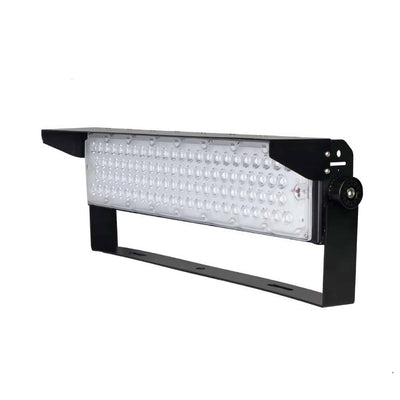
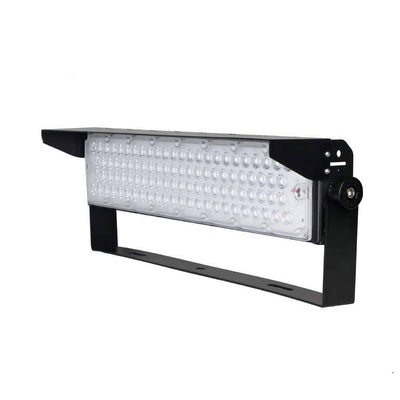
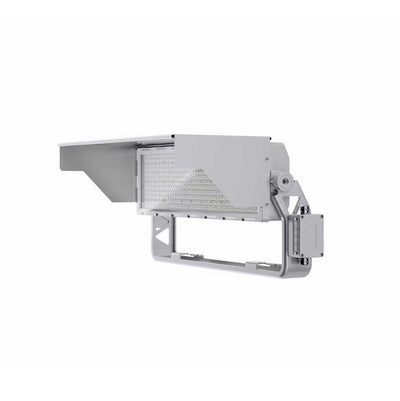

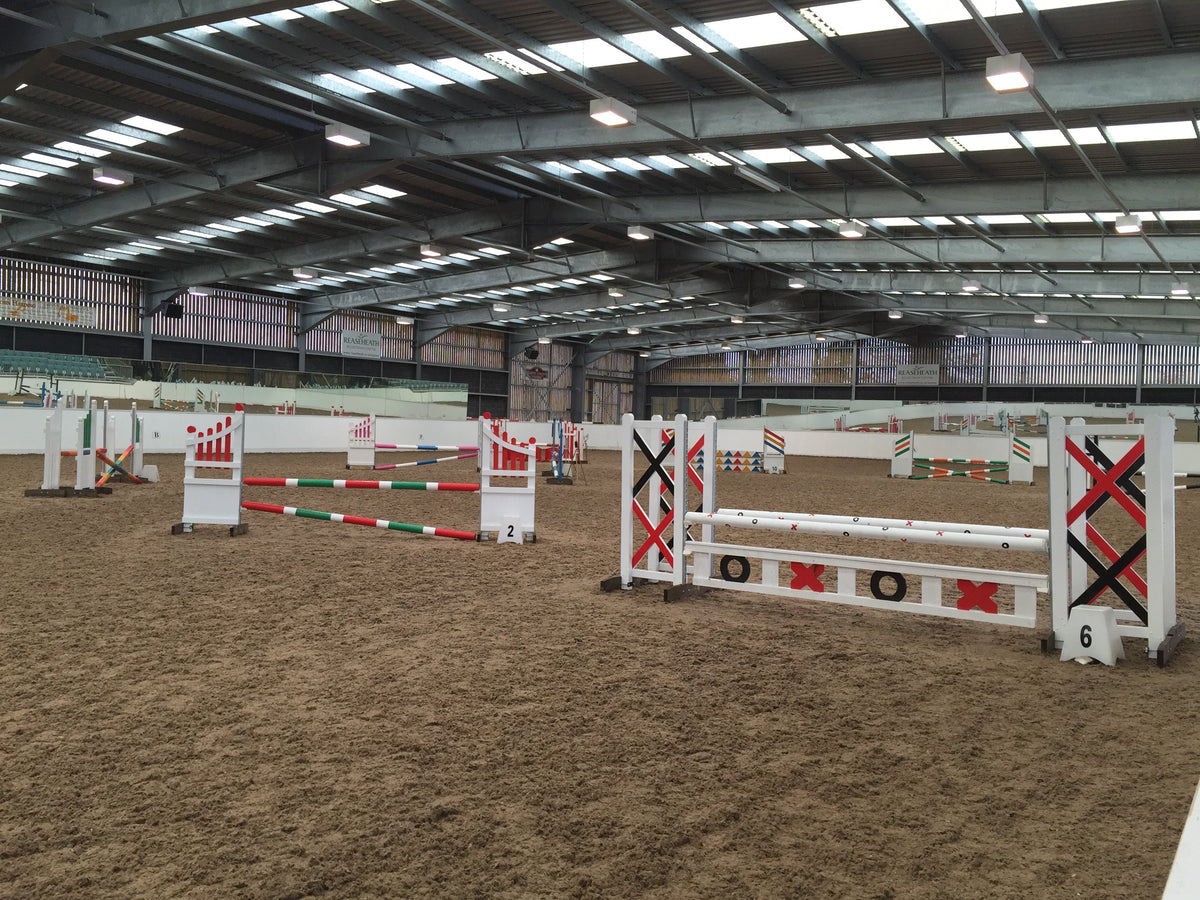
Riding hall: dust, height and even light
- Linear luminaires in rows: More even than single UFO high bays, fewer harsh shadows on the track.
- Dust protection: Arena surfaces create a lot of dust. Closed IP65 luminaires stay clean and cool.
- Colour temperature: 4000K to 5000K for good visibility; very cold light feels uninviting in timber halls.
- Soft start: Dimmable drivers avoid a sudden flash that can startle horses.
- Roof lights and windows: Use daylight and dim the LEDs with a daylight sensor.
Basics on luminaire count and spacing in halls can be found in LED High Bay Lighting.
Worked example: 20 × 60 m arena
Old installation with 8 metal halide floodlights of 1,000W (approx. 1,080W), 600 floodlight hours a year, €0.30/kWh. Replaced by 8 LED floodlights of 250W: saving 8 × 830W × 600 h = 3,984 kWh, around €1,200 a year, plus instant start without warm-up. More in Replacing HQL, HQI and Sodium Lamps with LED.
Frequently asked questions
How many lux does a riding arena need?
Around 100 lux for training and leisure, around 200 lux for club competitions and 500 lux or more for major events.
How many light poles does an arena need?
A 20 × 40 m arena usually needs 4–6 poles, a 20 × 60 m arena about 6, and larger jumping arenas 6–8 poles.
How tall should the poles be?
Usually 8–10 m. Lower poles create longer shadows and more glare.
Which luminaires suit an indoor riding hall?
Dust-protected linear hall luminaires or IP65 high bays in rows, dimmable for a soft start.
Does LED light disturb horses?
Not if the light is planned evenly, flicker-free and glare-free. Horses react mainly to harsh shadows and sudden changes in brightness.
Send us the arena size, pole positions or hall height. We prepare a free DIALux calculation and a no-obligation quote at direct-import prices 2–4× below comparable branded products. 5-year warranty.
Request a lighting planCover photo: Jonathan Hutchins, Wikimedia Commons, licence CC BY-SA 2.0.