ASR A3.4 Explained: Workplace Lighting Requirements for Halls, Warehouses and Workshops in Germany
What ASR A3.4 requires from employers in Germany: minimum lux per activity, glare, colour rendering, flicker, daylight, maintenance and how to plan and prove an LED retrofit.
Anyone operating a hall, warehouse or workshop in Germany has to design the lighting not by feel but according to the Technical Rule for Workplaces ASR A3.4. It defines how much light must reach each workplace as a minimum, how much glare is acceptable, when daylight is required and how the installation has to be maintained. This guide summarises the requirements for commerce and industry in practical terms and shows how to plan and document an LED retrofit that complies with ASR A3.4.
- ASR A3.4 "Lighting and visual connection" (May 2023 edition) specifies the German Workplace Ordinance. Anyone who complies with it is deemed to meet the legal requirements.
- The lux values in the annex are maintained minimum values that must still be reached after years of use, not values for a new installation.
- Typical values: traffic routes 50 lx, warehouses with order picking 200 lx, assembly and workshops 200 to 750 lx depending on the task, offices 500 lx.
- Besides lux, glare (UGR), colour rendering (usually Ra ≥ 80), uniformity and, since 2023, explicitly flicker count as well.
- The employer must assess the lighting in the risk assessment, maintain it and measure it where necessary. A DIALux calculation is the simplest proof.
What is ASR A3.4 and who does it apply to?
The German Workplace Ordinance (ArbStättV) only states in Annex 3.4 that workplaces must be "adequately" lit. What adequate means is set out in ASR A3.4, published by the Committee for Workplaces at the Federal Institute for Occupational Safety and Health (BAuA). The current edition dates from May 2023 and replaces the 2011 edition. It applies to every employer with employees, so to the warehouse as much as to the office next door.
Legally, the presumption of conformity matters: anyone who follows the ASR can assume they comply with the ordinance. Deviating is allowed, but the same level of safety must be demonstrated in another way. In practice, the trade supervisory authority and the employers' liability insurance association check against exactly these values during inspections or after accidents.
ASR A3.4 is often confused with DIN EN 12464-1. The DIN is a planning standard and in many areas more demanding; the ASR is the legally binding lower limit. Anyone planning to DIN generally meets the ASR as well. You can find the values of both documents per area in How Much Lux Do You Need?
Minimum illuminance for halls, warehouses and workshops
Annex 1 of ASR A3.4 lists minimum values per activity. The table below shows an excerpt of the values most often needed in commerce and industry. The complete annex of the current edition is always decisive.
| Area or activity | Minimum | UGR max. | Note |
|---|---|---|---|
| Traffic routes in buildings for people | 50 lx | 28 | Measured 0.2 m above the floor |
| Traffic routes with vehicles (forklifts, pallet trucks) | 100 lx | 28 | Crossings and transitions brighter |
| Storage rooms, uniform large-item goods | 50 lx | 25 | Storing and retrieving only, no search task |
| Storage rooms with search tasks, racking aisles | 100 lx | 25 | Consider vertical illuminance on the rack face |
| Order picking, packing, dispatch | 200–300 lx | 25 | Labels and scanners readable |
| Assembly and workshop, rough work | 200 lx | 25 | E.g. steel construction, welding |
| Assembly and workshop, medium-fine work | 300 lx | 25 | E.g. vehicle service, woodworking |
| Assembly and workshop, fine work | 500 lx | 22 | E.g. electrical work, precision mechanics |
| Very fine work, inspection, colour checking | 750–1,000 lx | 19 | Usually with a task light |
| Office, writing, reading, screen work | 500 lx | 19 | See the office lighting guide |
| Break rooms, sanitary rooms, changing rooms | 100–200 lx | 25 |
All values are maintained values: they must still be reached at the end of the maintenance interval, when luminaires are dirty and LEDs have lost output. That is why new installations are planned with a reserve, in halls usually with a maintenance factor of 0.7 to 0.8. How to turn that into a number of luminaires is explained in Warehouse Lighting Calculation.

More than lux: the other requirements
Glare
For each area the ASR gives a maximum UGR value. In halls and warehouses 25 to 28 is permitted, at workbenches 22, at screens 19. Forklift drivers who look up into the luminaires while manoeuvring are particularly critical. High bays with a narrow beam angle or linear luminaires with a diffuser have the advantage here. What the value means is explained in UGR Value Explained.
Colour rendering
In rooms with permanent workstations the ASR generally requires a colour rendering index Ra of at least 80. Lower values are only permitted where colours do not matter, for example in pure storage areas without workstations. For colour inspection and painting, Ra 90 makes sense (see CRI and Colour Rendering).
Uniformity
Illuminance must not vary strongly within the task area, and the surrounding area may only be one step darker than the task area. A brightly lit workstation in a dark hall is therefore not compliant, even if the lux value on the bench is correct.
Flicker and pulsation
Since the 2023 edition the ASR explicitly requires that lighting does not flicker disturbingly and does not create stroboscopic effects at rotating machinery. Cheap LED drivers with high ripple fail here. Look for flicker-free drivers on the datasheet (see LED Drivers Explained).
Light colour
The ASR does not prescribe a Kelvin value but requires a light colour that suits the task. In halls and workshops 4000K has proven itself, for colour inspection 5000K to 6500K.
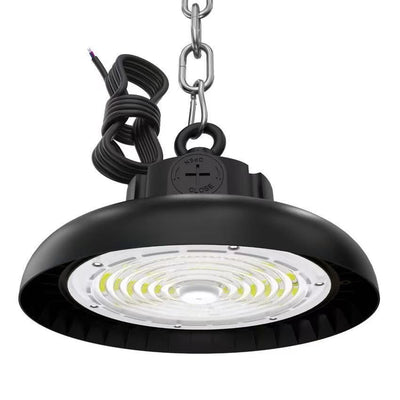
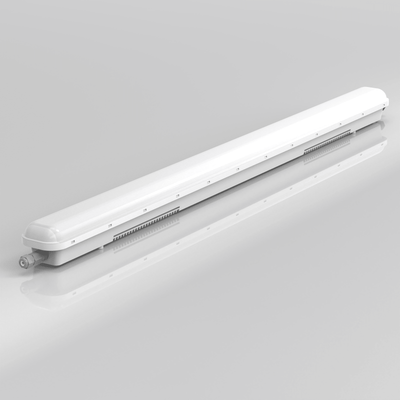
ASR-suitable luminaires with flicker-free driver and Ra ≥ 80


Daylight and visual connection
Under ASR A3.4, work rooms should receive sufficient daylight wherever possible and have a visual connection to the outside. The guide value is a daylight factor of at least 2 percent at the workstation or window areas of around one tenth of the floor area. Exceptions apply to rooms where this is not possible for operational reasons, such as cold stores, underground car parks or storage areas without permanent workstations. Artificial lighting replaces missing daylight but does not remove the requirement as such. For new buildings, the combination of roof lights and daylight-dimmed LED lighting therefore pays off (see DALI and Lighting Control).
Outdoor areas on company premises
The ASR also gives minimum values for traffic routes, loading zones and outdoor workplaces, from 5 lx for pure footpaths through roughly 20 to 50 lx for loading areas to 100 lx and more for outdoor workplaces, plus the requirement that drivers are not dazzled. Suitable values and luminaires are in Outdoor Lighting for Business Premises.
Emergency lighting
If the general lighting fails, employees must be able to end dangerous activities safely and leave the building. The requirements for this safety lighting are in ASR A3.4/7 (formerly ASR A3.4/3) and ASR A2.3: 1 lx on escape routes, at least 10 percent of normal lighting at workplaces with particular hazards. Everything else is in Emergency Lighting: Requirements, Regulations and Testing.
Employer duties: risk assessment, maintenance, measurement
The ASR requires not only correct planning but also correct operation:
- Risk assessment: Lighting is part of the risk assessment under the Occupational Safety Act. Document the visual task, the required value and how it is achieved for each area.
- Maintenance: A maintenance plan sets out when luminaires are cleaned and defective ones replaced. With LED there is no lamp replacement, but cleaning in dusty halls remains.
- Indicative measurement: In case of doubt, after conversions or complaints, illuminance is measured on the working plane (usually 0.85 m above the floor) and on traffic routes 0.2 m above the floor, with a class B lux meter or better.
- Instruction: Employees should know how the lighting and its controls work and whom to report defects to.

Planning an ASR-compliant LED retrofit step by step
- Define zones: Divide the hall by activity. A storage area at 100 lx, a picking zone at 200 lx and a workbench at 500 lx are planned separately. This saves luminaires and electricity.
- Take the values from the annex: Note minimum value, UGR and Ra per zone.
- Calculate with the maintenance factor: Initial value = minimum value ÷ maintenance factor. For 200 lx at a factor of 0.75, plan with around 270 lx.
- Choose luminaires: High bays from 6 m mounting height, linear high bays or tri-proof lights below that, panels in the office. Flicker-free driver, Ra ≥ 80, suitable beam angle.
- DIALux proof: A lighting calculation with lux distribution, uniformity and UGR per zone is the proof that authorities and insurers recognise. We prepare it free of charge.
- Measure after installation: Measure once, enter the values in the risk assessment, done.
A side effect: most halls with HQL, HQI or fluorescent tubes are below the ASR values today because the installations have aged. An LED retrofit fixes that and at the same time cuts electricity consumption by 50 to 70 percent (see LED Payback Period Calculator).
Common findings during inspections
- Too little light in racking aisles: The lux value in the middle of the hall is fine, but hardly anything reaches the floor between tall racks. Linear luminaires above the aisles solve this.
- Glare for forklift drivers: UFO high bays with 120° at 5 m dazzle when looking up.
- Aged installation: Planned ten years ago, never measured, now 40 percent below the value.
- No documentation: Lighting is missing from the risk assessment.
- Emergency lighting forgotten during the retrofit: Old luminaires with an emergency module were replaced and the escape route stays dark.
Frequently asked questions
Is ASR A3.4 legally binding?
The ASR itself is a technical rule. The Workplace Ordinance is binding, and the ASR describes how to meet it. Those who comply with the ASR are on the safe side; those who deviate must demonstrate equivalent safety.
How many lux does a warehouse need under ASR A3.4?
50 lx for simply storing and retrieving uniform goods, 100 lx for search tasks and in racking aisles, 200 lx and more for order picking and packing.
How many lux does a workshop need?
200 lx for rough, 300 lx for medium-fine, 500 lx for fine and 750 to 1,000 lx for very fine work and inspection stations.
What is the difference between ASR A3.4 and DIN EN 12464-1?
The ASR is the legally binding lower limit for workplaces in Germany; DIN EN 12464-1 is a European planning standard with partly higher values. Planning to DIN generally satisfies the ASR.
Do I have to have the illuminance measured?
There is no obligation to measure at fixed intervals. The ASR provides for indicative measurements where there is doubt, for example after conversions, complaints or with aged installations. A DIALux calculation plus a single measurement after installation is the usual proof.
Does ASR A3.4 also apply to LED lighting?
Yes, it is technology-neutral. The 2023 edition even addresses LED drivers specifically with its requirements on flicker and stroboscopic effects.
What happens if the values are not met?
The trade supervisory authority or employers' liability insurance association can demand improvements and set deadlines. After an accident, inadequate lighting can become relevant for liability.
Send us your floor plan, ceiling height and use per zone. We prepare a free DIALux lighting plan with lux, uniformity and UGR proof to ASR A3.4 and a no-obligation quote at direct-import prices 2–4× below comparable branded products. 5-year warranty, delivery in 2–5 working days.
Request a free lighting plan