Cold Store Lighting: LED for Chilled and Freezer Areas
LED lighting for cold stores and freezer warehouses: lux values, temperature rating, condensation and ammonia, sensors and the double saving on light and cooling.
In a cold store, every watt counts twice: electricity for the light and electricity for the refrigeration plant that has to remove the luminaires' heat again. LED is particularly efficient here because it works even better in the cold, gives full light instantly and, with sensors, only lights up when someone is in the room. This guide shows what to look for in luminaires for chilled and frozen areas.
- Storage areas approx. 100–200 lux, picking approx. 200–300 lux, packing and inspection approx. 300–500 lux.
- Luminaires and drivers must be rated for the temperature, down to -30 °C or lower in freezer areas.
- Condensation during defrosting and at doors: IP65 is the minimum, IP66 is better.
- With ammonia refrigeration, choose ammonia-resistant luminaires.
- Every watt of light saved also saves cooling capacity. Motion sensors are therefore especially effective.
How much light does a cold store need?
| Area | Illuminance | Note |
|---|---|---|
| Storage without constant staff traffic | approx. 100 lux | With motion sensor |
| Storage with forklift traffic | approx. 150–200 lux | Even in the aisles |
| Picking, reading labels | approx. 200–300 lux | Vertical light on racking |
| Packing, quality control | approx. 300–500 lux | Good colour rendering Ra ≥ 80 |
The values are based on EN 12464-1. Aisles follow the same planning rules as in normal warehouses (see Warehouse Lighting).

What matters in cold store luminaires
- Temperature range: Check the permitted ambient temperature in the data sheet. Many standard luminaires are rated to -20 °C; freezer stores need drivers rated to -30 °C or -40 °C.
- Condensation: Moisture forms during defrosting and at doors. IP65 protects against it, IP66 also against water-jet cleaning (see IP Ratings Explained).
- Ammonia: Ammonia attacks many plastics and seals. With NH3 refrigeration, use ammonia-resistant luminaires.
- Shatter resistance: No glass covers around food (see Production and Food Industry Lighting).
- Instant start: Fluorescent lamps dim and start poorly in the cold; LED delivers full light instantly.
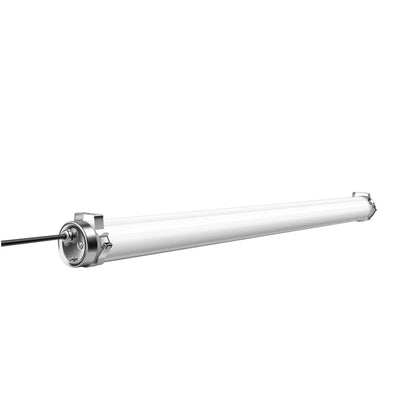
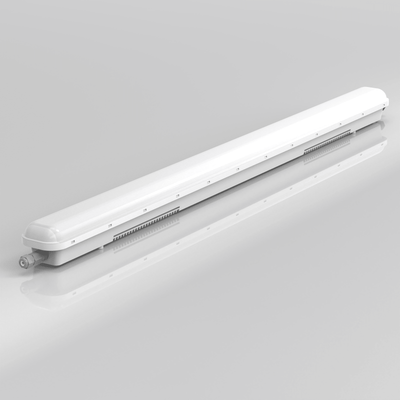
Luminaires for chilled and frozen areas

Double saving: light and cooling
Almost all of a luminaire's power ends up as heat in the room, which the refrigeration plant must remove. Depending on the plant, each watt of light needs roughly an extra 0.3 to 0.5 watts of cooling, more in freezer areas. Converting from fluorescent to LED and adding motion sensors therefore cuts two bills at once.
Worked example
Cold store with 40 fluorescent fittings 2 × 58W (approx. 140W), continuous operation 8,760 h, €0.28/kWh. Replaced by 40 LED tri-proof lights of 55W with motion sensors (averaging 40% on-time):
- Lighting before: 40 × 140W × 8,760 h = 49,056 kWh
- Lighting after: 40 × 55W × 0.4 × 8,760 h = 7,709 kWh
- Lighting saving around 41,300 kWh, around €11,600 a year, plus cooling energy saved on top
Calculate with your own values: LED Payback Period Calculator.
Frequently asked questions
Do LED luminaires work in a freezer store?
Yes, LED is even more efficient in the cold. What matters is that luminaire and driver are rated for the temperature, down to -30 °C or lower in freezer areas.
What protection rating does a cold store luminaire need?
At least IP65 because of condensation, IP66 with water-jet cleaning and IP69K in wet areas with high-pressure cleaning.
Why ammonia-resistant luminaires?
Many refrigeration plants use ammonia. Leaking NH3 attacks ordinary plastics, making them brittle and leaky.
Are motion sensors worthwhile in a cold store?
Yes, especially. Storage areas are often entered only briefly, and every watt of light saved also reduces the cooling load.
How many lux does picking in a cold store need?
Around 200–300 lux, with enough vertical light on the rack fronts so labels are readable.
Send us the room size, temperature and refrigerant. We select suitable luminaires, prepare a free DIALux lighting plan and a no-obligation quote at direct-import prices 2–4× below comparable branded products.
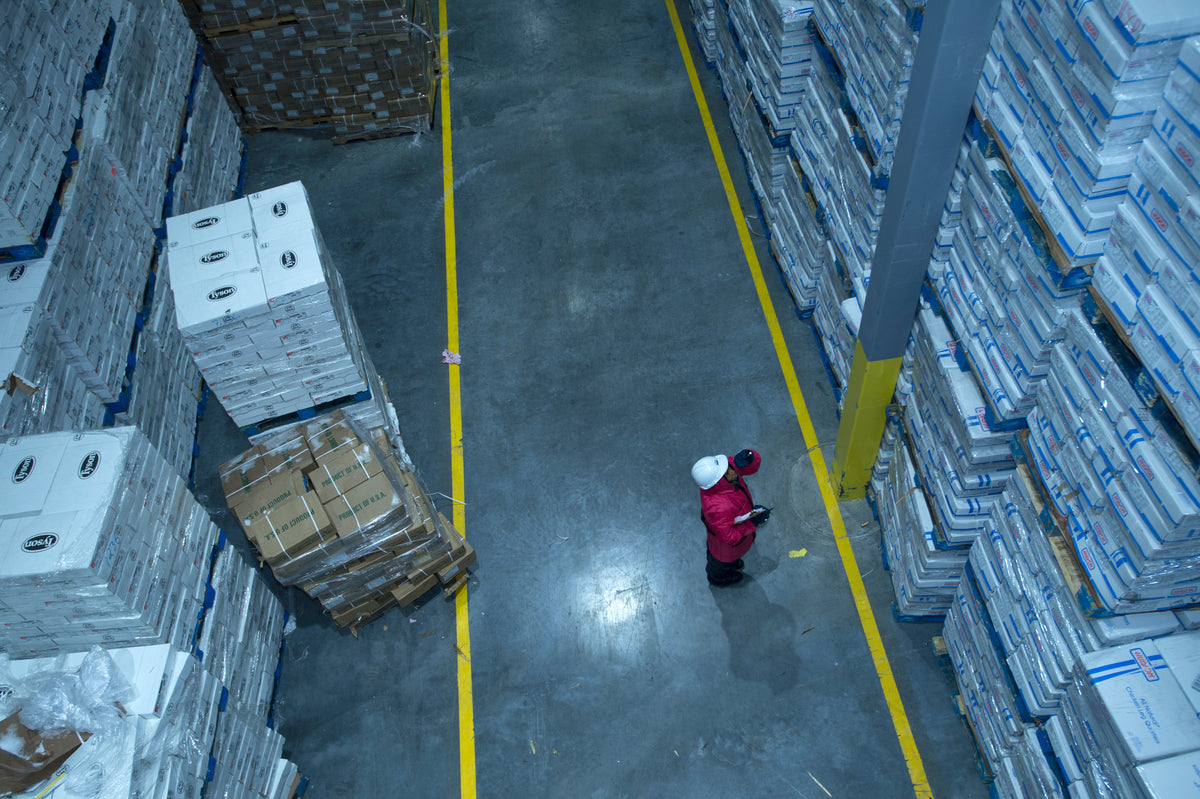
Request a quoteCover photo: U.S. Department of Agriculture, Wikimedia Commons, licence CC BY 2.0.