Tennis Court Lighting: Lux Levels, Mast Layout and LED Planning
How to light an outdoor tennis court or indoor tennis hall: EN 12193 classes, mast positions, asymmetric optics, glare, colour temperature and running costs.
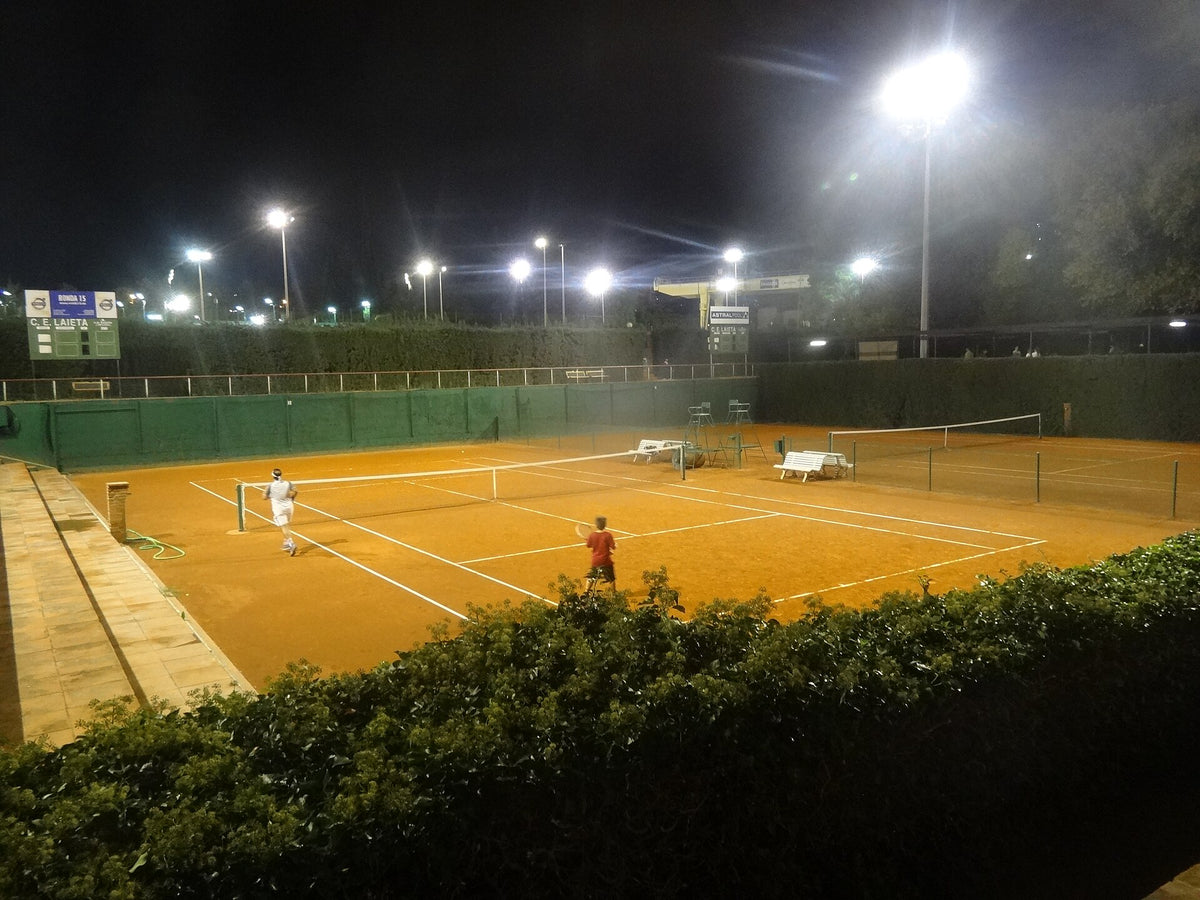
Good tennis lighting makes a court playable in the evening and in winter, without dazzling players or losing the ball in shadow. Three things decide the result: the right lighting class to EN 12193, the position of the masts, and optics that put the light on the court instead of into the neighbourhood.
- Outdoor court: Class III (recreation, schools) approx. 200 lux, Class II (training, club matches) approx. 300 lux, Class I (top competition) approx. 500 lux.
- Indoor tennis hall: Class III approx. 300 lux, Class II approx. 500 lux, Class I approx. 750 lux.
- Masts belong on the long sides, never behind the baseline, or players look straight into the light when serving.
- 4 or 6 masts per court at 8–10 m height with asymmetric floodlights are common.
- Uniformity matters more than maximum brightness: dark corners are immediately noticeable in tennis.
Lighting classes to EN 12193
EN 12193 divides sports facilities into three classes depending on the level of play. The values below are the usual guide values for tennis; what counts is the maintained value, i.e. the illuminance still achieved after years of use.
| Class | Use | Outdoor court | Indoor hall | Uniformity |
|---|---|---|---|---|
| III | Recreation, school sport, basic training | approx. 200 lux | approx. 300 lux | approx. 0.5–0.6 |
| II | Performance training, regional competition | approx. 300 lux | approx. 500 lux | approx. 0.7 |
| I | National and international competition | approx. 500 lux | approx. 750 lux | approx. 0.7 |
Most club courts manage with Class III or II. If you want to play league matches under floodlights, plan for Class II. Halls with TV coverage have additional requirements for vertical illuminance and flicker. How light distribution and uniformity on sports surfaces are planned is explained in our guide Light Distribution on Sports Fields.
Mast layout: where the light belongs
A tennis court including run-off measures around 36 × 18 m. Luminaires are mounted on the long sides and aimed obliquely onto the court. Luminaires behind the baselines are a mistake: when serving and on high balls, the player looks exactly in that direction.
| Layout | Masts per court | Typical height | Suitable for |
|---|---|---|---|
| 4 masts (2 per long side) | 4 | 8–10 m | Class III, recreational courts |
| 6 masts (3 per long side) | 6 | 8 m | Class II, more even lighting |
| Shared centre masts on adjacent courts | 3 per court | 9–10 m | Several courts side by side, saves masts |
Rule of thumb for power: for Class III, 6 floodlights of 200–250W per court are usually enough; for Class II you need either more luminaires or higher wattage. The exact number depends on mast height, optics and surroundings and is set by a lighting calculation.
Optics: asymmetric rather than round
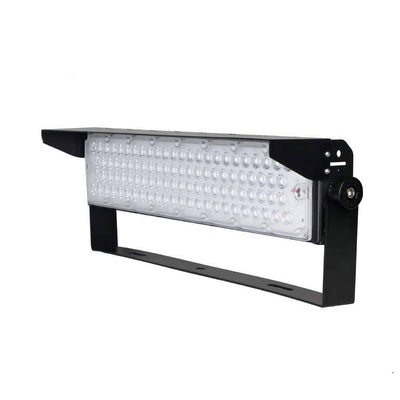
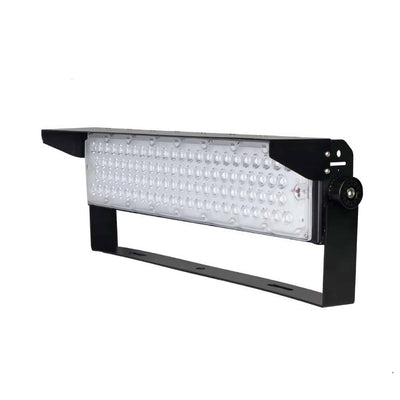
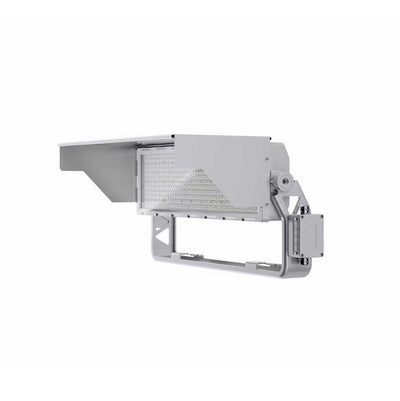
A round 60° floodlight spreads light evenly in every direction, including upwards and over the fence. Asymmetric optics direct the light flat onto the court with the housing mounted horizontally. That brings three benefits: less glare for players, less spill light for neighbours, and more light where it is needed. In residential areas this is often a condition for planning permission.
Narrow optics (20–40°) suit high masts and long throws; wider optics (60–90°) suit low masts close to the court.

LED luminaires for tennis courts

Indoor tennis halls: what matters inside
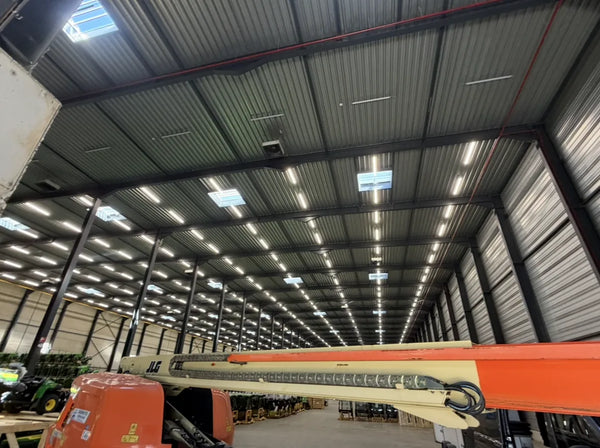
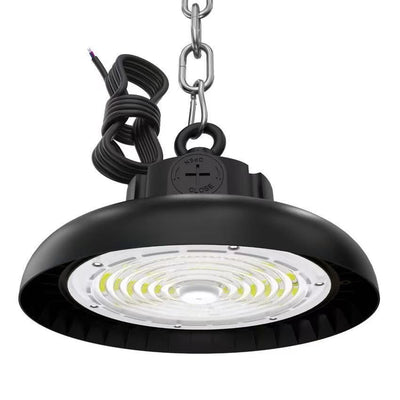
Indoors the main problem is glare when looking up. Linear luminaires in rows parallel to the court's long axis, outside the centre of the court, have proven themselves. Single round high bays directly above the net or baseline disturb the serve. In addition:
- Ball impact resistance: Luminaires must withstand ball strikes, at least IK08, better IK10 or a protective grille (see IK Protection Rating Explained).
- Light ceiling: A share of indirect light via the ceiling reduces harsh contrast between luminaire and dark background.
- Flicker-free light: With fast balls, flicker shows immediately as a stroboscopic effect. Branded drivers with low ripple are a must.
For the basics of hall planning, such as number of luminaires and spacing, see our guide LED High Bay Lighting.

Colour temperature, controls and costs
5000K (daylight white) has proven itself for tennis: the yellow ball stands out well against the surface. With dimmable drivers the same court can run at Class III for training and Class II for matches. A timer or coin or app access ensures the light only burns when people are actually playing.
A worked example: 6 luminaires of 250W instead of 6 × 1,000W metal halide save 4.5 kWh per hour. At 800 floodlight hours a year and €0.30/kWh, that is around €1,080 per court per year. Run your own numbers with our guide LED Payback Period Calculator.
Common mistakes in tennis lighting
- Luminaires behind the baseline: Dazzles on the serve. Put masts on the long sides.
- Masts too low: Below 8 m the angles get flat and glare increases.
- Round 120° floodlights: Much of the light lands outside the court and uniformity suffers.
- Looking only at lux: 300 lux with dark corners plays worse than 250 lux evenly distributed.
- Forgetting the neighbours: Spill light can cost the permit and club harmony. Plan asymmetric optics from the start.
Frequently asked questions
How many lux does a tennis court need?
For recreation and school sport (Class III) around 200 lux outdoors, for training and club matches (Class II) around 300 lux, for top competition (Class I) around 500 lux. Indoors the values are higher: roughly 300, 500 and 750 lux.
How many floodlight masts does a tennis court need?
4 masts (2 per long side) are common for recreational courts, 6 masts for more even lighting. With several courts side by side, centre masts can light two courts at once.
How high should the masts be?
Usually 8 to 10 m. Lower masts lead to flat angles and more glare; higher masts increase cost and foundation work.
Which colour temperature is best for tennis?
5000K daylight white has proven itself because the ball appears high-contrast and true to colour. 4000K is also possible; warmer colour temperatures are not recommended for sport.
Can I simply replace my old floodlights with LED?
Usually yes, if masts and supply cables are in good condition. LED floodlights are lighter than old metal halide units, so mast load is rarely an issue. Aiming and optics should be re-planned, though, so that uniformity is right.
Does this also apply to padel?
The principles are similar, but values and luminaire positions differ because of the smaller court and glass walls. Suitable luminaires can be found under Padel Court Lighting.
Send us the number of courts, the class you need and your existing masts. We prepare a free DIALux lighting calculation with number of luminaires, aiming and uniformity, plus a no-obligation quote at direct-import prices 2–4× below comparable branded products. 5-year warranty.
Request a lighting planCover photo: Jordiferrer, Wikimedia Commons, licence CC BY-SA 4.0.