Emergency Lighting: Requirements, Regulations and Testing
Emergency lighting explained: when it is mandatory, EN 1838 minimum lux for escape routes and anti-panic areas, battery systems, testing duties and LED retrofits.
If the power fails, everyone must be able to leave the building safely. That is the job of safety lighting, usually called emergency lighting. For workplaces, halls, places of assembly and retail premises it is mandatory, and it must not only be installed but also tested and documented regularly.
- The obligation comes from workplace, building and fire regulations, depending on the building and country.
- Escape routes: at least 1 lux on the centre line; open (anti-panic) areas: at least 0.5 lux (EN 1838).
- High-risk task areas: at least 10% of normal lighting or 15 lux, within 0.5 seconds.
- Duration usually 1 hour; places of assembly and retail often 3 hours.
- Testing: monthly function test, annual full-duration test, everything recorded in a log book (EN 50172).
When is emergency lighting mandatory?
Safety lighting is required wherever employees or visitors would be at risk during a power failure: in large workplaces or those without sufficient daylight, in halls with machinery, in stairwells and corridors used as escape routes, in places of assembly, schools, sports halls, shops, hotels and car parks. Exactly which areas need it follows from the operator's risk assessment and the fire safety concept.
The three types of emergency lighting
| Type | Purpose | Minimum (EN 1838) |
|---|---|---|
| Escape route lighting | Escape routes clearly visible and usable | 1 lux on the centre line, max/min uniformity no worse than 40:1 |
| Anti-panic lighting | Large areas without defined escape routes, avoid panic | 0.5 lux on the floor area |
| High-risk task area lighting | Safely shut down dangerous work (e.g. at machines) | 10% of normal lighting, at least 15 lux, within 0.5 s |
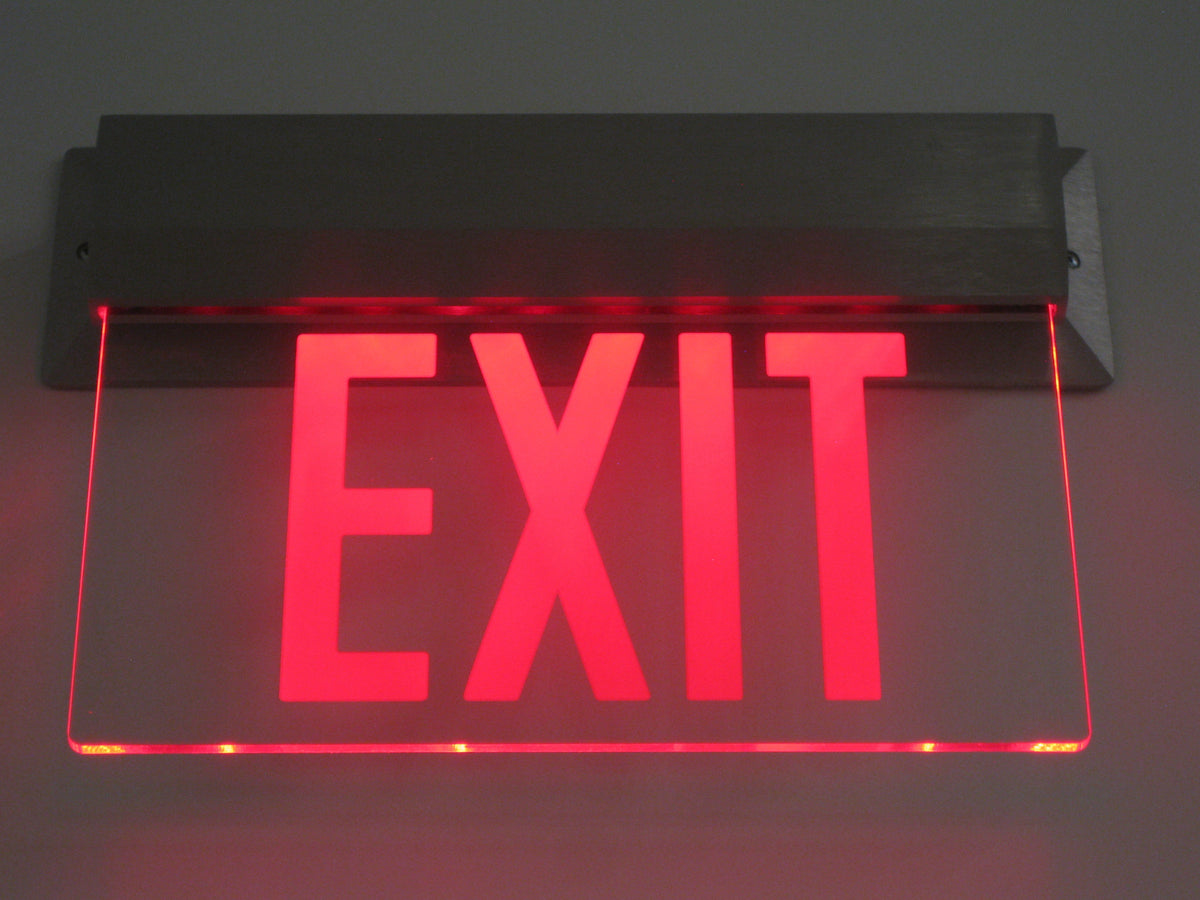
Safety signs (pictograms with escape direction) come on top. Their viewing distance depends on sign height: internally illuminated signs are recognisable at about 200 times their height, externally lit signs at about 100 times. A 20 cm high internally illuminated sign therefore covers around 40 m.

Self-contained or central battery?
| System | Principle | Suitable for |
|---|---|---|
| Self-contained luminaires | Each luminaire has its own battery | Smaller buildings, halls with few escape routes, retrofits |
| Self-testing self-contained luminaires | Luminaire tests itself and reports faults | Businesses wanting to cut testing effort |
| Central battery system | One central battery cabinet supplies all luminaires | Large buildings, places of assembly, many luminaires |
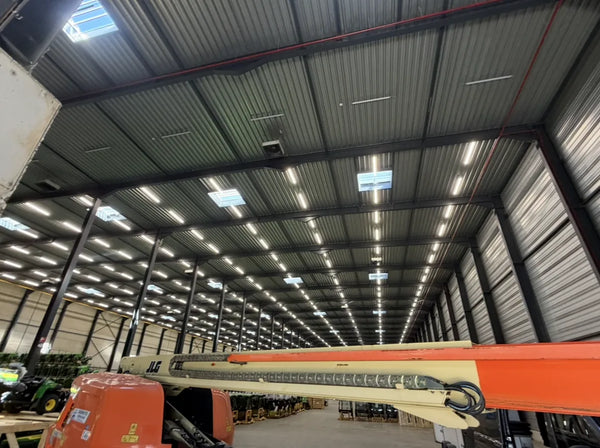
A practical solution when converting to LED: high bays or tri-proof lights with a built-in emergency module. Some of the normal luminaires take over safety lighting during a power failure, with no extra fittings on the ceiling.
Testing and documentation
- Daily: visual check of the indicator on a central battery system (if present).
- Monthly: function test of all luminaires on battery (brief mains disconnection).
- Annually: full-duration test over the rated duration (1 or 3 hours).
- Log book: record all tests, faults and repairs. Fire inspectors and insurers will ask for it.
Self-testing luminaires perform the monthly and annual tests automatically and signal faults via an LED. That saves staff hours but does not replace documentation.
Don't forget emergency lighting in an LED retrofit
Anyone converting halls or offices to LED often changes luminaires that are part of the safety lighting. Old fluorescent fittings with an emergency module must not simply be fitted with LED tubes without testing their function afterwards (see Replacing Fluorescent Tubes with LED). Include safety lighting in the lighting design from the start. How much light is needed in normal operation is covered in How Much Lux Do You Need?
Common mistakes
- Batteries never tested: After a few years they often last minutes instead of an hour.
- Signs too small: In long halls the viewing distance doesn't reach the next sign.
- Wrong escape direction: After alterations, pictograms point into dead ends.
- No log book: Without records, the installation is treated as untested.
- Emergency lighting forgotten in the LED upgrade: The new lighting is efficient, but the escape route stays dark in a power cut.
Frequently asked questions
Is emergency lighting mandatory in every hall?
Not across the board. Risk assessment, size, use and fire safety concept decide. In halls with machinery, public access or long escape routes it is practically always required.
How bright must an escape route be during a power failure?
Under EN 1838 at least 1 lux on the centre line of the escape route, and at least 0.5 lux in open areas without defined routes.
How long must emergency lighting stay on?
Usually 1 hour; in places of assembly, retail premises and many special buildings 3 hours. The fire safety concept is decisive.
How often must emergency lighting be tested?
Function test monthly, full-duration test once a year, both recorded in the log book. Self-testing luminaires automate the tests.
Can a normal LED luminaire also be emergency lighting?
Yes, with a built-in emergency module and battery. The luminaire works normally and switches to battery during a power failure.
We include escape routes and emergency lighting directly in your free DIALux lighting plan and prepare a no-obligation quote at direct-import prices 2–4× below comparable branded products.
Request a lighting plan