Replacing Fluorescent Tubes with LED: T8 Retrofit Guide (Magnetic & Electronic Ballast)
How to replace T8 fluorescent tubes with LED tubes: identifying magnetic or electronic ballasts, choosing length and wattage, the step-by-step swap, ballast bypass and when a new fitting makes more sense.
Since 24 August 2023, T5 and T8 fluorescent tubes may no longer be placed on the EU market. Existing installations may keep running, but replacement tubes are becoming scarce and expensive. The good news: in most fittings, a fluorescent tube can be swapped for an LED tube in a few minutes, cutting power consumption per light point by 50–60%. The only thing that really matters is which ballast sits inside your fitting.
- Fitting with a starter = conventional magnetic ballast: swap the tube and the starter, done. No change to the wiring.
- Fitting without a starter = electronic ballast: either an LED tube listed as compatible with your ballast, or a ballast bypass carried out by a qualified electrician.
- Wattage rule of thumb: 18W fluorescent → 9W LED (60 cm), 36W → 18W (120 cm), 58W → 24W (150 cm).
- On a magnetic ballast, a 58W tube draws around 70W including ballast losses, the LED tube around 26W. At 3,000 operating hours, that saves roughly 130 kWh per tube per year.
- If lampholders are brittle, diffusers yellowed or fittings no longer sealed, a complete LED tri-proof light is often a better investment than a tube swap.

Why retrofit now? The EU ban and what it means for you
The basis is the RoHS Directive together with Delegated Directive (EU) 2022/284. Because T5 and T8 fluorescent lamps contain mercury and LED now offers equivalent alternatives, the exemption has expired. The common T8 lengths of 60, 120 and 150 cm are affected, as is T5.
What matters in practice: only placing new tubes on the market is banned. You may keep operating existing tubes, and retailers may sell remaining stock. Anyone running halls, workshops, car parks or corridors with hundreds of tubes should still not wait until the last stock is gone. A planned replacement is cheaper than an emergency swap tube by tube, and the energy saving starts on day one.
Step 1: Magnetic or electronic ballast? How to identify yours
Whether the swap takes one minute or needs an electrician depends entirely on the ballast. Three quick checks are enough:
| Feature | Magnetic ballast (conventional) | Electronic ballast |
|---|---|---|
| Starter in the fitting | Yes, small cylinder with bayonet socket | No |
| Switch-on behaviour | Flickers for one or two seconds, then bright | Starts instantly without flicker |
| Ballast rating plate | Heavy choke, marked "magnetic", "KVG/VVG" or efficiency class B1/B2/C/D | Light electronic unit, marked "electronic ballast", "EVG" or class A2/A3 |
| Retrofit effort | Swap tube and starter | Compatible tube or ballast bypass by an electrician |
A practical tip: point your phone camera at a lit tube. If you see stripes or flicker on screen, the fitting usually runs on a magnetic ballast at 50 Hz. A steady image suggests an electronic ballast. Always confirm with the rating plate before ordering.
Step 2: Choosing the right LED tube
Length and wattage
T8 tubes have a 26 mm diameter and a G13 base. The length of the old tube determines the LED tube. Wattage is no measure of brightness; lumens and luminous efficacy are what count (more in our guide Lumen vs. Lumen per Watt).
| T8 fluorescent tube | System power with magnetic ballast (approx.) | LED tube | LED luminous flux (at 150 lm/W) |
|---|---|---|---|
| 60 cm, 18W | approx. 27W | 9W | approx. 1,080 lm (120 lm/W) |
| 90 cm, 30W | approx. 38W | 12W | approx. 1,800 lm |
| 120 cm, 36W | approx. 45W | 18W | approx. 2,700 lm |
| 150 cm, 58W | approx. 70W | 24W | approx. 3,600 lm |
To be honest about the numbers: on paper, a 58W fluorescent tube has more lumens than a 24W LED tube. But the fluorescent tube emits light all around, and much of it is lost in the reflector and housing. The LED tube emits directionally downwards. In fittings with a reflector or diffuser, the result on the working surface is therefore usually equivalent. In open battens without a reflector, where light levels are already tight today, recalculate the illuminance first or let us prepare a free lighting calculation. Reference values per room can be found under How Much Lux Do You Need?
Glass or aluminium, with or without sensor
- Glass tube: Looks like a classic fluorescent tube, high efficacy up to 150 lm/W. Standard for offices, warehouses and corridors.
- Aluminium tube: Better heat dissipation and more break-resistant. Useful in workshops and wherever tubes may be knocked.
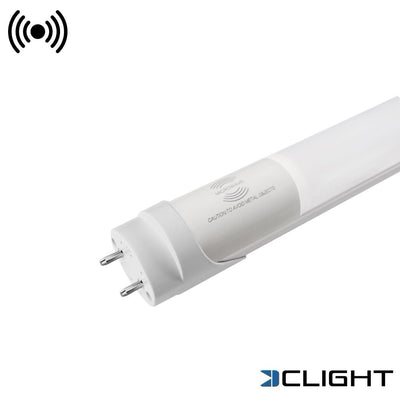
- With integrated sensor: Switches on with movement and off again after a run-on time. Ideal for car parks, stairwells, basement corridors and racking aisles with only occasional traffic.
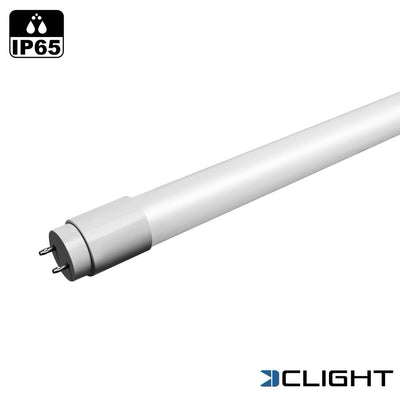
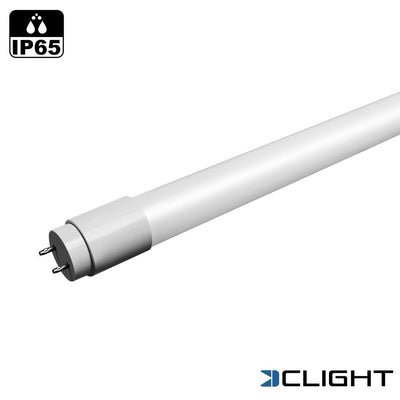
- IP65 tube: For damp areas such as garages, wash rooms or unheated halls, where an open batten is exposed to condensation. More on protection ratings in our guide IP Ratings Explained.
Colour temperature
4000K (neutral white) is the standard for offices, schools, warehouses and production. 6000K (daylight white) suits workshops, cold rooms and inspection areas that need high contrast. 3000K is best kept for reception and break areas. The effect of colour temperatures is explained in our guide LED Colour Temperature.
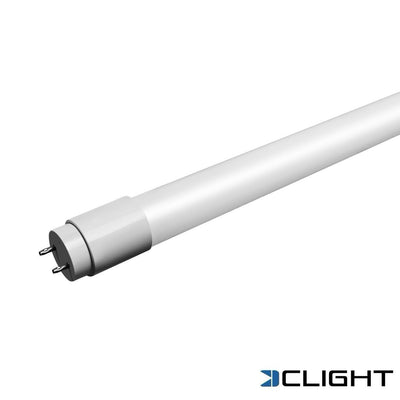
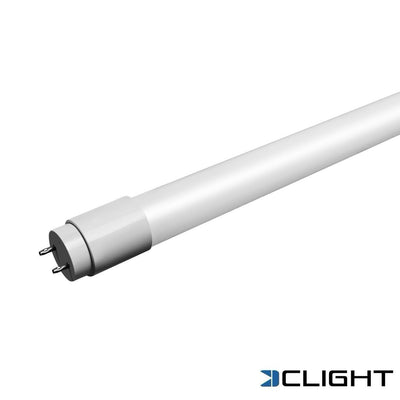
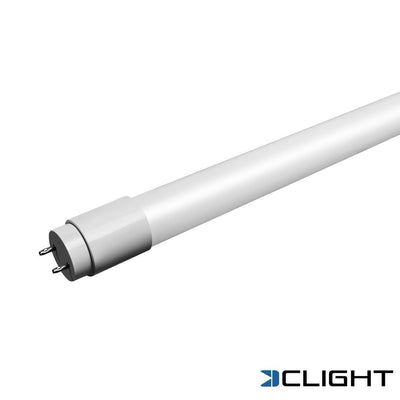
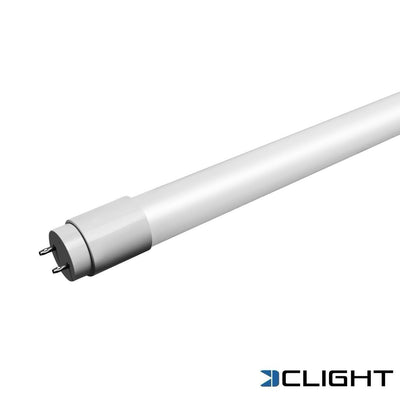
T8 LED tubes including LED starter
Step 3: Retrofitting with a magnetic ballast, step by step
In fittings with a starter, the ballast stays in the fitting and the wiring is not changed.
- Isolate the circuit: Switch off at the circuit breaker, not just at the light switch.
- Remove the fluorescent tube: Rotate the tube 90° and pull it out of the lampholders. The old tube contains mercury and belongs at a collection point, not in household waste.
- Replace the starter: Swap the old glow starter for the included LED starter. This step is mandatory: without the LED starter the tube is short-circuited and damaged.
- Fit the LED tube: Insert it into the G13 lampholders and rotate 90° until it locks. Check the beam direction: the light-emitting side faces down.
- Test: Switch the power back on. The tube starts instantly without flicker.
Check the condition of the lampholders as you go. After 20 or 30 years, lampholders are often brittle and break when rotated. Damaged lampholders must be replaced by a qualified electrician.
Retrofitting with an electronic ballast: two routes
Route A: LED tube compatible with electronic ballasts
Some LED tubes run on the existing electronic ballast. They only work with ballast types the manufacturer has approved in its compatibility list. If your ballast is not listed, you must not use this solution. The ballast also stays in the system with its own lifetime and losses.
Route B: bypass the ballast (direct connection to 230V)
Direct wiring is the cleaner long-term option: the ballast is disconnected and the tube is supplied directly with mains voltage. This is a modification of the fitting and may only be carried out by a qualified electrician in accordance with local wiring regulations. Follow the wiring diagram in the tube's data sheet (single-ended or double-ended supply) and label converted fittings permanently so nobody fits a fluorescent tube later. Whoever modifies a fitting this way takes on manufacturer responsibility for it. For larger installations, replacing them with new LED fittings is therefore often the clearer solution, both legally and economically. General connection notes can be found in our guide Connecting an LED Light Fitting.

Tube swap or new fitting?
| Situation | Recommendation |
|---|---|
| Fitting intact, magnetic ballast with starter | LED tube with LED starter: fast, low-cost, no modification |
| Fitting intact, electronic ballast on compatibility list | LED tube compatible with electronic ballasts |
| Electronic ballast, no compatible tube, few fittings | Ballast bypass by a qualified electrician |
| Brittle lampholders, yellowed diffuser, leaking tri-proof fitting | New LED tri-proof light |
| Large installation with electronic ballasts, hall above 5 m ceiling height | New fittings or LED high bays based on a lighting plan |
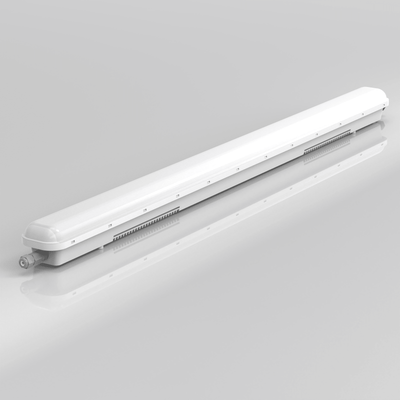
A new LED tri-proof light with integrated LEDs reaches far higher efficacy than any tube, is IP65-sealed and no longer needs starters or ballasts. In wet or dusty environments it is the longer-lasting solution.
Worked example: workshop with 50 twin fittings
50 fittings with 2 × 58W fluorescent tubes on magnetic ballasts, 3,000 operating hours per year, electricity at €0.25/kWh:
- Before: 100 tubes × approx. 70W system power = 7.0 kW
- After: 100 LED tubes × approx. 26W (24W plus residual ballast loss) = 2.6 kW
- Saving: 4.4 kW × 3,000 h = 13,200 kWh, around €3,300 per year
- Material: 100 LED tubes 150 cm with LED starter, well under €1,000 at our direct-import prices
- Payback: a few months, plus no more starter changes or flickering tubes
Run the numbers for your own site with our guide LED Payback Period Calculator.
The 5 most common mistakes when swapping tubes
- Leaving the old starter in the fitting: The LED tube is short-circuited. Always fit the included LED starter.
- Magnetic-ballast tube in an electronic-ballast fitting: It won't work, or it destroys tube and ballast. Check the ballast first, then order.
- Overlooking tandem wiring: With 2 × 18W on a shared magnetic ballast, two tubes run in series. This needs dedicated tandem solutions; if in doubt, check the wiring diagram.
- Dimmable electronic-ballast installations: Standard LED tubes are not dimmable. If you need dimming, plan new fittings with a dimmable driver instead (see 0-10V, 1-10V and TRIAC).
- Converting emergency lighting: Fittings with an emergency module are part of the safety lighting. They must not simply be swapped; the system has to be tested after any modification.
Frequently asked questions
May I still use fluorescent tubes after the ban?
Yes. Since 24 August 2023, only placing new T5 and T8 fluorescent lamps on the EU market is banned. Existing tubes may keep running and remaining stock may be sold. Replacements are, however, becoming increasingly hard to find.
Can I simply put an LED tube into my old fitting?
For fittings with a starter (magnetic ballast), yes: swap the tube and starter, no modification needed. For fittings without a starter (electronic ballast), only with a tube approved for your ballast, or after a ballast bypass by a qualified electrician.
Which LED tube replaces a 58W fluorescent tube?
A 150 cm LED tube rated at 24W. At 150 lm/W it delivers around 3,600 lumens and emits directionally downwards, so fittings with a reflector usually achieve the same brightness on the working surface at less than half the consumption.
What is the LED starter for?
The LED starter replaces the glow starter and bridges the starter socket. It acts as a link or fuse, not an ignitor. Without it, the LED tube would be short-circuited.
Does the magnetic ballast stay in the fitting and keep using power?
The ballast stays wired in, but with an LED tube it only causes small losses of a few watts because far less current flows. If you want to save that remainder too, have an electrician bypass the ballast.
Are LED tubes flicker-free?
High-quality LED tubes with a good driver operate flicker-free. For screen workstations and areas with rotating machinery, choose explicitly flicker-free versions to avoid stroboscopic effects.
Send us the quantity, lengths and photos of the rating plates of your fittings. We will tell you which LED tube fits, where a new fitting pays off more, and prepare a no-obligation quote at direct-import prices 2–4× below comparable branded products. EU-wide delivery in 2–5 working days, 5-year warranty.
Request a quote