Light Distribution on Sports Fields: Standards, Planning & LED
From DIN EN 12193 to the finished order: everything about lighting classes, light distribution, GR value and LED selection for sports fields and sports halls.
Standards-compliant sports field lighting requires more than achieving a lux value: uniformity, glare limitation, colour rendering and a light distribution suited to the sport in question are equally decisive. This guide takes you from the relevant standards through light planning to the correct LED selection – practical guidance for local authorities, clubs, electrical planners and architects.
- The core standard for sports lighting is EN 12193:2019 with three lighting classes (LC I–III) for outdoor and indoor facilities.
- In addition to illuminance (lux), uniformity (U₀), glare limitation (GR value), colour rendering (Ra) and colour temperature are regulated by the standard.
- Asymmetric light distribution and correct mast geometry are the key to uniform illumination without disruptive glare – particularly for outdoor facilities.
- Sports halls additionally require ball-impact-resistant luminaires; school sport also follows EN 12464-1.
- LED floodlights with IP66, 140–170 lm/W and DALI control typically pay back against metal halide installations within 3–5 years.
Why light distribution on sports fields is more than a lux value
Many planning projects fail not because of insufficient light, but because of incorrectly distributed light. A football pitch with an average of 300 lux can still be non-compliant if uniformity is inadequate or players are dazzled by poorly aimed luminaires. EN 12193 therefore defines a whole set of requirements that must all be met simultaneously.
For B2B buyers this means: selecting the correct LED luminaire does not begin in the product catalogue, but with a complete light plan. Only once the lighting class, mast positions, beam angles and glare limit values have been established can the appropriate luminaire be specified.

EN 12193: The three lighting classes at a glance
EN 12193 applies to the most common sports practised in Europe – for both outdoor and indoor facilities. It distinguishes three lighting classes based on the level of use.
| Lighting Class | Use | Eh,av min. (lux) | Uniformity U₀ min. | Colour Rendering Ra min. | GR Limit (Outdoor) |
|---|---|---|---|---|---|
| LC I | National / international competition | ≥ 500 | 0.7 | ≥ 65 | ≤ 50 |
| LC II | Regional match play / club sport | ≥ 200 | 0.6 | ≥ 65 | ≤ 55 |
| LC III | Training / recreational sport | ≥ 75 | 0.5 | ≥ 20 | ≤ 55 |
Significantly higher requirements apply to TV broadcasts: HDTV typically requires at least 1,400–2,000 lux; the precise specifications are determined by the relevant governing body (e.g. FIFA, UEFA). These values are well above the minimum standard requirements and must be agreed separately with the governing body concerned.
Important: the lighting class should be selected correctly from the outset. Retrofitting from LC III to LC I is technically possible, but considerably more expensive than an installation dimensioned correctly from the start.
Light distribution: asymmetric vs. symmetric – the decisive difference
Light distribution describes how a luminaire distributes its luminous flux in space. For sports facilities, choosing the correct luminous intensity distribution curve is at least as important as the wattage.
Outdoor facilities: asymmetric light distribution
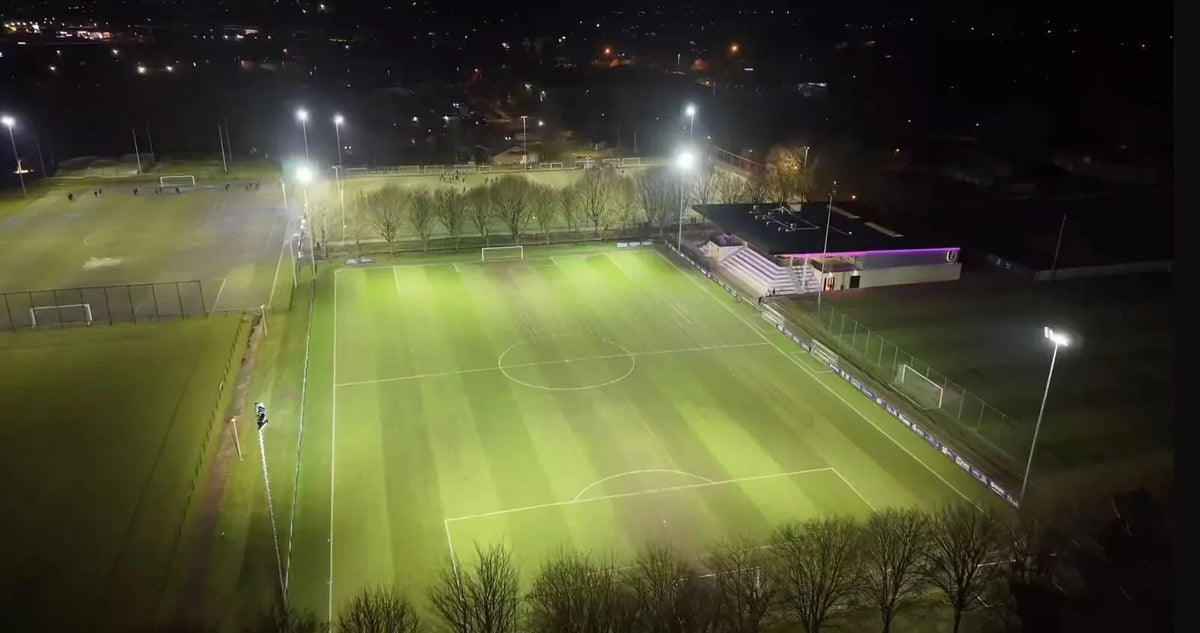
For outdoor sports facilities, well-shielded LED floodlights with asymmetric luminous intensity distribution are recommended. These direct the main luminous flux precisely onto the playing surface without illuminating players or spectators directly. The tilt angle of the luminaire on the mast is critical: luminaires mounted at too shallow an angle produce high GR values and cause glare for players and neighbouring residents.
Recommended mounting heights in accordance with EN 12193:
- Training facilities: at least 16 m
- Competition facilities LC I: 18–20 m
The mast geometry – number of masts, spacings, positions relative to the playing field – directly influences uniformity. Four-mast installations at the corners are widely used for football, but with unfavourable orientation they deliver poorer uniformity values than six- or eight-mast configurations.
Sports halls: glare protection when looking upwards
In sports halls, glare when looking up at high balls (volleyball, basketball) is the central problem. Luminaires must not be mounted directly above the playing area if this leads to disruptive direct glare. Specifically:
- Above volleyball courts: no luminaires in the ceiling zone directly above the playing surface
- Above basketball hoops: no luminaires within a radius of 4 m
Instead, luminaires are positioned to the side of the playing area or in the peripheral zones of the hall. Suitable light distributions here are high bays with narrow to medium beam angles (60°–90°) and UGR values below 22. More in our guide Sports Hall Lighting.
The GR value: glare limitation for outdoor facilities
The Glare Rating (GR) is the standardised measure of direct glare for outdoor sports facilities. The scale runs from 10 (no glare) to 90 (intolerable glare). EN 12193 sets a maximum value of GR ≤ 50 (LC I) or GR ≤ 55 (LC II/III) for most sports.
The GR value is calculated in the light plan – it depends on the luminance of the luminaires, their position, the tilt angle and the number of luminaires. An early GR check in the DIALux model prevents costly remedial work on site.
To calculate the GR value you need the complete luminaire data file (IES or LDT) from the manufacturer. When purchasing, ensure that these files are available for all luminaires offered.
Sport matrix: which luminaire for which application?
| Sport / Facility | Lighting Class | Lux min. | Luminaire Type | Mounting Height | Protection Rating |
|---|---|---|---|---|---|
| Football (training) | LC III | 75 | LED floodlight, asymmetric | ≥ 16 m | IP65/IP66 |
| Football (club sport) | LC II | 200 | LED floodlight, asymmetric | ≥ 16 m | IP65/IP66 |
| Football (national competition) | LC I | 500 | LED floodlight, asymmetric | 18–20 m | IP66 |
| Tennis (outdoor) | LC I–III | 200–500 | LED floodlight, narrow (20°–40°) | 8–10 m | IP65/IP66 |
| Sports hall (multi-purpose) | LC I–III | 200–750 | LED high bay, ball-impact resistant | 7–12 m | IP65 |
| Basketball (indoor) | LC I–II | 500–750 | LED high bay, side-mounted | 7–10 m | IP65 |
| Padel court | LC II–III | 200–300 | LED floodlight, 40°–60° | 5–7 m | IP65/IP66 |
| School sport (indoor) | EN 12464-1 | ≥ 300 | LED high bay, ball-impact resistant | 5–8 m | IP65 |
For football pitch lighting, tennis court lighting, basketball court lighting and padel court lighting, Clightstore offers sport-specific pre-configured LED luminaires in each category.
Further relevant standards for sports lighting
EN 12193 is the core standard, but not the only one. Depending on the facility and its use, additional regulations must be observed:
- Ball-impact resistance: luminaires in sports halls that may be hit by balls must be tested as ball-proof (in Germany to DIN VDE 0710-13 and DIN 18032).
- EN 12464-1: Lighting of indoor work places – applies to school sport and sports facilities in educational establishments; prescribes a minimum of 300 lux.
- EN 1838: Emergency lighting – to be observed for publicly accessible sports facilities with spectators (see Emergency Lighting).
- Light pollution rules: outdoor facilities near residential areas must limit spill light; national guidelines (e.g. the LAI guideline in Germany) and local permit conditions apply.
Note on protection rating: at least IP65 is recommended for outdoor facilities. High-quality LED floodlights for professional sport achieve IP66 (to IEC 60529) and are therefore also protected against powerful jets of water. Read more in our guide IP Ratings Explained.
LED floodlights for outdoor sports facilities
For competition and training facilities outdoors, LED floodlights with IP66, Philips or MOSO drivers and selectable beam angle are recommended. The following models cover the power range for LC I to LC III:


The full range of LED sports field lighting and the LED floodlights premium series can be found in the respective categories.

LED high bays for sports halls and multi-purpose halls
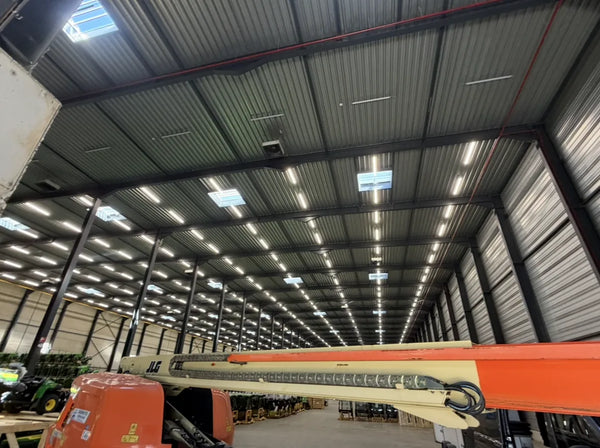
For sports halls, multi-purpose halls and school sports halls, ball-impact-resistant LED high bays with IP65, dimmable driver and UGR values below 22 are suitable. The following models are designed for mounting heights from 6 m:
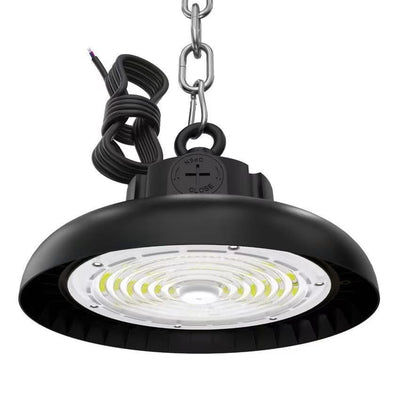
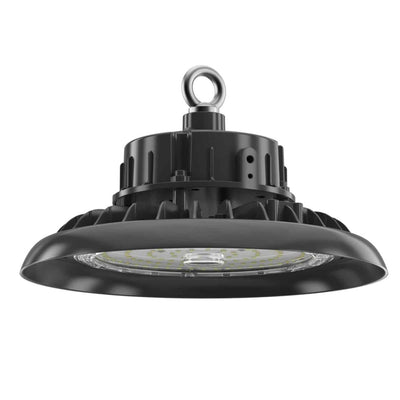
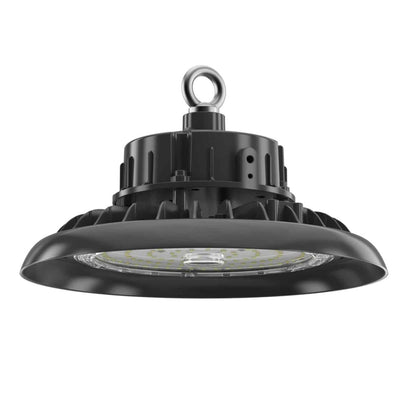
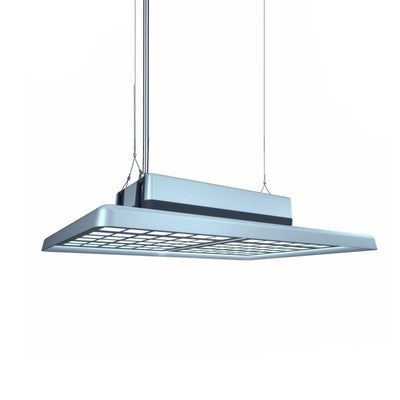
The full range can be found in the LED high bays category.
TCO comparison: LED vs. metal halide
Purchase costs are only one part of the total cost of ownership (TCO). Particularly for sports facilities that are in operation for several hours each day, energy costs and maintenance expenditure make the decisive difference.
A typical example for a football pitch LC II with four masts and four luminaires each (16 luminaires in total):
- Metal halide installation (1,000W each): 16,000W total power, approx. 1,000 operating hours/year = 16,000 kWh/year. Additionally lamp replacement every 3–4 years, control gear, start-up times of 5–10 minutes.
- LED installation (600W each, 160 lm/W): 9,600W total power at comparable light output, approx. 9,600 kWh/year. Instant start, dimmable for training operation (e.g. 50%), no lamp replacement for 50,000+ hours.
- Energy saving: approx. 40% compared with metal halide at comparable lighting quality.
- Payback: At an electricity price of €0.25/kWh and 1,000 operating hours/year, the annual saving is approx. €1,600 – the additional cost of the LED installation is typically recovered within 3–5 years.
Note: these figures are indicative. For your specific installation we will prepare an individual TCO calculation as part of the free DIALux light planning service.
On colour temperature: 5000K (daylight white) is recommended for sports facilities with TV coverage; for purely training and recreational facilities, 4000K (neutral white) is sufficient. Read more in our guide LED Colour Temperature.
Funding for sports field lighting 2026
Funding for LED sports lighting varies by country. In Germany, the key programme is now the Municipal Directive (Kommunalrichtlinie) of the National Climate Initiative (NKI): local authorities and non-profit sports clubs can receive 50% funding for converting floodlights and sports hall lighting to LED, and financially weak municipalities up to 65% (as of May 2026). BAFA funding for interior lighting under the BEG was discontinued on 21 July 2026 (see BAFA LED Funding 2026). State sports federations and KfW municipal loans can complement this. In the Netherlands and Belgium, separate national and regional schemes apply.
Important: funding applications must generally be submitted before construction begins, and conditions change regularly. Check the current status and commission the planning early, so that all documents (light plan, product data sheets, energy calculation) are available in good time.
Typical planning errors and how to avoid them
- Lighting class selected too low: If the club is later promoted, retrofitting is more expensive than an installation dimensioned correctly from the outset. Plan with the next 10–15 years in mind.
- GR value not checked: Glare problems are often only noticed after commissioning. Always have the GR value calculated in the light plan – before placing the order.
- No zone control planned: Without a dimming function, the installation runs at full power during training. DALI or 1–10V control saves considerable energy during training operation.
- Missing IES/LDT files: Without luminaire data files, no standards-compliant DIALux simulation is possible. Insist on complete photometric data when purchasing.
- Light pollution ignored: Asymmetric floodlights and shields reduce stray light considerably.
- Electrical installation by unqualified persons: All connection and installation work on 230V/400V installations must be carried out exclusively by qualified electricians, in particular on masts and outdoor facilities.
Further information on lux requirements in various settings can be found in our guide How much lux do you need?.
Frequently asked questions
What is the difference between lighting classes I, II and III under EN 12193?
LC I applies to national and international competition (≥ 500 lux, U₀ ≥ 0.7), LC II to regional match play and club sport (≥ 200 lux, U₀ ≥ 0.6) and LC III to training and recreational sport (≥ 75 lux, U₀ ≥ 0.5). The class determines not only the lux value but also requirements for uniformity, colour rendering and glare limitation.
How much lux does a football pitch need?
According to EN 12193, the minimum is 75 lux for training (LC III), 200 lux for regional match play (LC II) and 500 lux for national competition (LC I). Significantly higher requirements apply to TV broadcasts, typically between 1,400 and 2,500 lux. More in our guide How Many Lux Does a Football Pitch Need?
What is the GR value and how is it calculated?
The GR value (Glare Rating) is the standardised measure of direct glare for outdoor sports facilities, from 10 (no glare) to 90 (intolerable glare). It is calculated in light planning software (e.g. DIALux) on the basis of luminaire data, mast positions and tilt angles. EN 12193 prescribes GR ≤ 50 (LC I) or GR ≤ 55 (LC II/III) for most sports.
Which standards apply to sports hall lighting?
The core standard is EN 12193. Additionally, luminaires must be ball-impact resistant, EN 1838 applies to emergency lighting and, for school sport, EN 12464-1 with a minimum of 300 lux.
Can an existing metal halide floodlight installation be converted to LED?
Yes, in most cases. The existing masts can often be reused. It is important that the new LED floodlights are planned photometrically from scratch, as LED luminaires have different light distributions. A DIALux simulation ensures that the standard values are met after conversion. All electrical work must be carried out by a qualified electrician.
What funding is available for LED conversion of sports facilities?
In Germany, the main programme is the NKI Municipal Directive: local authorities and non-profit sports clubs receive 50% (financially weak municipalities up to 65%) for converting floodlights and sports hall lighting to LED, as of May 2026. BAFA funding for interior lighting ended on 21 July 2026. Applications must be submitted before construction begins; we support you with the technical documentation.
How do I avoid light pollution problems with neighbours?
Asymmetric LED floodlights, correct tilt angles and optional shields reduce stray light considerably. An early spill-light calculation in the light plan avoids conflicts with authorities and neighbours.
What protection rating must LED luminaires for outdoor sports facilities have?
At least IP65 (to IEC 60529); for professional facilities and exposed locations we recommend IP66.
Clightstore offers you a free DIALux light plan including GR value calculation, uniformity verification and product recommendation – tailored to your sport, lighting class and funding situation. EU-wide delivery in 2–5 working days, up to 5 years' warranty.
Request a free light plan