Hockey Pitch Lighting: Lux Levels, Mast Heights and LED Planning
How much light a hockey pitch needs for training and matches (FIH, KNHB), where to put the masts, how many LED floodlights you need and what LED saves compared with metal halide.
A full-size hockey pitch needs at least 200 lux for training, 350 lux for club competition and 500 lux for high-level national competition, according to the international hockey federation FIH, with a uniformity (Emin/Eav) of at least 0.6 to 0.7. In practice that means 6 or 8 masts of 15 to 18 metres outside the run-off area, and roughly 12 LED floodlights of 1000W for training or 18 to 24 for match level. This guide gives the values, the mast layouts, a worked LED example and the savings compared with metal halide.
- FIH (non-televised hockey): 200 lux for development and community training, 350 lux (Class II) for training and club competition, 500 lux (Class I) for high-level national and international competition.
- Uniformity matters more in hockey than in most sports: the small, fast ball has to stay visible everywhere. FIH asks for Emin/Eav ≥ 0.7 for match levels and ≥ 0.6 for training.
- Masts stand at least 5 m behind the back-lines and 6 m behind the side-lines. 18 m is the optimum height; with 8 masts, 15 m is enough.
- For a 91.4 × 55 m pitch: 12–14 LED floodlights of 1000W for 200 lux, 18–20 for 300 lux, 20–22 of 1500W for 500 lux.
- Replacing 2 kW metal halide floodlights with LED typically halves the power, and the light is dimmable between training and match level.
How much light does a hockey pitch need?
Hockey is played with a hard ball of about 7 cm on a flat synthetic surface, and it moves fast and low. Players have to read it at the stick and across the whole pitch, so hockey asks for more light and, above all, more even light than recreational football. The governing body FIH publishes its own lighting levels for non-televised outdoor hockey:
| Level of play | Maintained illuminance Eh | Uniformity Emin/Eav (U2) | Uniformity Emin/Emax (U1) | Glare rating GR | Ra / colour temperature |
|---|---|---|---|---|---|
| Development and community training | ≥ 200 lux | ≥ 0.6 | ≥ 0.4 | < 50 | > 65 / > 4000K |
| Class II – training and club competition | ≥ 350 lux | ≥ 0.7 | ≥ 0.5 | < 50 | > 65 / > 4000K |
| Class I – high-level national and international competition | ≥ 500 lux | ≥ 0.7 | ≥ 0.5 | < 50 | > 65 / > 4000K |
Televised hockey has its own FIH guide with much higher vertical illuminance towards the cameras. National federations can set their own values: in the Netherlands, light plans to the KNHB and NSVV guidelines work with 200 lux for training and 300 lux for matches. Always check what your federation and your municipality require before you order.
Indoor hockey falls under EN 12193 for sports halls (300, 500 and 750 lux for classes III, II and I, uniformity 0.7). That is covered in our guide Sports Hall Lighting. For other outdoor sports, see Light Distribution on Sports Fields.

Mast positions and heights
A full-size hockey pitch measures 91.4 × 55 m. With the run-off areas the total area is about 101.4 × 63 m, and the masts must stand outside it. FIH recommends at least 5 m behind the back-lines and 6 m behind the side-lines.
| Layout | Mast height (FIH) | Notes |
|---|---|---|
| 4 corner masts | 21 m | Fewer masts, but more player shadow and glare, and weaker vertical light in the middle of the side-lines |
| 4 side masts | 18 m | Possible for training levels |
| 6 side masts | 18 m | The most common layout for club pitches |
| 8 side masts | 15 m | Lower masts, best uniformity, less visible from the neighbourhood |
Side layouts usually give the most even result. FIH considers 18 m the optimum height: higher masts let the floodlights aim more steeply, which improves uniformity and keeps more light on the pitch. Place the end masts behind the end lines where possible, so goalkeepers get enough light. On a Hockey5s court (about 40 × 24 m), FIH recommends 4 corner masts of 15 m or 6 side masts of 12 m, set back 3 m.
How many LED floodlights do you need?
A first estimate follows from: lumens needed = lux × area ÷ (utilisation factor × maintenance factor). For a 91.4 × 55 m pitch (5,027 m²) with floodlights on side masts, a utilisation factor of 0.6 and a maintenance factor of 0.8 are realistic starting values. With our LED sports field lights at 170 lm/W, that gives:
| Level | Lux | LED floodlights (40° or 30°) | Connected load |
|---|---|---|---|
| Training (FIH, KNHB) | 200 | 12–14 × 1000W | 12–14 kW |
| Club matches (KNHB) | 300 | 18–20 × 1000W | 18–20 kW |
| FIH Class II | 350 | 22–24 × 1000W | 22–24 kW |
| FIH Class I | 500 | 20–22 × 1500W | 30–33 kW |
The exact number depends on mast height, aiming and the required uniformity, so a DIALux light plan always comes before the order. It shows the lux grid on the pitch and the light towards neighbours, which is what most planning applications ask for. Narrow beams (30° or 40°) suit 15–18 m masts: they throw the light across the pitch and keep it off the surroundings. On choosing between floodlight types, see LED Floodlight or Stadium Light?
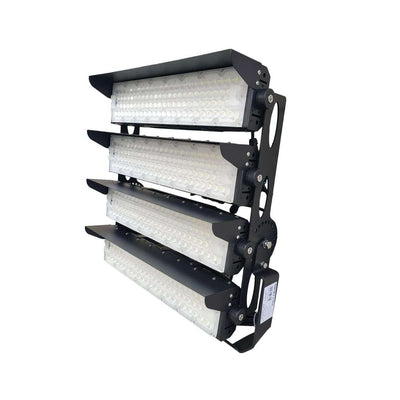
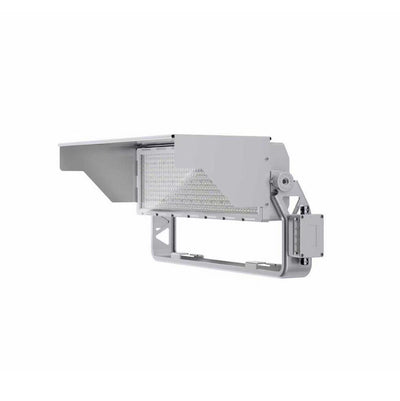
LED sports field lights for hockey pitches – narrow 30° and 40° beams, 170 lm/W, IP66, dimmable, 5-year warranty:


Uniformity, glare and switching modes
- Uniformity: FIH measures on a grid of at most 10 × 10 m. Dark patches between the masts are where players lose the ball in the air, so aim for the uniformity first and the average second.
- Glare: keep the glare rating below 50. Higher masts and narrow, well-aimed beams keep the floodlights out of the players' line of sight.
- Colour: Ra above 65 and a colour temperature of at least 4000K, with the same colour temperature on every mast. Our sports field lights are 5000K.
- Switching modes: FIH expects the training level to be reached by switching or dimming a match installation. Dimmable LED (1-10V or DALI) does this without the warm-up delay of metal halide.

What does LED save compared with metal halide?
Many hockey pitches still run on 2 kW metal halide floodlights (about 2.16 kW including the ballast). Example: an older installation with 16 of them (34.6 kW) replaced by 18 LED floodlights of 1000W (18 kW) for 300 lux.
- Power: 34.6 kW → 18 kW, about 48% less, with more light on the pitch.
- At 900 lit hours a year: 14,900 kWh less, about €4,470 a year at €0.30/kWh.
- Training at dimmed output saves more, and LED needs no relamping.
FIH makes the same comparison in its lighting guide: 32 floodlights over 10 years with 3,000 operating hours in total cost €42,104 to run with metal halide and €19,560 with LED, including relamping. Our project at Patro Eisden Maasmechelen shows a real relighting with 40% less power and more light. For football pitches, see How Many Lux Does a Football Pitch Need?
Neighbours and planning permission
Hockey clubs are often close to housing, and floodlights are a common reason for objections. Ask for a light plan that also shows the illuminance on the nearest windows and the upward light, aim the floodlights inwards, and agree a switch-off time. Higher masts help here as well, because the floodlights can be aimed more steeply. More in Light Pollution and Outdoor LED Lighting.
Frequently asked questions
How many lux does a hockey pitch need?
FIH recommends at least 200 lux for training, 350 lux for club competition (Class II) and 500 lux for high-level national and international competition (Class I). In the Netherlands, KNHB-compliant light plans use 200 lux for training and 300 lux for matches.
How high should hockey floodlight masts be?
FIH considers 18 m the optimum for 4 or 6 side masts, 15 m for 8 side masts and 21 m for 4 corner masts. Masts stand at least 5 m behind the back-lines and 6 m behind the side-lines.
How many LED floodlights does a hockey pitch need?
As a first estimate for a 91.4 × 55 m pitch: 12–14 floodlights of 1000W for 200 lux, 18–20 for 300 lux and 20–22 floodlights of 1500W for 500 lux. A DIALux light plan gives the exact number for your masts.
Why does hockey need more light than football?
The ball is small, hard and fast, and stays low on a flat synthetic surface. Players need to see it clearly everywhere, so hockey asks for higher uniformity (Emin/Eav 0.7 at match level) and more lux than recreational football.
Can we keep our existing masts?
Often yes, if the masts are in good condition and can carry the weight and wind area of the new floodlights. Have that checked, and plan the LED layout on the existing positions and heights.
Can the same lights be used for training and matches?
Yes. Plan the installation for the match level and dim it for training. That is how FIH describes the training level, and dimmable LED switches instantly between both.
Do you make a free light plan for a hockey pitch?
Yes. Send us the pitch size, the mast positions and heights and the level you play at. We make a free DIALux light plan with lux grid, uniformity and light towards neighbours, and a non-binding quote.
- FIH – Lighting for Non-Televised Hockey, version 2.2 (2018, updated 2020): lighting levels, uniformity, mast positions and heights, 10-year cost comparison.
- Signify standard light plans for hockey pitches (Netherlands): 200 lux training and 300 lux matches to the KNHB and NSVV guidelines.
- EN 12193:2018 – Light and lighting – Sports lighting (indoor hockey, lighting classes).
- CIE 150:2017 – Limitation of the effects of obtrusive light from outdoor lighting installations.
Last checked: November 2026, Nick Cuppens, Clightstore.
Send us the pitch size, mast positions and heights and your level of play. We prepare a free DIALux light plan and a non-binding quote at direct-import prices, 2 to 4 times below comparable branded floodlights. EU-wide delivery in 2–5 working days, up to 5 years' warranty.
Request free light planning