Symmetrical vs. Asymmetrical Light Distribution in LED: Guide
When do you need symmetrical, and when asymmetrical light distribution? This guide explains the differences, standards and provides a clear decision aid for light planners and procurement teams.
Symmetrical light distribution radiates evenly in all directions – ideal for centre-ceiling mounting in warehouses and industrial halls. Asymmetrical light distribution directs light precisely in one direction – essential for wall mounting, mast luminaires, façades and sports facilities. Choosing correctly reduces energy consumption, meets standard requirements and prevents glare.
- Symmetrical light distribution is suited to centre-ceiling mounting in high bays, warehouses and offices (DIN EN 12464-1).
- Asymmetrical light distribution is standard for mast luminaires, wall-mounted floodlights, sports pitches and street lighting (DIN EN 12193, DIN EN 13201).
- The luminous intensity distribution curve (LDC) immediately shows whether a luminaire distributes light symmetrically or asymmetrically.
- Asymmetrical luminaires avoid stray light in unused directions, measurably increasing energy efficiency.
- Mounting position, lux target and standard requirement together determine which distribution type is correct.
What does light distribution mean in LED luminaires?
The term light distribution describes how a luminaire emits its luminous intensity spatially. It is not the same as the beam angle: the beam angle indicates how wide or narrow the light exits. Light distribution additionally describes whether this emission is equally strong in all directions or deliberately directed in one direction.
Light distribution is made visible in the luminous intensity distribution curve (LDC), also known as a polar curve. It forms part of every professional luminaire data sheet and is the basis of every DIALux simulation. Anyone who can read an LDC makes well-informed light planning decisions – without surprises on site.
How do I read an LDC?
The LDC represents luminous intensity (in candela, cd) in a polar diagram. The luminaire is located at the centre point. Symmetrical luminaires show nearly identical curves in several cross-sectional planes – the curve is a mirror image left and right of the central axis. Asymmetrical luminaires display a clearly different curve in at least one plane: light is directed more strongly in one direction, whilst the opposite side receives little or no light.
For light planning: always request the LDC file (IES or LDT) from the manufacturer and import it into DIALux. Clightstore provides these files free of charge for all products.
Symmetrical light distribution: characteristics and applications
With symmetrical light distribution, luminous intensity is rotationally symmetrical or at least equal in two principal planes. The light distributes itself evenly downwards and to the sides in a cone shape. Typical beam angles range between 60° and 120°.
This distribution is the first choice when the luminaire is mounted centrally above the area to be illuminated. It produces high uniformity (U₀) without complex alignment. For high-bay racking, production halls and assembly areas, LED high bays with symmetrical distribution are the standard solution.
Typical applications of symmetrical light distribution
- Storage halls and logistics centres (centre-ceiling mounting)
- Production and assembly halls
- Offices and administrative buildings (LED panels)
- Multi-storey car parks with ceiling installation
- Supermarkets and retail areas

Asymmetrical light distribution: characteristics and applications
Asymmetrical light distribution is achieved through specially shaped reflectors, prisms or freeform lenses that direct the luminous flux precisely in one direction. The LDC shows a significantly more far-reaching curve in one plane than in the opposite direction. Rearward stray light is reduced to a minimum.
This distribution is always appropriate when the luminaire cannot be mounted centrally above the usable area, or when glare towards oncoming traffic, spectators or residents must be avoided. For mast luminaires on sports pitches, street lights and wall-mounted floodlights for façades, asymmetrical distribution is technically necessary.
Typical applications of asymmetrical light distribution
- Sports pitches and stadiums (mast mounting to the side of the playing area)
- Road and pathway lighting
- Façade and building illumination
- Industrial premises and outdoor car parks
- Wall-mounted floodlights in warehouses (side walls)

Comparison table: symmetrical vs. asymmetrical at a glance
| Characteristic | Symmetrical light distribution | Asymmetrical light distribution |
|---|---|---|
| LDC shape | Mirror image in all planes | Markedly different depending on plane |
| Typical mounting position | Centre ceiling above the usable area | Wall, mast, laterally offset |
| Alignment required | No | Yes, precise alignment necessary |
| Stray light | Uniform in all directions | Minimal in the opposite direction |
| Glare risk | Dependent on shielding angle | Low with correct alignment |
| Energy efficiency | Good with central mounting | Higher with lateral mounting |
| Typical products | High bays, panels, downlights | Floodlights, mast luminaires, street lights |
| Relevant standards | DIN EN 12464-1 | DIN EN 12193, DIN EN 13201 |
Decision guide: which light distribution for which situation?
Mounting position is the most important starting point. If the luminaire is positioned centrally above the usable area, symmetrical distribution is almost always the correct choice. If the luminaire is laterally offset, mounted on a wall or on a mast, you need asymmetrical distribution – otherwise a considerable proportion of the luminous flux is lost in unused directions.
| Application | Mounting position | Recommended distribution | Lux reference value (maintained illuminance Em) | Standard |
|---|---|---|---|---|
| Storage hall | Centre ceiling | Symmetrical (60°–90°) | ≥ 200 lx, U₀ ≥ 0.6 | DIN EN 12464-1 |
| Production hall | Centre ceiling | Symmetrical (90°–120°) | 300–500 lx, U₀ ≥ 0.6 | DIN EN 12464-1 |
| Office / desk | Ceiling, grid | Symmetrical, UGR ≤ 19 | ≥ 500 lx, U₀ ≥ 0.6 | DIN EN 12464-1 |
| Sports pitch (football) | Mast, lateral | Asymmetrical | 200–750 lx (depending on class) | DIN EN 12193 |
| Road / pathway | Mast, lateral | Asymmetrical | Class M/C/P | DIN EN 13201 |
| Façade / outdoor premises | Wall or mast | Asymmetrical | ≥ 20–50 lx (orientation) | DIN EN 12464-2 |
| Car park (ceiling) | Centre ceiling | Symmetrical (120°) | ≥ 75 lx | DIN EN 12464-1 |
Detailed lux reference values for all work areas can be found in our guide How much lux do you need?. For sports facilities we also recommend the article Light distribution on sports fields: standards & light planning.
Standards overview: what do the regulations require?
DIN EN 12464-1:2021-11 – Indoor workplaces
This standard sets out requirements for lighting quality and quantity at indoor workplaces. In addition to minimum maintained illuminance values (e.g. Em = 500 lx for office tasks), it also requires a minimum uniformity of U₀ ≥ 0.6 in the task area. Relevant to light distribution: the minimum shielding angle is at least 15° for luminances of 20,000–50,000 cd/m², and at least 20° for 50,000–500,000 cd/m². Symmetrical high bays with a wide beam angle generally meet these requirements without difficulty at the correct mounting height.
DIN EN 12193 – Sports facility lighting
This standard defines lighting classes for various sports and competition levels. Since masts are always positioned to the side of the playing area, asymmetrical light distribution is technically necessary here. Only in this way can light be directed onto the playing field without causing glare for athletes or spectators. Further details are available in our guide How much lux does a football pitch need?. Suitable products can be found in our category LED sports field lighting.
DIN EN 13201 – Road lighting
For roads and pathways, the standard prescribes lighting classes (M, C, P). Asymmetrical distribution is standard here to avoid glare for oncoming traffic and to concentrate the luminous flux on the carriageway. LED street lights are designed to meet this requirement as a matter of course.
Energy efficiency: why asymmetrical luminaires are more efficient with lateral mounting
A symmetrical luminaire mounted on a wall directs a considerable proportion of its luminous flux back into the wall or upwards – both of which represent losses. An asymmetrical luminaire directs the same luminous flux precisely onto the usable area. The result: more lux per watt on the working surface, without consuming more energy.
This efficiency gain is measurably demonstrable. With a symmetrical luminaire on a wall, a significant proportion of the luminous flux – depending on the mounting situation, up to 20–30% – can fall on unused surfaces. An asymmetrical variant of equal wattage achieves correspondingly higher illuminance values on the target area. Our guide Calculating LED payback period shows how this affects the return on investment.
UGR and glare: what does light distribution have to do with it?
The UGR value (Unified Glare Rating) describes the glare sensation at workplaces. It is directly related to light distribution: luminaires with high luminance in the direction of view produce high UGR values. Symmetrical luminaires with a wide beam angle and a small shielding angle can be problematic in offices (UGR > 19). Asymmetrical luminaires that direct light precisely downwards or to the side reduce luminance in the direction of view and therefore the UGR value.
For display screen workplaces, DIN EN 12464-1 specifies a limit of UGR ≤ 19. Further details are available in our guide UGR value explained: glare limitation in practice.
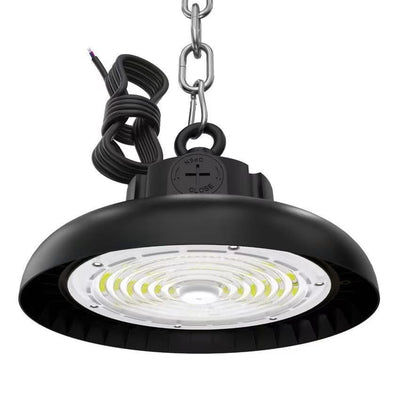
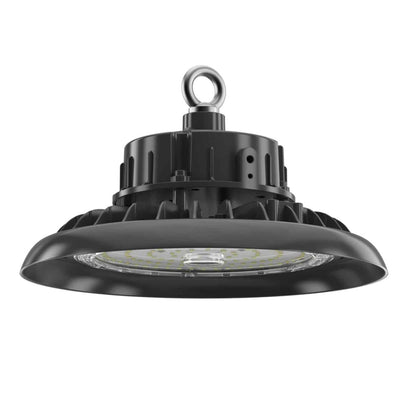
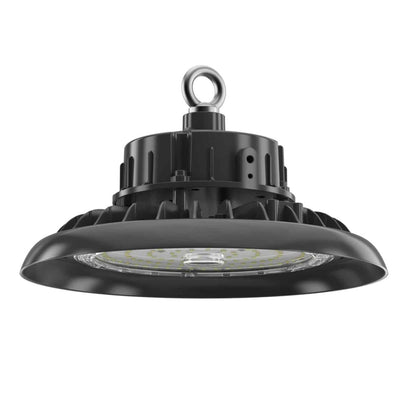
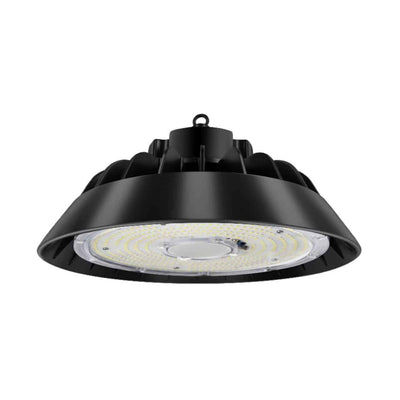
LED high bays for symmetrical light distribution
For storage halls, production facilities and logistics centres with centre-ceiling mounting, we recommend these proven LED high bays with symmetrical distribution, high efficiency and up to 5 years' warranty:
LED floodlights for asymmetrical light distribution
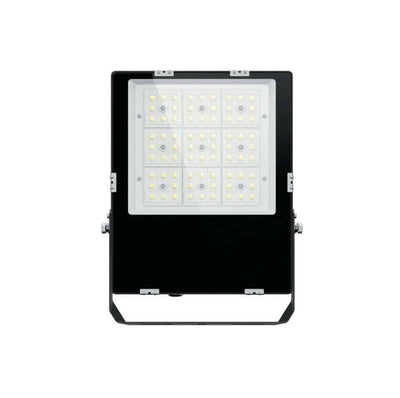
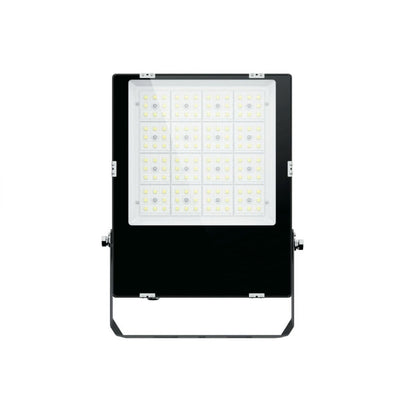
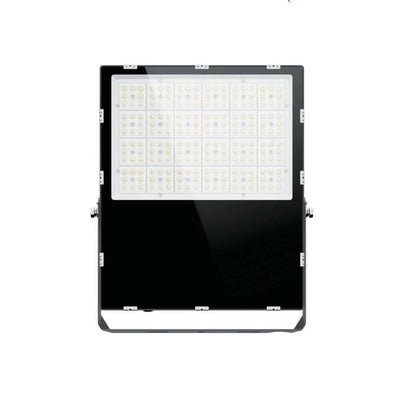
For outdoor installations, sports pitches, façades and mast mounting, our LED floodlights with asymmetrical distribution, IP66 protection and up to 5 years' warranty provide the right solution:

Note on mounting and electrical installation
The mounting and electrical connection of LED luminaires to 230V or 400V mains supplies must be carried out exclusively by a qualified and approved electrician. DIN VDE 0100, DGUV Regulation 3 and the five safety rules of electrical engineering apply. This guide is intended to support light planning and does not replace professional electrical installation.
Frequently asked questions
What is the difference between beam angle and light distribution?
The beam angle indicates how wide or narrow the light exits a luminaire – measured as the angle within which at least 50% of the maximum luminous intensity is achieved. Light distribution additionally describes whether this emission is equally strong in all directions (symmetrical) or deliberately directed in one direction (asymmetrical). A luminaire can have a wide beam angle and still distribute light asymmetrically.
When is asymmetrical light distribution appropriate?
Asymmetrical light distribution is always appropriate when the luminaire cannot be mounted centrally above the usable area: for mast luminaires on sports pitches and roads, for wall-mounted floodlights on façades and industrial premises, and for floodlights on outdoor car parks. It prevents stray light in unused directions and reduces glare for residents, oncoming traffic or athletes.
How do I recognise in the LDC whether a luminaire distributes light asymmetrically?
In the luminous intensity distribution curve (LDC), a symmetrical luminaire shows nearly identical, mirror-image curves in all cross-sectional planes. An asymmetrical luminaire displays a clearly different curve in at least one plane: the curve extends further on one side than on the other. Always request the IES or LDT file and import it into DIALux to simulate the actual light distribution.
Which light distribution do I need for a storage hall?
For storage halls with centre-ceiling mounting, symmetrical light distribution is the correct choice. A beam angle of 60°–90° is suitable for tall halls (from 8 m upwards), and 90°–120° for lower halls. DIN EN 12464-1 requires a maintained illuminance Em of at least 200 lx and a uniformity of U₀ ≥ 0.6. Further details are available in our guide Warehouse lighting: LED guide.
Which standard applies to sports facility lighting and which light distribution is required?
DIN EN 12193 governs the lighting of sports facilities. Since masts are always positioned to the side of the playing area, asymmetrical light distribution is technically necessary. The standard defines lighting classes with specific lux and uniformity values depending on the sport and competition level. Football, tennis, basketball and padel each have their own requirements.
Does light distribution affect the UGR value?
Yes, directly. Luminaires with high luminance in the direction of view produce high UGR values. Asymmetrical luminaires that direct light precisely downwards or to the side reduce luminance in the direction of view and therefore the UGR value. For display screen workplaces, DIN EN 12464-1 specifies a limit of UGR ≤ 19. Symmetrical luminaires with a wide beam angle can exceed this value without a sufficient shielding angle.
Can I use an asymmetrical luminaire inside a hall?
Yes, but only with lateral or wall-adjacent mounting. If, for example, you wish to illuminate racking aisles from the side or illuminate a hall wall, asymmetrical distribution is more efficient. With central ceiling mounting above the usable area, symmetrical distribution is generally the better choice, as asymmetrical luminaires would direct part of the luminous flux into unused directions.
Does Clightstore offer light planning with DIALux?
Yes. Clightstore offers free DIALux light planning for B2B projects. Based on your room dimensions, mounting height, lux targets and standard requirements, we produce a professional simulation with LDC evaluation and product recommendation. Request your free light planning via the contact form.
Our light planning team will produce a free DIALux simulation for you, including LDC evaluation, standard compliance verification and a tailored product recommendation – for halls, outdoor installations, sports pitches and more. EU-wide delivery in 2–5 working days, up to 5 years' warranty.
Request free light planning