LED High Bays with Philips Driver: Selection, Dimming & Warranty
Everything B2B buyers and planners need to know about LED high bays with Philips driver: standards, dimming, beam angles and warranty explained concisely.
LED high bays with Philips driver combine certified driver technology, standards-compliant luminous efficacies of up to 210 lm/W and a plannable service life – decisive criteria for commercial and industrial projects. This guide explains which high bay is suitable for which type of facility, how dimming protocols are selected correctly and what the 5-year warranty actually covers.
Please note: Philips is the brand of the driver (the power supply) fitted in these luminaires, not the brand of the luminaire itself.
- Philips drivers (Xitanium family) achieve up to 92 % efficiency, a flicker value below 5 % and are designed for ambient temperatures up to 50 °C.
- EN 12464-1 specifies maintained illuminance values of 100 to 1,000 lx depending on the activity – the number of luminaires can be estimated using a simple formula.
- 1-10V dimming is suitable for straightforward brightness control; DALI enables zone-based automation and individual addressing.
- The beam angle (60°, 90° or 120°) must match the mounting height – an incorrect choice creates hotspots or dark zones.
- Clightstore delivers LED high bays with Philips driver across the EU within 2–5 working days, including free DIALux light planning.
Why the driver determines service life and light quality
The LED driver is the heart of every high bay – it converts the mains voltage into the direct current required by the LED modules. A low-quality driver causes flickering, overheating and premature failure of the entire luminaire, even if the LED chips themselves are still intact.
Philips drivers from the Xitanium family are specifically developed for demanding industrial and high-bay applications. They achieve an efficiency of up to 92 %, maintain a flicker value below 5 % and are designed for ambient temperatures up to 50 °C. This makes them particularly suitable for production facilities, high-bay warehouses and sports halls, where heat and dust act on the electronics continuously.
Compared with no-name power supplies, Philips drivers also offer integrated surge protection (typically 4 kV surge protection), which reduces damage caused by mains voltage fluctuations – a frequently underestimated risk in industrial environments with heavy machinery.
Standards-compliant lux planning to EN 12464-1
EN 12464-1 "Lighting of indoor work places" defines minimum maintained illuminance values (Ēm), UGR limit values and colour rendering requirements for work areas. In most European countries the standard is applied through national workplace safety regulations; planners and operators should ensure compliance.
| Area / Activity | Ēm (lx) | UGR max. | Ra min. |
|---|---|---|---|
| General storage | 100 | 25 | 40 |
| Order picking | 200 | 25 | 60 |
| Packing | 300 | 25 | 80 |
| Medium assembly / production | 500 | 22 | 80 |
| Fine assembly | 750 | 19 | 80 |
| Quality control | 1,000 | 19 | 90 |
| Sports hall – training | 300 | 22 | 65 |
| Sports hall – competition | 500 | 19 | 65 |
Further information on lux reference values for all areas can be found in our guide How much lux do you need?.
Quick formula for the number of luminaires
Use the following formula to determine the required number of high-bay luminaires as an initial planning reference:
Number of luminaires = (Ēm × area in m²) ÷ (luminous flux per luminaire in lm × maintenance factor)
A maintenance factor of 0.8 is recommended for clean industrial environments and 0.7 for dusty or contaminated facilities. Example: a production facility of 500 m² is to be illuminated to 500 lx. A 100W high bay with 210 lm/W delivers 21,000 lm. Result: (500 × 500) ÷ (21,000 × 0.8) ≈ 15 luminaires. This formula provides a reference value; a DIALux simulation is essential for standards-compliant planning.

Beam angle and mounting height: the right combination
The beam angle of the high bay determines how wide the light cone falls on the working surface. Too narrow an angle creates hotspots directly below the luminaire and dark zones in between; too wide an angle causes light to be lost to the sides and the illuminance on the usable area decreases.
| Mounting height | Recommended beam angle | Typical application |
|---|---|---|
| 4–6 m | 120° | Low-bay warehouses, workshops |
| 6–10 m | 90° | Production facilities, sports halls |
| 10–15 m | 60° | High-bay warehouses, industrial facilities |
| 15 m and above | 45–60° | Large halls, shipbuilding halls |
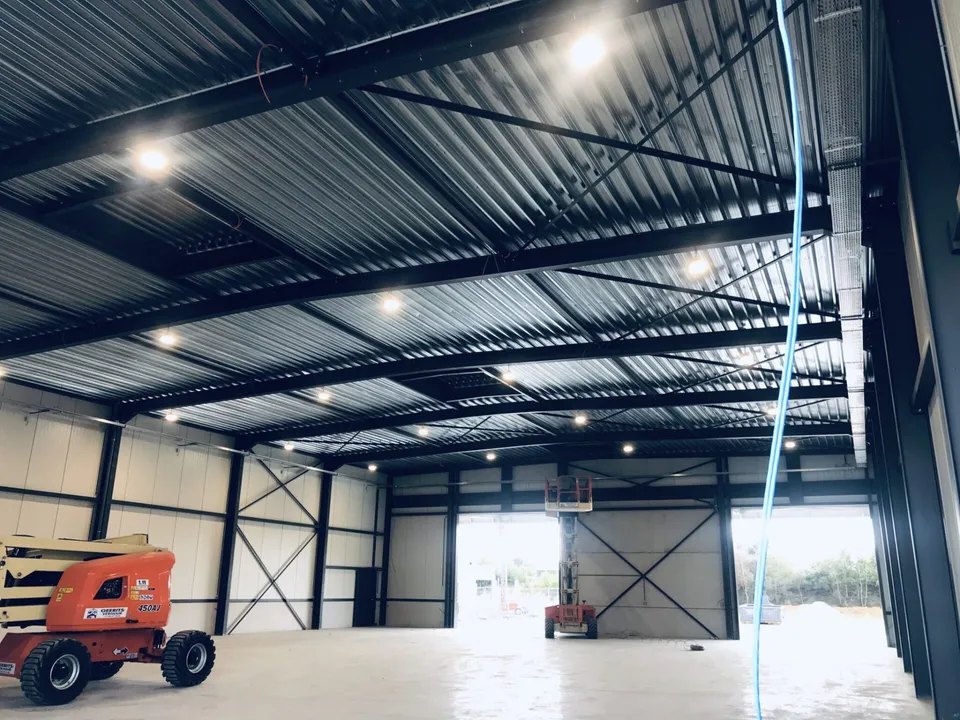
For high-bay warehouses from 10 m mounting height, LED high bays with 60° optics are recommended to concentrate the illuminance in the racking aisles. In sports halls with 8–10 m ceiling height, the 90° angle is the standard choice for uniform area illumination.
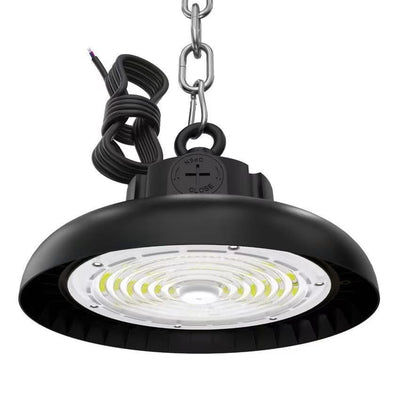
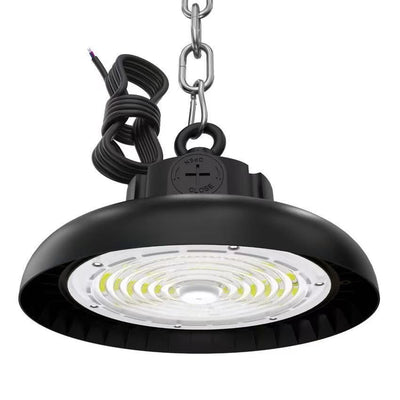
LED high bays with Philips driver – 210 lm/W, 0-10V dimmable, IP65, 5-year warranty:


Dimming protocols compared: 1-10V, DALI and PWM
The choice of dimming protocol is one of the most important planning decisions – and at the same time the most frequently underestimated. Incompatible combinations of driver and control device lead to flickering, humming or a restricted dimming range.
1-10V dimming
The 1-10V protocol is a widely used method for high bays. A separate control signal between 1 and 10 V DC regulates the luminous flux of the driver – 10 V corresponds to 100 %, 1 V corresponds typically to 10 % minimum brightness. Switching off is carried out via a separate mains switch.
Advantages: simple wiring, cost-effective control devices, broad compatibility. Disadvantage: no individual addressing of single luminaires; all luminaires connected in parallel dim together. Suitable for: straightforward facility control with few zones.
DALI dimming (Digital Addressable Lighting Interface)
DALI is a digital bus protocol that makes every luminaire individually addressable. Up to 64 devices can be operated on a single DALI line, grouped together and controlled individually. DALI drivers store scenes and dimming levels internally – even after a power failure.
Advantages: zone-based control, operational status feedback, integration into building automation (KNX, BACnet). Disadvantage: higher investment costs for control devices and commissioning. Suitable for: large production facilities, sports halls with competitive events, buildings with BMS integration.
A detailed technical explanation of all dimming protocols can be found in our guide 0-10V, 1-10V & TRIAC dimming: differences explained.
PWM dimming
PWM (pulse-width modulation) switches the current on and off at high frequency (typically 400–1,000 Hz). At low frequencies, PWM dimming can cause perceptible flickering – critical in environments with rotating machinery (stroboscopic effect). Philips drivers with a PWM input typically operate at frequencies above 400 Hz to minimise this risk.
Application scenarios: which high bay for which area?
Industrial facility and production
Production facilities require at least 500 lx with UGR ≤ 22 and Ra ≥ 80 in accordance with EN 12464-1. High bays of 100–200W with a 90° beam angle and 4,000 K neutral white are recommended – this colour temperature promotes concentration and enables good colour rendering during quality control. Ra ≥ 80 is required for fine assembly and Ra ≥ 90 for quality inspection.
High-bay warehouse and logistics
In high-bay warehouses from 10 m height, 60° optics and high luminous efficacies (≥ 180 lm/W) are essential to achieve the required 200 lx for order picking with fewer luminaires. For racking aisles and low-level storage areas, LED tri-proof lights with IP65 and Philips driver are an economical alternative to UFO high bays. Further information is provided in our guide Warehouse lighting: LED guide for storage & logistics.
Sports halls
Sports halls place particular demands on glare limitation and uniformity. For training and competition lighting in sports halls, the requirements of EN 12193 (sports facility lighting) must be observed; EN 12464-1 applies additionally for general work areas. DALI-dimmable high bays enable switching between training illuminance (300 lx) and competition illuminance (500 lx) via scene control. For outdoor sports facilities, please refer to our LED sports field lighting. Detailed standard values for sports areas are explained in our guide Light distribution on sports fields: standards & planning.
Outdoor areas and facades
LED high bays with IP65 are suitable for covered outdoor areas, loading bays and yard lighting. For fully exposed outdoor areas, LED floodlights with IP66 and Philips driver are recommended, as they withstand high-pressure water jets. The protection classes IP65 and IP66 in accordance with IEC 60529 are explained in our guide IP protection classes explained.

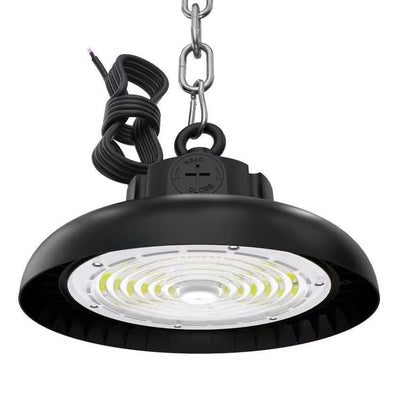
LED floodlights with Philips driver for outdoor areas and loading bays – IP66, 150 lm/W, 5-year warranty:


Warranty and service life: what Philips drivers really mean
L70B50 – what does it mean?
The service life rating L70B50 means: after the stated number of operating hours (e.g. 50,000 h), at least 50 % of luminaires still have at least 70 % of their original luminous flux. This is a widely used industry standard for LED service life projections, based on measurement procedures in accordance with LM-80 and the extrapolation method TM-21.
Philips drivers are designed to meet these service life values and contribute significantly to ensuring that the complete luminaire reaches the stated operating hours. A low-quality driver can prematurely degrade the LED chips through overcurrent or overheating – even if the LEDs themselves were designed for high operating hours.
What the 5-year warranty covers
The Clightstore 5-year warranty covers material defects and manufacturing faults in the luminaire and driver. Warranty claims are triggered by defects attributable to production errors – such as driver failure, LED module defect or housing failure under normal operating conditions.
Not covered by the warranty: mechanical damage caused by improper installation, operation outside the specified ambient temperature, surge damage without an installed surge protection device, and damage caused by unauthorised modifications to the luminaire.
Safety notice regarding installation
All connection and installation work on 230V/400V installations must be carried out exclusively by qualified electricians. The national wiring regulations based on HD 60364 apply (in the UK: BS 7671), together with the five safety rules of EN 50110-1. Planners and buyers should take this into account during project planning and tendering.
Philips driver vs. Mean Well: which driver for which application?
Both manufacturers supply high-quality drivers for industrial applications. The choice depends on the application scenario:
| Criterion | Philips Xitanium | Mean Well |
|---|---|---|
| Efficiency | up to 92 % | up to 94 % |
| Flicker | < 5 % | < 5 % (model-dependent) |
| Dimming protocols | 1-10V, DALI, PWM | 1-10V, DALI, PWM, SCP |
| Surge protection | 4 kV (typical) | 4–10 kV (model-dependent) |
| Strengths | High bays, sports, industry, outdoor | Broad product range, special voltages |
| Warranty (manufacturer) | 5 years | 5 years |
Philips drivers are particularly prevalent in high-bay and sports lighting, where brand certification and planning reliability are paramount. Mean Well offers a broader model range for special voltages and specific applications. For standard projects in industry and logistics, both drivers are a reliable choice.
B2B advantages at Clightstore
Clightstore sources LED high bays with Philips driver through direct import. All products are delivered across the EU within 2–5 working days, free of charge from 100 €.
A free DIALux light planning service is available for projects of 10 luminaires or more. The Clightstore planning team produces a standards-compliant simulation to EN 12464-1 with lux false-colour representation, uniformity values and a luminaire positioning plan. Information on the cost-effectiveness and payback period of your LED investment can be found in our guide Calculating LED payback period: ROI & savings.
Frequently asked questions
What is the difference between 1-10V and DALI dimming for high bays?
1-10V is an analogue control signal that dims all luminaires connected in parallel together – simple and cost-effective. DALI is a digital bus protocol that addresses each luminaire individually, stores scenes and provides status feedback. DALI is suitable for complex facility automation with zone-based control and BMS integration; 1-10V for straightforward applications with few zones.
Why does my LED high bay flicker or hum?
Flickering is frequently caused by incompatible dimmers (e.g. a TRIAC dimmer on a 1-10V driver) or by a faulty driver. Humming may indicate incorrect earthing or resonance effects in the driver. First check the compatibility of the driver and control device. If problems persist, a qualified electrician should inspect the installation.
How much lux does a warehouse require?
According to EN 12464-1, 100 lx (UGR 25, Ra 40) is required for general storage areas. 200 lx applies to order picking and 300 lx to packing areas. These values are minimum requirements and must be maintained on the working surface – not only directly below the luminaires.
Which beam angle is correct for a production facility 8 m high?
At a mounting height of 6–10 m, a beam angle of 90° is recommended. This ensures uniform illumination of the working surface without excessive edge shadowing. In very wide facilities, a combination of 90° and 120° luminaires may be beneficial to illuminate the peripheral areas adequately.
Why is a Philips driver better than a no-name power supply?
Philips drivers from the Xitanium family are certified to IEC 61347, achieve up to 92 % efficiency, maintain the flicker value below 5 % and feature integrated surge protection (typically 4 kV). No-name power supplies frequently do not meet these requirements reliably, which can lead to premature failure, flickering and, in the worst case, a fire risk.
Can I use an LED high bay with IP65 outdoors?
IP65 in accordance with IEC 60529 provides complete dust protection and protection against water jets from any direction – sufficient for covered outdoor areas and loading bays. For fully exposed outdoor areas with direct rainfall or high-pressure cleaning, luminaires with IP66 are recommended. Details on protection classes are explained in our guide on IP protection classes.
What does the 5-year warranty cover and what does it not cover?
The warranty covers material defects and manufacturing faults in the luminaire and Philips driver under normal operating conditions. Not covered are mechanical damage caused by improper installation, operation outside the specifications (e.g. excessively high ambient temperature), surge damage without installed protection, and damage caused by unauthorised modifications.
How many high bays do I need for my facility?
As a reference value: number of luminaires = (target lux × facility area in m²) ÷ (luminous flux per luminaire in lm × maintenance factor). For standards-compliant planning with uniformity verification and lux false-colour representation, we recommend the free DIALux light planning service from Clightstore – simply submit a project enquiry.
Clightstore produces a free DIALux light planning service for your project to EN 12464-1 – including lux simulation, luminaire positioning and product recommendation with Philips driver. EU-wide delivery within 2–5 working days, up to 5 years warranty.
Request free light planning