LED Panel 120x30: Applications, Mounting, Wattage & Alternatives
Everything about the LED panel 120x30: standard values per EN 12464-1, mounting options, backlit vs edgelit and calculation formula for offices, warehouses and workshops.
The LED panel 120x30 (also referred to as 30x120) is the most widely used long-format panel in commercial interior fit-outs – ideal for grid ceilings, surface mounting and pendant suspension. This guide shows you which wattage class, UGR value and mounting method are required for your application in compliance with EN 12464-1, and how to calculate the correct number of panels needed.
- The 120×30 cm format fits standard grid ceilings and is available from 18W to 36W – with efficiencies of up to 200 lm/W.
- For office workstations, EN 12464-1 specifies a minimum of 500 lx, UGR ≤ 19 and Ra ≥ 80.
- Backlit panels provide more uniform illumination than edgelit panels; backlit is recommended for UGR-critical areas.
- Three mounting options: recessed into a grid ceiling, surface-mount frame on a solid ceiling, pendant suspension.
- All 230V connection work must be carried out by a qualified electrician (national electrical regulations apply).
Why the 120×30 cm format is so widespread
The 120×30 cm dimension corresponds exactly to one quarter of a standard grid ceiling bay (120×120 cm), allowing seamless integration into existing office and commercial infrastructure without additional effort. At the same time, the format is narrow enough for use in corridors, hallways and changing rooms without visually dominating the space. Compared with square formats such as the LED panel 60×60 or the LED panel 62×62, the long format provides a more linear light distribution that is particularly well suited to row arrangements.
In B2B direct import, the price advantage over branded goods can be considerable. However, the purchasing decision should not be based on price alone – the normative requirements of the intended application are equally critical.
Standards-compliant light planning per EN 12464-1: application table
EN 12464-1:2021 defines minimum values for illuminance (lux), glare limitation (UGR), colour rendering (Ra) and uniformity (U₀ ≥ 0.6) for indoor workplaces. The table below shows the requirements for typical applications of the LED panel 120×30 and the recommended wattage class in each case.
| Application | Target illuminance (Em) | UGR limit | Ra minimum | Recommended panel wattage |
|---|---|---|---|---|
| Office (writing, reading, screen work) | 500 lx | ≤ 19 | ≥ 80 | 18–25W (up to 200 lm/W) |
| Meeting room | 500 lx | ≤ 19 | ≥ 80 | 18–25W (up to 200 lm/W) |
| Reception / front desk | 300 lx | ≤ 22 | ≥ 80 | 18W (up to 200 lm/W) |
| Corridor / hallway | 100 lx | ≤ 28 | ≥ 40 | 18W (up to 200 lm/W) |
| Warehouse with fixed racking | 200 lx | ≤ 25 | ≥ 60 | 25–36W |
| Despatch and packing | 300 lx | ≤ 25 | ≥ 60 | 25–36W |
| Medium-precision assembly / workshop | 500 lx | ≤ 22 | ≥ 80 | 36W or backlit 25W |
| Changing room / washroom | 200 lx | ≤ 25 | ≥ 80 | 18W (up to 200 lm/W) |
Further information on lux requirements by room type can be found in our guide How much lux do you need?. The UGR value and its practical significance are explained in our article UGR value explained: glare limitation in practice.
Calculating the number of panels: a practical formula
For an initial rough estimate without DIALux software, lighting planners use the following formula:
Number of panels = (floor area [m²] × target illuminance [lx]) ÷ (luminous flux per panel [lm] × maintenance factor)
The maintenance factor for clean indoor spaces is typically 0.8. As an example: for an office of 60 m² requiring 500 lx, lit by panels each producing 5,000 lm, the calculation gives: (60 × 500) ÷ (5,000 × 0.8) = 7.5 → 8 panels. For a precise, standards-compliant calculation including a uniformity verification, we recommend the free DIALux light planning service from Clightstore.
Please note: mounting height has a significant effect on the illuminance at the working plane. For ceiling heights above 3.5 m, you should switch to higher-wattage panels (36W) or to LED high bays.

Backlit vs edgelit: which panel type for which application?
LED panels 120×30 are available in two fundamental construction principles. The choice directly affects uniformity, UGR value and LED service life. Our detailed comparison can be found in the guide Backlit vs edge-lit LED panel: which is better?.
| Feature | Backlit | Edgelit |
|---|---|---|
| LED arrangement | Directly behind the diffuser plate | Along the edges, light guided via light guide plate |
| Uniformity | Very high | Medium to high |
| Depth | Approx. 35–50 mm | Approx. 10–15 mm |
| UGR suitability | Excellent (UGR < 19 achievable) | Good (UGR < 19 with specialist diffuser) |
| Efficiency | Up to 200 lm/W | Up to 140 lm/W |
| Typical application | Office, surgery, meeting room | Prestige spaces, design-led requirements |
| Thermal management | Better (LEDs distributed across panel) | Concentrated at the edges |
For UGR-critical office workstations we recommend backlit panels with certified UGR < 19. Edgelit panels are suitable where a slim profile or a particular aesthetic is required.
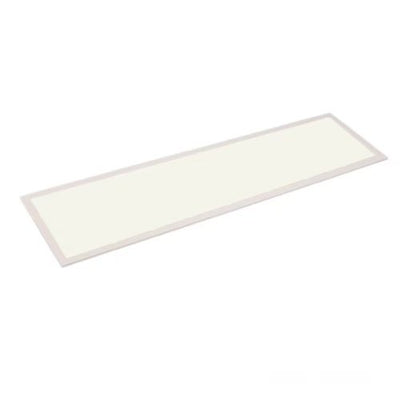
High-efficiency office panels: UGR < 19, 200 lm/W
The following backlit panels with up to 200 lm/W and certified UGR < 19 meet the requirements of EN 12464-1 for office workstations. Wattage is selectable between 18W and 25W – ideal for varying ceiling heights and lux targets.
Mounting options in a B2B context
The LED panel 120×30 is available in three mounting configurations, which differ in installation effort, ceiling construction and maintenance access. The choice of mounting method should be determined during the planning phase, as it governs product selection and the accessories required.
Recessed into a grid ceiling
With suspended grid ceilings (T-bar systems, 600×1200 mm grid module), the panel is simply dropped into the existing grid bay. No additional frame is required. The driver is positioned in the ceiling void. This option is the fastest and most cost-effective solution for large-scale projects.
Surface-mount frame on a solid ceiling
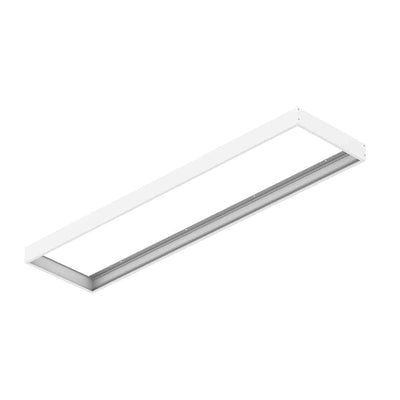
Where no grid ceiling is present, a surface-mount frame allows the panel to be fitted directly to the structural ceiling. The frame (approx. 68 mm overall depth) conceals the driver and connection cables completely. This option is particularly popular in older buildings, workshops and refurbishment projects. The appropriate surface-mount frame for the 30×120 format is available separately.
Pendant suspension
For rooms with high ceilings or prestige areas, pendant suspension is an excellent choice. Specialist pendant kits allow drop heights of 0.3 to 1.5 m. Pendant suspension improves uniformity at the working plane by bringing the light source closer to the task level. For offices with ceiling heights above 3.5 m, this is often the standards-compliant solution.
Safety notice: All 230V mains connection work must be carried out exclusively by a qualified and competent electrician. The electrical installation regulations of your country apply (for example BS 7671 in the UK, DIN VDE 0100 in Germany). Further information can be found in our guide Connecting an LED lamp: step-by-step guide.
Dimmability and control: DALI, 0–10V and TRIAC
Dimmable LED panels 120×30 are available with three common control technologies. The choice depends on the existing building automation infrastructure and the project budget.
DALI (Digital Addressable Lighting Interface) enables individual addressing of each panel, group control and lighting scenes. It is the standard for professional office and commercial buildings with building management systems. 0–10V / 1–10V is a simple and cost-effective dimming solution for large areas where individual addressing is not required. TRIAC dimming works with standard phase-cut dimmers and is suitable for smaller installations. Our detailed comparison of dimming systems can be found in the guide 0–10V, 1–10V & TRIAC dimming: differences explained.
When purchasing, pay close attention to the actual usable dimming range: quality panels dim down to 1–5% without flicker or colour shift. Budget models often cut out at 20–30% or exhibit flicker – a problem that is frequently encountered in practice.
IP rating and suitable locations
Standard LED panels 120×30 are rated IP40 or IP41 – sufficient for dry indoor spaces such as offices, meeting rooms and warehouses without moisture exposure. For workshops, changing rooms or garages where splashing water is a risk, a minimum of IP44 is required. In such cases we recommend switching to LED tri-proof lights, which are specifically designed for damp and dusty environments. IP ratings are defined in IEC 60529; a full overview can be found in our guide IP ratings explained: IP20, IP41, IP44, IP54, IP69K.
Alternatives to the LED panel 120×30: when does a different format make sense?
The 120×30 format is not the optimum choice for every application. The overview below helps with the decision:
- LED panel 60×60: For square grid ceilings (600×600 mm); more uniform light distribution in square rooms.
- LED panel 120×60: Higher luminous flux per luminaire; ideal for rooms with a larger grid module or higher lux requirements.
- LED panel 60×30: For narrow corridors and hallways; half the length of the 120×30 format.
- LED panel 30×30: For small grid bays or decorative applications.
- LED tri-proof lights: For workshops, garages and outdoor areas requiring IP65 or higher.
For warehouse buildings with ceiling heights above 5 m, LED panels are generally unsuitable – in these situations LED high bays or linear light systems are used instead. More information can be found in our guide Warehouse lighting: LED guide for storage & logistics.
Edgelit panels and surface-mount frames: complementary range
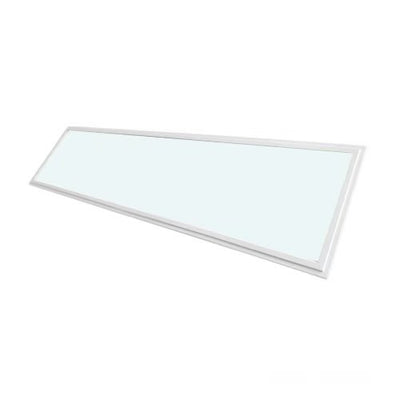
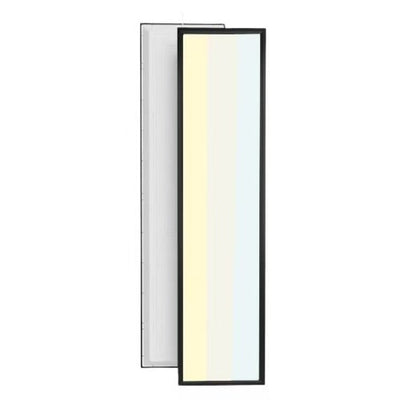
For design-led applications or surface mounting on solid ceilings: edgelit panels with UGR < 19 and the matching surface-mount frame for the 30×120 format.

Quality criteria for B2B purchasing: what buyers should look for
In B2B direct import, product quality varies considerably. The following criteria are critical for reliable project planning:
- Flicker-free operation: Flicker index < 0.1 and flicker frequency > 1,000 Hz per IEEE 1789. Relevant for screen-based workstations and production areas with rotating machinery.
- CRI / Ra value: Minimum Ra 80 for offices, Ra 90 for surgeries, laboratories and quality control. Scrutinise manufacturer claims carefully – request certified test reports.
- Driver included: Quality panels are supplied with an integrated or included driver. Separate drivers increase installation effort and introduce additional failure points.
- Warranty: A minimum of 3 years, ideally 5 years. Clightstore offers up to 5 years' warranty on all panels.
- Efficiency: 140–200 lm/W represents the current state of the art. Values below 100 lm/W indicate outdated technology.
- Certifications: CE marking is mandatory for placing products on the EU market; additional marks such as ENEC or TÜV provide an additional level of assurance.
For payback period calculations and ROI analysis, we recommend our guide Calculating LED payback period: ROI & savings.
Frequently asked questions
What is the difference between an LED panel 120x30 and 30x120?
They are the same format – only the order in which the dimensions are written differs. 120×30 cm and 30×120 cm refer to identical products. Both conventions are common in the trade; there is no technical difference.
How many LED panels 120x30 do I need for a 30 m² office?
Using a backlit panel producing 5,000 lm and a maintenance factor of 0.8, the formula gives: (30 m² × 500 lx) ÷ (5,000 lm × 0.8) = 3.75 → 4 panels. For 18W panels at 200 lm/W (3,600 lm) the calculation would be: (30 × 500) ÷ (3,600 × 0.8) = 5.2 → 6 panels. For a standards-compliant plan including a uniformity verification, we recommend a free DIALux calculation.
Can I mount LED panels 120x30 without a grid ceiling?
Yes. Using a surface-mount frame, the panels can be fitted directly to a solid ceiling. The frame conceals the driver and cables and is available at approximately 68 mm overall depth. Pendant suspension using the appropriate accessories is also an option.
Which UGR value must be observed for offices?
EN 12464-1:2021 specifies a maximum UGR of 19 for office workstations (writing, reading, screen work). Panels with UGR < 19 are certified accordingly and the value is stated on the datasheet. Ensure that the UGR value applies to the actual installation situation (room dimensions, mounting height, reflectance values).
Are LED panels 120x30 suitable for damp locations?
Standard panels rated IP40 or IP41 are not suitable for damp locations. For changing rooms, workshops or garages where splashing water is a risk, a minimum of IP44 is required. In such cases we recommend using LED tri-proof lights with the appropriate protection class.
What does "adjustable wattage" mean on 18W/25W panels?
Some panels allow the operating wattage to be selected via a DIP switch or jumper on the driver – typically between 18W and 25W. This makes it possible to use the same product for different ceiling heights and lux requirements without stocking multiple models. A clear advantage for large projects with varying room types.
Which colour temperature is recommended for offices?
For offices and meeting rooms, 4000K (neutral white) or 5000K (daylight white) are most commonly specified. 4000K promotes concentration without feeling too cold; 5000K–6000K is suited to areas requiring high levels of alertness. More information can be found in our guide LED colour temperature: 2700K to 6000K – effect & selection.
How long does delivery take for large orders?
Clightstore delivers across the EU within 2–5 working days from stock. For large-scale projects with high quantities, we recommend enquiring early to confirm availability and volume pricing. Project enquiries can be submitted directly via the contact form.
Clightstore offers a free, no-obligation DIALux light study: a 3D light plan, lux values, a product list and a savings overview. Send us your floor plan or dimensions and we will calculate the optimum number of panels for your room.
Request free light planning