LED Floodlights: Which Wattage for Which Area? 10W–400W
From 10W to 400W: this guide shows which LED floodlight wattage genuinely suits a car park, warehouse, sports field or industrial site – with lux tables and references to relevant standards.
The correct wattage for an LED floodlight depends not on wattage alone, but on the required illuminance in lux, the mounting height and the area to be lit. Anyone who understands these three variables can make a precise choice – and avoid costly over- or under-specification. This guide provides standards-compliant reference values, a mounting height matrix and clear recommendations for B2B applications from 10W to 400W.
- Wattage alone tells you nothing – lumens, lux and mounting height must all be considered together.
- The formula: Required lumens = target lux value × area (m²) ÷ utilisation factor.
- Standards: DIN EN 12464-2 (outdoor workplaces) and DIN EN 12193 (sports facilities) define minimum lux values.
- For continuous outdoor use, at least IP65 is required; for exposed or mechanically stressed locations, IP66 and additionally IK08 are recommended.
- LED typically saves 75–90% energy compared with halogen – a 100W LED floodlight typically replaces a 500W halogen floodlight.
Why wattage alone is not enough: understanding lumens, lux and luminous efficacy
Many buyers and facility managers still base their LED floodlight purchases primarily on wattage. This regularly leads to poor investment decisions. What matters instead is luminous efficacy in lumens per watt (lm/W) – because two 200W floodlights can deliver anywhere between 20,000 and 34,000 lumens depending on driver and chip quality.
Illuminance in lux describes how much luminous flux actually reaches a surface. It is the measure prescribed by standards such as DIN EN 12464-2 and DIN EN 12193. For more on which lux values apply to different areas, see our guide How much lux do you need?.
The basic planning formula is: Required lumens = target lux value × area (m²) ÷ utilisation factor. The utilisation factor typically lies between 0.5 and 0.8 depending on beam angle, mounting height and the reflectance of the surroundings. Our guide Lumens vs. lumens per watt explains the difference between the two.
Target lux values by application and standard
Before selecting a wattage, establish the normative target lux value for your application. The table below summarises the most important reference values.
| Application | Target lux value | Standard | Notes |
|---|---|---|---|
| Commercial car park (medium traffic volume) | ≥ 10 lx | DIN EN 12464-2 | Minimum requirement; security areas ≥ 20 lx |
| Outdoor storage and logistics yard | 20–50 lx | DIN EN 12464-2 | Depending on traffic intensity and security requirements |
| Construction site / temporary lighting | 50–100 lx | DIN EN 12464-2 | Higher for work areas, lower for traffic routes |
| Industrial site / operations yard | 50–150 lx | DIN EN 12464-2 | Depending on visual task and hazard potential |
| Sports field – training / recreational (Class III) | ≥ 75 lx | DIN EN 12193 | Uniformity U₁ ≥ 0.25, Ra ≥ 65 |
| Sports field – regional competition (Class II) | ≥ 200 lx | DIN EN 12193 | Uniformity U₁ ≥ 0.40, Ra ≥ 65 |
| Sports field – national/international competition, TV (Class I) | ≥ 500 lx | DIN EN 12193 | Uniformity U₁ ≥ 0.60, Ra ≥ 65, glare limitation required |
| Façade lighting / accent lighting | 30–100 lx | Planning value | Depending on façade reflectance |
For sports field lighting to DIN EN 12193, uniformity, glare limitation and colour rendering (Ra) are also regulated by the standard, in addition to illuminance. Detailed light planning guidance can be found in our guide Light distribution on sports fields.
Mounting height matrix: wattage × height × area
Mounting height is the most frequently underestimated factor. As height increases, illuminance decreases quadratically – a floodlight at 8 m illuminates the same area with significantly fewer lux than one at 4 m. The matrix below provides reference values for typical outdoor applications using modern LED floodlights (≥ 150 lm/W).
| Wattage | Typical luminous flux | Mounting height | Illuminable area (approx.) | Achievable lux (approx.) | Typical application |
|---|---|---|---|---|---|
| 10–30W | 1,500–4,500 lm | 2–3 m | 10–30 m² | 50–150 lx | Driveway, building entrance, advertising sign |
| 50W | 7,500–9,000 lm | 3–5 m | 30–60 m² | 75–150 lx | Small car park, yard lighting |
| 100W | 15,000–17,000 lm | 5–7 m | 80–150 m² | 75–150 lx | Operations yard, loading bay, construction site |
| 150W | 22,500–25,500 lm | 6–8 m | 150–250 m² | 75–150 lx | Large car park, outdoor storage, training pitch Class III |
| 200W | 28,000–34,000 lm | 8–10 m | 200–400 m² | 75–200 lx | Industrial site, sports field Class II/III |
| 240W | 36,000–41,000 lm | 8–12 m | 300–500 m² | 75–200 lx | Large operations site, logistics centre |
| 300W | 45,000–51,000 lm | 10–14 m | 400–700 m² | 75–200 lx | Port facility, large construction site, sports complex |
| 400W | 60,000–68,000 lm | 12–20 m | 500–1,000 m² | 75–500 lx | Stadium, large sports facility, industrial site |
Note: These values are planning reference figures. For standards-compliant verification – particularly for sports facilities to DIN EN 12193 or outdoor workplaces to DIN EN 12464-2 – a DIALux simulation using the actual photometric files (IES/LDT) of the luminaires to be installed is required.

Halogen replacement: what does an LED floodlight actually replace?
A classic 500W halogen floodlight delivers around 9,000–10,000 lumens at a luminous efficacy of approximately 18–20 lm/W. A modern LED floodlight at 150 lm/W achieves the same luminous flux with just 60–70W. In practice, 500W halogen floodlights are frequently replaced by 100W LED floodlights, because higher luminous efficacy and lower light loss through heat work together.
Rule of thumb for conversion: LED watts = halogen watts ÷ 5 to 8 (depending on the luminous efficacy of the LED model). Always check the actual lumen output of the LED product rather than relying on wattage alone. For more on payback calculations and the ROI of an LED retrofit, see our guide Calculating LED payback period.
B2B segments: which wattage for which application?
Car parks and operations yards
For commercial car parks with medium traffic volume, DIN EN 12464-2 requires a minimum of 10 lux. In practice, 20–30 lux is targeted to ensure safety and orientation. Depending on pole spacing and mounting height (typically 6–8 m), 100W to 200W floodlights with IP66 are a suitable choice. For locations with a risk of vandalism, IK08 is additionally recommended.
Warehouses, logistics and outdoor sites
Outdoor storage areas and logistics yards require 20–50 lux for traffic routes and up to 100 lux in active work areas. Here, 150W to 300W floodlights with IP66 are used – and, for operation in cold zones, an operating temperature range down to −40 °C. For the interior lighting of warehouses, see our guide Warehouse lighting.
Sports facilities
Sports fields to DIN EN 12193 require 75 lx (Class III), 200 lx (Class II) or 500 lx (Class I) depending on the lighting class. For training pitches (Class III), 200W floodlights on 8–10 m masts may be sufficient. For regional competition (Class II), 300W to 400W floodlights are generally required. Additional requirements apply for colour rendering (Ra ≥ 65), uniformity and glare limitation. Our LED sports field lighting range covers solutions for all lighting classes.
Construction sites and temporary lighting
Construction sites require robust, mobile solutions. 150W to 300W floodlights with IP66, IK08 and a wide operating temperature range are widely used here. A low flicker content protects personnel from visual fatigue during long shifts. For ATEX zones on construction sites or in industry, please refer to our EX floodlights range.
Façade and accent lighting
For façade lighting on logistics centres or commercial buildings, 50W to 200W floodlights with asymmetric light distribution are used. The beam angle should be matched to the façade height – narrower angles (30–60°) for tall façades, wider angles (90–120°) for broad area illumination. For more on symmetric and asymmetric light distribution, see our guide Symmetric and asymmetric light distribution.

Technical selection criteria: what matters beyond wattage
IP protection rating and IK impact resistance
For permanent outdoor use, at least IP65 is required (protection against water jets). IP66 provides additional protection against powerful water jets and is recommended for exposed locations such as port facilities or construction sites. Impact resistance class IK08 to IEC 62262 means protection against impacts of 5 joules – relevant for publicly accessible areas. Details on IP protection ratings can be found in our guide IP protection ratings explained.
Driver quality and warranty
The driver is the heart of an LED floodlight. Reputable drivers from Meanwell or Sosen stand for stability, low flicker content and long service life. For professional use, look for a power factor ≥ 0.95 and total harmonic distortion (THD) < 10%. Clightstore offers up to 5 years' warranty on its floodlights – a decisive argument for facility managers and buyers.
Colour temperature and colour rendering
For outdoor workplaces and sports facilities, neutral white (4,000 K) or daylight white light (5,000–6,000 K) is recommended, as it supports visual acuity and contrast perception. For façade and accent lighting, warm white light (3,000 K) may be aesthetically appropriate. The colour rendering index Ra should be ≥ 65 for sports facilities (DIN EN 12193). For more on choosing colour temperature, see our guide LED colour temperature.
Dimmability and control
For operational sites with a variable usage profile, a dimmable floodlight (0–10V or DALI) is worthwhile. This allows illuminance to be reduced during low-activity periods, saving energy. Our guide 0-10V, 1-10V & TRIAC dimming explains the different dimming protocols.
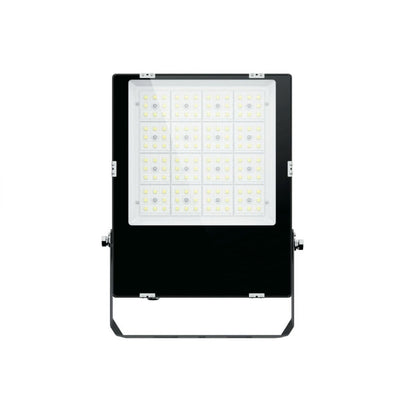
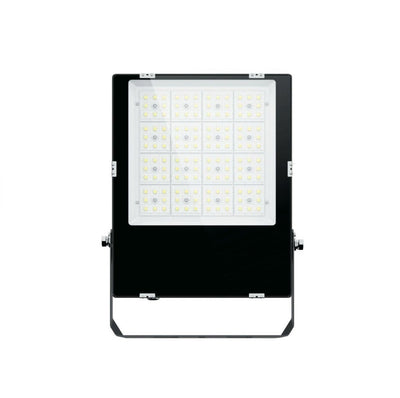
Product recommendations: 200W LED floodlights for commercial and industrial use
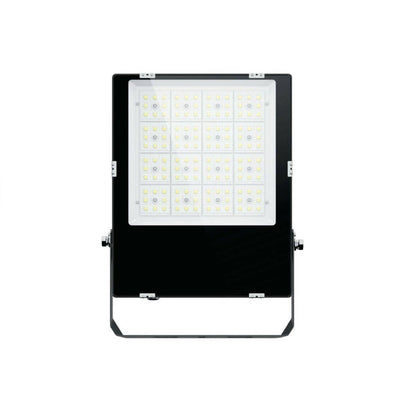
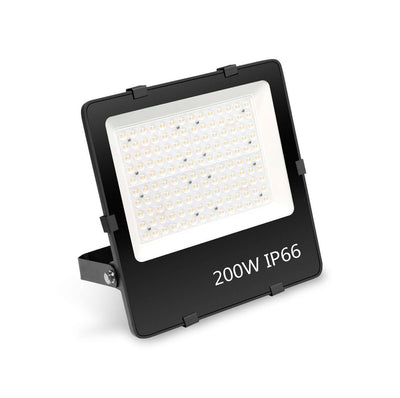
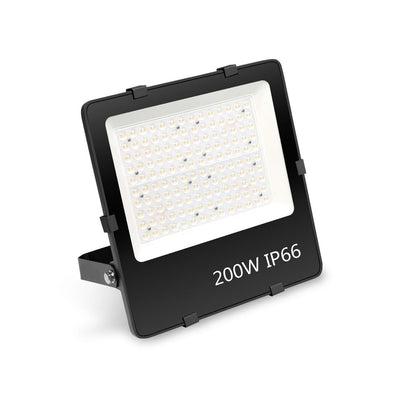
For operations yards, outdoor storage areas and sports facilities of lighting Class II/III, 200W floodlights with high luminous efficacy, IP66 and proven drivers are recommended. The following models from our LED floodlights range meet these requirements:

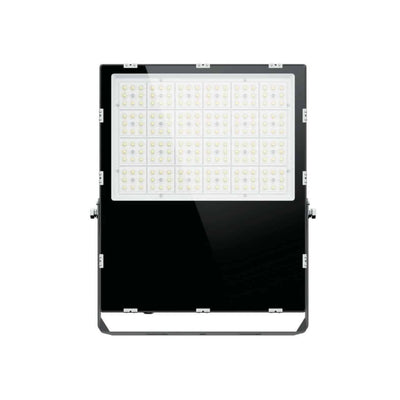
Product recommendations: 240W–400W LED floodlights for large areas and sports facilities
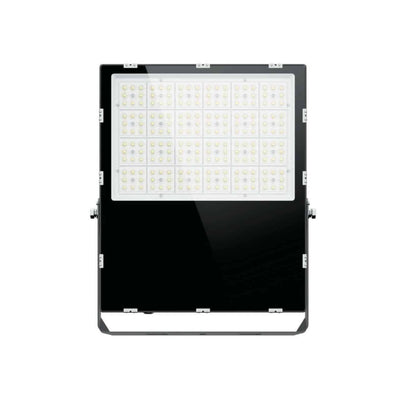
For large industrial sites, stadiums and sports facilities of lighting Class I/II, 240W to 400W floodlights with Meanwell or Sosen drivers and high luminous efficacy are a suitable choice. Our LED floodlights premium series offers solutions with 5 years' warranty:
Safety notice: installation and electrical connection
The installation and electrical connection of LED floodlights to 230V or 400V mains supplies must be carried out exclusively by qualified electricians. The electrical installation regulations of your country apply (in Germany, for example, DIN VDE 0100, DGUV Regulation 3 and the 5 safety rules). Work at heights above 3 m additionally requires suitable equipment and a risk assessment in accordance with the Industrial Safety Regulation (BetrSichV). This guide does not replace professional light planning or installation.
Frequently asked questions
How many watts should an LED outdoor floodlight have for a commercial car park?
This depends on the size of the car park, the mounting height and the required lux value. For a commercial car park with medium traffic volume, DIN EN 12464-2 requires a minimum of 10 lux. At a mounting height of 6–8 m and a pole spacing of 15–20 m, 100W to 150W floodlights with ≥ 150 lm/W are typically sufficient. A DIALux simulation provides the precise verification.
How many lumens do I need for my outdoor area?
Calculate the requirement using the formula: Required lumens = target lux value × area (m²) ÷ utilisation factor. For 50 lux over 200 m² with a utilisation factor of 0.6, the result is: 50 × 200 ÷ 0.6 = approx. 16,700 lumens. A 100W floodlight at 170 lm/W delivers 17,000 lumens – which fits this example. Distribute the luminaires so that the required uniformity is achieved.
Which LED floodlight do I need for a sports field?
This depends on the lighting class in accordance with DIN EN 12193. For training and recreational use (Class III, ≥ 75 lx), 200W floodlights on 8–10 m masts may be sufficient. For regional competition (Class II, ≥ 200 lx), 300W to 400W floodlights are generally required. Additional requirements apply for uniformity, colour rendering (Ra ≥ 65) and glare limitation. Our LED sports field lighting range offers suitable solutions.
Which protection rating do I need for LED floodlights used outdoors?
For permanent outdoor use, at least IP65 is required. IP66 provides additional protection against powerful water jets and is recommended for exposed locations. For mechanically stressed areas (public spaces, construction sites), IK08 should additionally be met. Our guide IP protection ratings explained provides full details.
How much electricity does a 200W LED floodlight consume running 10 hours a day?
A 200W LED floodlight consumes 200 Wh per hour, so 2 kWh per day at 10 hours of operation. Over a month (30 days) that is 60 kWh. A comparable halogen floodlight at 700–800W would consume 210–240 kWh – LED saves around 70–75% in energy costs here. Over several years this adds up to considerable savings, which our payback calculation sets out in detail.
Which halogen wattage does a 150W LED floodlight replace?
A 150W LED floodlight at 170 lm/W delivers approximately 25,500 lumens. A halogen floodlight at 18–20 lm/W would theoretically need to consume 1,275–1,420W to match this. In practice, a 150W LED floodlight typically replaces a 500W halogen floodlight, because halogen floodlights deliver significantly less usable light onto the surface than their rated luminous flux suggests, due to heat losses and ageing.
When do I need a 400W LED floodlight?
400W LED floodlights are used when large areas (500–1,000 m²) need to be illuminated from a great mounting height (12–20 m) with high illuminance (≥ 200 lx). Typical applications include stadiums, large sports facilities, port sites and extensive industrial areas. For standards-compliant sports facility lighting to DIN EN 12193 Class I, a 400W floodlight with Ra ≥ 65 and high uniformity is required.
Can LED floodlights be dimmed, and which protocols are supported?
Many professional LED floodlights support dimming via 0–10V or DALI. This enables demand-led control – for example, reduced output during low-activity periods or when integrated with motion sensors. When purchasing, ensure that the driver and control system are compatible. Our guide 0-10V, 1-10V & TRIAC dimming explains the differences between the common protocols.
Clightstore offers you a free DIALux light planning service with standards-compliant lux verification. Our light planners determine the optimum number of luminaires, mounting height and wattage for your specific area – based on your requirements and the applicable standards. EU-wide delivery in 2–5 working days, direct import, up to 5 years' warranty.
Request free light planning