Surface-Mounted or Recessed Spotlights? Choosing the Right LED Ceiling Spotlight
Surface-mounted or recessed spotlights – which LED ceiling spotlight suits which ceiling type, application and standard? The B2B decision guide for planners and buyers.
Whether surface-mounted or recessed spotlights: the right choice depends not on aesthetics but on the ceiling construction, the required lux level, the IP protection class and the installation effort involved. This guide provides planners, electricians and commercial buyers with a standards-based decision framework – from concrete ceilings to suspended grid ceilings.
- Surface-mounted spotlights are fixed directly onto the ceiling surface – no void required, ideal for concrete ceilings and existing buildings.
- Recessed spotlights sit flush with the ceiling and require a suitable void (the installation depth depends on the model – see the data sheet) as well as a suitable ceiling construction (plasterboard, grid ceiling).
- The standard DIN EN 12464-1 defines maintained illuminance values (Ēm) for workplaces; these determine the number and wattage of spotlights, not the other way around.
- The IP protection class and UGR limit value must be established before selecting luminaires – particularly in wet areas, outdoor environments and industrial settings.
- For concrete ceilings and industrial buildings, surface-mounted spotlights or track systems are recommended; for offices and retail spaces with grid ceilings, recessed spotlights are the more cost-effective solution.
The Basic Principle: What Distinguishes Surface-Mounted and Recessed Spotlights?
The decisive difference lies in the mounting method. A surface-mounted spotlight (also known as a surface-mounted downlight or surface-mounted spotlight) is screwed visibly onto the underside of the ceiling with its housing exposed. It requires only a ceiling back box or an accessible cable feed – no void, no cut-out.
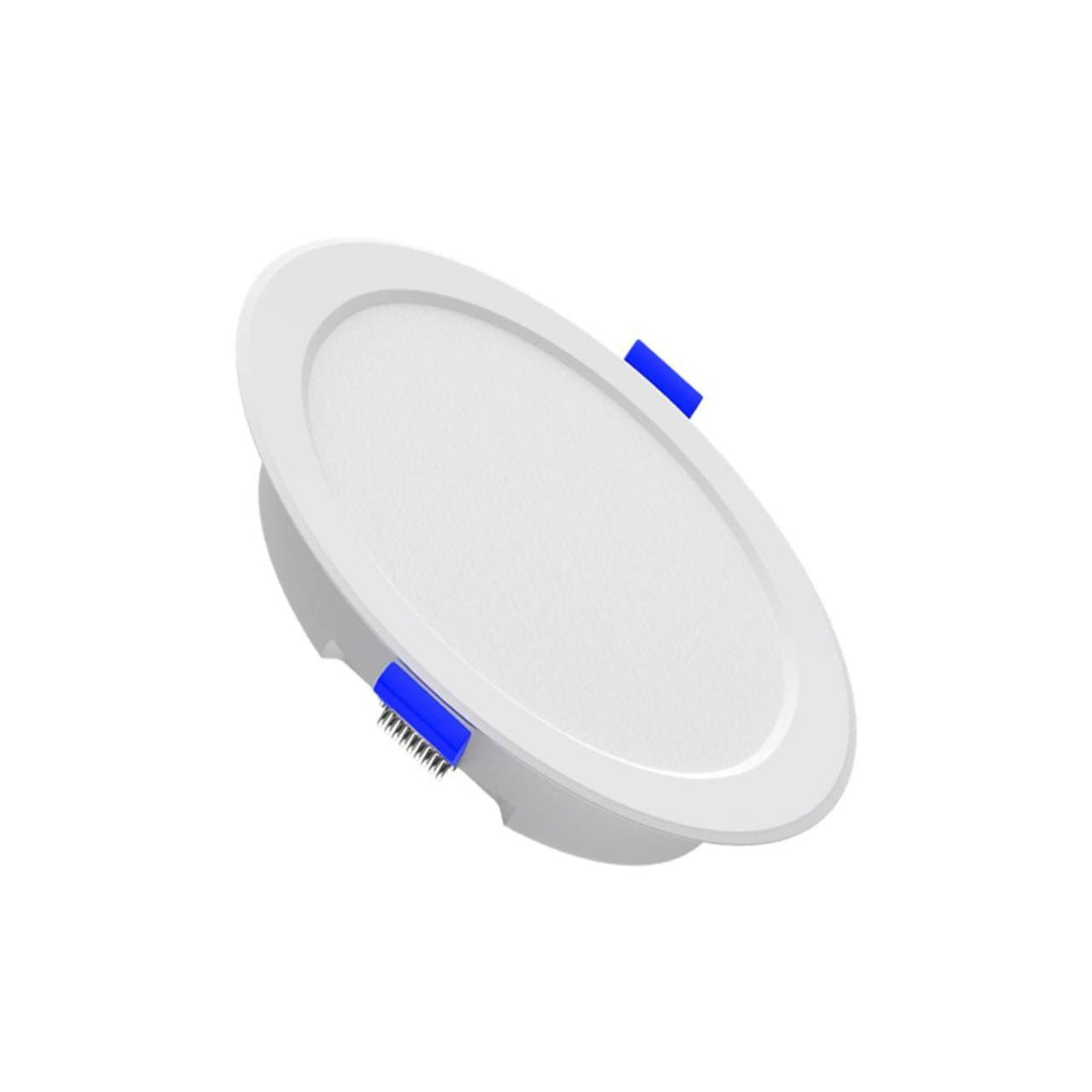
A recessed spotlight is inserted into a cut-out and sits flush with the ceiling surface. This requires a sufficiently deep void – deep enough for the fixture and the driver (see the data sheet). Without a suspended ceiling or plasterboard construction, a recessed spotlight cannot be installed.
Both types are available as LED ceiling spotlights and, depending on the model, can be dimmed, supplied in various colour temperatures and configured with different beam angles.
Decision Matrix: Which Spotlight Type Suits Which Situation?
The table below summarises the most important criteria. It does not replace a full light planning exercise but provides quick orientation for preliminary planning.
| Criterion | Surface-Mounted Spotlight | Recessed Spotlight |
|---|---|---|
| Ceiling construction | Concrete, timber, solid ceiling, any surface | Plasterboard, grid ceiling, hollow ceiling |
| Void required | None | Minimum 60–100 mm (model-dependent) |
| Installation effort | Low – direct fixing | Medium – cut-out, spring clips or mounting frame |
| Visual effect | Visible housing, compact body | Flush, visually calm, minimalist |
| Typical application | Existing buildings, industry, corridors, stairwells | New build, office, retail space, residential |
| Tenanted properties | Suitable (no ceiling penetration) | Limited (reinstatement more complex) |
| IP protection available | IP20 to IP65+ | IP20 to IP65 (depending on model) |
| Dimmability | Model-dependent (TRIAC, 0–10V) | Model-dependent (TRIAC, 0–10V) |
| Replacement / maintenance | Easily accessible | Accessible via the cut-out opening |
Note: our current LED surface-mounted spotlights are IP41 and therefore intended for dry interior areas. For damp or dusty areas, choose luminaires with the matching IP class, for example our LED tri-proof lights.
Installation Scenarios by Ceiling Type
Concrete Ceiling – Surface-Mounted Spotlight or Track
On bare concrete ceilings, a recessed spotlight is not possible without an additional sub-structure. Here, surface-mounted spotlights are the most cost-effective solution: they are fixed directly to the concrete surface using suitable anchors or plugs, and the cable feed is routed via a flush-mounted back box or a cable trunking solution. All connection work must be carried out by a qualified electrician.
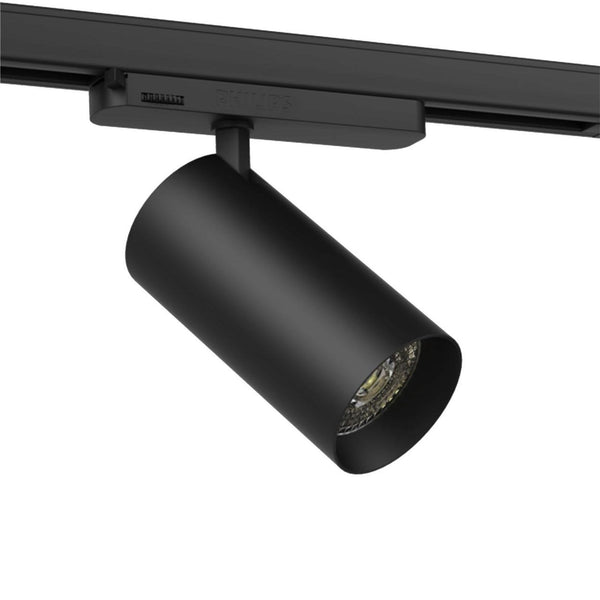
For larger areas with multiple spotlights, LED 3-phase track lights are a practical option. They allow flexible positioning without requiring additional electrical installation for each individual spotlight.
Plasterboard and Grid Ceilings – Recessed Spotlights
Suspended ceilings made from plasterboard or mineral fibre provide the ideal void for recessed spotlights. Before planning, measure the actual installation depth available – including insulation, the sub-structure and the minimum clearance from combustible materials.
Important: recessed spotlights without a fire-protection cover may only be used in insulated ceilings if the product is explicitly approved for this application. Otherwise, an intumescent fire hood is required.
Freestanding Halls and Industrial Buildings
In production and storage halls with ceiling heights from 4 m upwards, neither surface-mounted nor recessed spotlights are the first choice. In these situations, LED high bays or linear light systems are used. For ceiling heights up to 4 m, however, high-output surface-mounted spotlights or downlights can be appropriate – for example in welfare rooms, changing areas or office spaces within a hall.

Standards-Based Lux Requirements: What Must the Lighting Achieve?
Before specifying the spotlight type and wattage, define the lux target. DIN EN 12464-1 sets maintained illuminance values (Ēm) for indoor workplaces – these are minimum values that must not be fallen below on average throughout the entire service life.
| Application area | Ēm (Lux) | UGR max. | Ra min. | Recommended spotlight type |
|---|---|---|---|---|
| Corridor, stairwell | 100 | 28 | 40 | Surface-mounted or recessed spotlight |
| Storage without reading tasks | 100 | 25 | 60 | Surface-mounted spotlight, downlight |
| Storage with reading tasks / despatch | 300 | 25 | 60 | Surface-mounted spotlight, high bay |
| Office, desk work | 500 | 19 | 80 | Recessed spotlight, LED panel |
| Industry, medium-precision work | 300 | 22 | 80 | Surface-mounted spotlight, high bay |
| Industry, fine-precision work | 500 | 19 | 80 | High bay, task light |
| Retail space, shop floor | 300–500 | 22 | 80 | Recessed spotlight, track system |
For a detailed overview of all lux reference values, we recommend our guide How much lux do you need?. The UGR value and its significance for glare limitation are explained in our article UGR value explained.
Rule of Thumb: How Many Spotlights Do I Need?
A simple planning formula for preliminary sizing (not a substitute for a DIALux calculation):
Number of luminaires = (Area m² × Ēm lux) ÷ (Luminous flux per luminaire lm × Maintenance factor)
The maintenance factor is typically 0.80 for clean office environments and 0.67 for industrial environments with dust or dirt. An example: for a 50 m² office with a target of 500 lux and recessed spotlights each producing 700 lm (maintenance factor 0.80), the calculation gives: (50 × 500) ÷ (700 × 0.80) = 44.6 → approximately 45 spotlights. In practice, higher-output units or LED panels are used to reduce the number of luminaires.
For precise calculations incorporating reflectance values, room geometry and maintenance factors, we offer a free DIALux light planning service – please get in touch.
IP Protection Classes: What Applies Where?
The IP protection class in accordance with IEC 60529 determines which spotlight may be used in which environment. For wet areas, outdoor environments and industrial settings, the IP class must be established as a binding requirement before selecting luminaires.
A full explanation of all IP classes can be found in our guide IP protection classes explained. For wet-area applications, LED tri-proof lights are also available, specifically designed for these requirements.
| IP class | Protection against | Typical location | Spotlight type |
|---|---|---|---|
| IP20 | Contact (finger), no water protection | Dry interiors, office, residential | Surface-mounted or recessed spotlight |
| IP44 | Splash water from all directions | Bathroom zone 2, covered outdoor area | Surface-mounted spotlight IP44 |
| IP54 | Limited dust protection, splash water | Production halls, workshops | Surface-mounted spotlight IP54 |
| IP65 | Full dust protection, water jets | Outdoor areas, washrooms, food industry | Surface-mounted spotlight IP65, tri-proof light |
| IP67 | Full dust protection, temporary immersion | Outdoor installations, cleaning areas | Specialist luminaire IP67 |
LED Surface-Mounted Spotlights: Product Recommendations for Offices, Corridors and Commercial Use
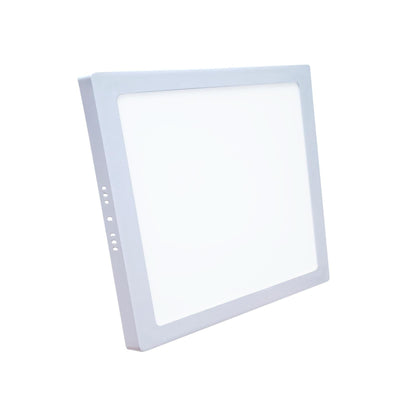
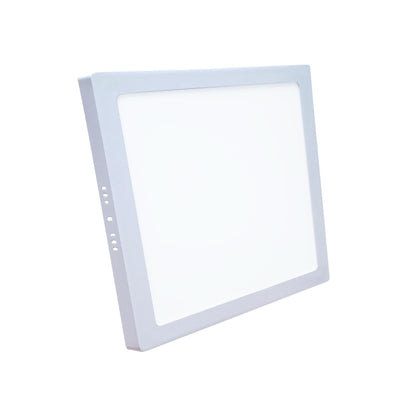
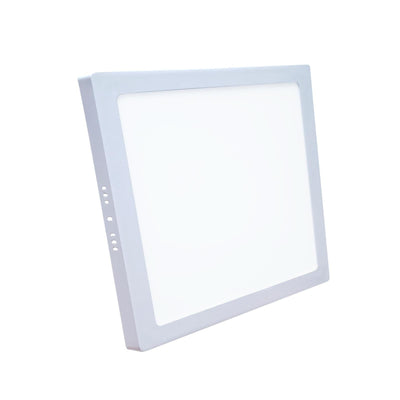
Our round and square LED surface-mounted spotlights can be fixed directly onto any ceiling surface – no void required. They are available in 6W, 12W and 24W (120, 170 and 300 mm), in 3000K, 4000K or 6000K, with IP41 and a 3-year warranty.

LED Recessed Spotlights: Product Recommendations for Grid Ceilings and New Build
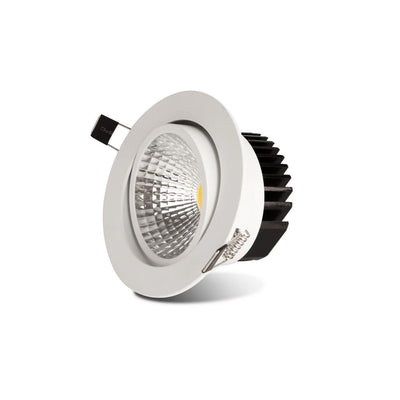
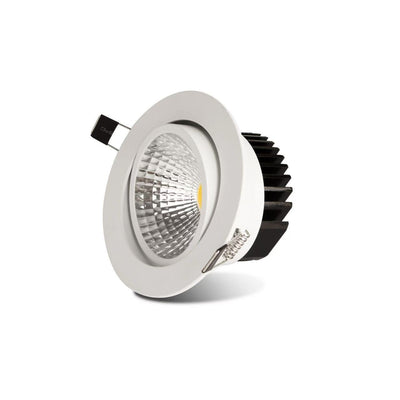
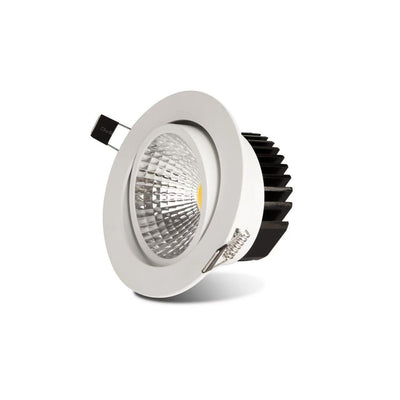
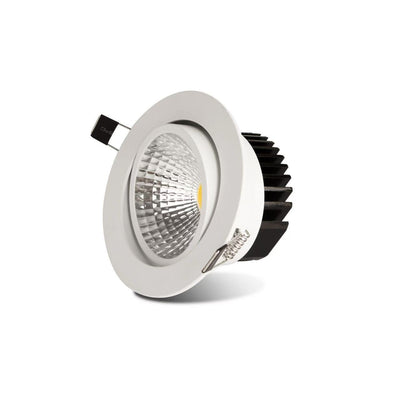
Our LED recessed spotlights are available from 3W to 9W, in 2700K, 3000K, 4000K and 6000K, with IP41, a 55° beam angle and cut-out diameters from Ø70 to Ø104 mm. All models come with a 3-year warranty.
Dimmability and Colour Temperature: What Needs to Be Clarified Before Purchase?
Dimmability
Not every LED spotlight is dimmable. For dimmable applications, both the spotlight and the dimmer must be compatible. Common dimming protocols are TRIAC (leading-edge/trailing-edge phase cut) for residential and office environments, and 0–10V or DALI for commercial installations. Our guide 0–10V, 1–10V & TRIAC dimming explains the differences.
Colour Temperature
Colour temperature has a significant influence on working atmosphere and perception. For offices and work areas, 4000K (neutral white) is recommended; for residential and reception areas, 3000K (warm white); for storage areas and production halls, 5000–6000K (daylight white) for improved visibility. A detailed explanation is provided in our guide LED colour temperature: 2700K to 6000K.
Safety Notice: Electrical Installation
All connection and mounting work on 230V circuits must be carried out exclusively by a qualified and approved electrician. The electrical installation regulations of your country apply (in Germany, for example, DIN VDE 0100, DGUV Regulation 3 and the 5 safety rules). This guide does not replace professional electrical planning.

Alternatives: When Are Other Luminaire Types More Suitable?
Surface-mounted and recessed spotlights are not the optimum solution for every application. The overview below shows when other luminaire types are more appropriate:
- Large open-plan offices and schools: LED panels (e.g. 60×60 cm or 120×60 cm) deliver more uniform light distribution with a low UGR value.
- Production and storage halls with ceiling heights from 4 m: LED high bays or linear high bays are more efficient.
- Retail spaces with accent lighting: LED 3-phase track lights allow flexible aiming without new installation.
- Wet areas and outdoor environments: LED tri-proof lights or IP65 surface-mounted spotlights.
- Outdoor installations and façades: LED floodlights from 10W for targeted area illumination.
Frequently Asked Questions
How much installation depth do I need for an LED recessed spotlight?
The required installation depth varies by model. The fixture height of our LED recessed spotlights is 26.5 to 40 mm; the exact installation depth including the driver is given in the product data sheet. Measure the available void before ordering – including insulation and the ceiling sub-structure – and allow space for the cable feed.
Can I mount surface-mounted spotlights on a concrete ceiling?
Yes, this is the classic application for surface-mounted spotlights. They are fixed using suitable concrete anchors or plugs. The cable feed is routed via a flush-mounted back box or cable trunking. No void is required. The electrical connection must be made by a qualified electrician.
What IP class do I need for outdoor use?
For covered outdoor areas (e.g. carports, roof overhangs), a minimum of IP44 is required. For exposed outdoor areas subject to direct rainfall, we recommend IP65. In areas subject to high-pressure cleaning or heavy dust, IP67 or higher is necessary. Further details can be found in our guide IP protection classes explained.
Can I dim LED recessed spotlights with a GU10 base without any issues?
Only if the lamp and the dimmer are compatible. Check that the spotlight is listed as "dimmable" and use a TRIAC dimmer suitable for LED. Not all dimmers that worked with halogen lamps are compatible with LED. Our dimmable recessed spotlights are explicitly marked as TRIAC-dimmable.
How do I calculate the light cone and the spacing between spotlights?
The light cone is determined by the beam angle and the mounting height. Rule of thumb: illuminated diameter ≈ 2 × mounting height × tan(half beam angle). With a 38° beam angle and a mounting height of 2.5 m, the cone diameter is approximately 1.8 m. For uniform illumination, adjacent light cones should overlap slightly. For precise calculations, use our free DIALux light planning service.
Are LED recessed spotlights also available in warm white with a wide beam angle?
Yes. Our recessed spotlights are available in 2700K and 3000K (warm white), as well as in 4000K and 6000K. The beam angle is 55°, which gives focused general lighting for rooms with moderate ceiling heights. The exact angle is given in the respective product data sheet.
Which standard applies to workplace lighting?
The key standard is DIN EN 12464-1 (Lighting of indoor workplaces). It defines maintained values for illuminance (Ēm in lux), glare limitation (UGR) and colour rendering (Ra) for various activity areas. For sports facilities, DIN EN 12193 additionally applies. Our light planning takes all relevant standards into account.
When is a track system preferable to individual ceiling spotlights?
Track systems are preferable when spotlights need to be positioned flexibly or repositioned at a later stage – for example in retail spaces, showrooms or exhibition areas. They allow multiple spotlights to be connected to a single cable feed without individual installation runs. More information is available in our guide LED track system and track spotlights.
Send us your floor plan or dimensions and receive a free, no-obligation DIALux light study: a 3D light plan, lux values, a product list and a savings overview. Directly imported products, EU-wide delivery in 2–5 working days and up to 5 years' warranty.
Request free light planning