LED Track Lighting System: Wattage, Beam Angle, CRI & Light Planning
Standards-compliant light planning for 3-phase track lighting systems: wattage, beam angle, CRI and load distribution for industrial, retail and commercial applications.
An LED track lighting system combines maximum flexibility with precise light direction – provided the wattage, beam angle and CRI value are matched to the specific application. This guide shows you how to plan a 3-phase system in compliance with DIN EN 12464-1, distribute loads correctly and select the right luminaires for industrial, retail and commercial use.
- 3-phase tracks allow three independently controllable circuits on a single track – ideal for zone-based lighting.
- The beam angle determines whether a spotlight accentuates (15–30°), illuminates merchandise (30–45°) or floods surfaces (45–60°).
- CRI ≥ 80 applies to general lighting; colour-critical retail, galleries and quality control call for CRI ≥ 90.
- The lumen calculation follows the formula: target lux × area ÷ maintenance factor = total lumens required.
- Connection and installation to 230V/400V must be carried out exclusively by qualified electricians (national electrical regulations apply).
1-Phase vs. 3-Phase Track: System Comparison
The fundamental difference lies in the number of switchable circuits. A 1-phase track carries a single circuit; all mounted spotlights switch and dim together. This is sufficient for straightforward applications with a uniform lighting requirement.
A 3-phase track, by contrast, carries three galvanically isolated phases. Each phase can be switched, dimmed or addressed via the DALI protocol independently. This enables zone-based lighting scenarios on a single track – without any additional cabling.
| Criterion | 1-Phase Track | 3-Phase Track |
|---|---|---|
| Circuits | 1 | 3 (independently controllable) |
| Max. load per track | approx. 3,680W (16 A) | 3 × 3,680W (16 A per phase) |
| Zone control | No | Yes (3 zones) |
| DALI integration | Limited | Fully possible |
| Compatibility | Manufacturer-specific | European standard (IEC 60570) |
| Installation effort | Low | Medium (5-conductor supply) |
| Typical application | Residential, small shops | Retail, industry, commercial, museums |
For commercial projects with more than one lighting zone, the 3-phase system is generally recommended. The additional cost is offset by the elimination of separate switching circuits and the greater planning flexibility. Our LED 3-phase track lights are compatible with the European standard profile.
Beam Angle: Which Angle for Which Application?
The beam angle is the most important optical parameter of a track spotlight. It determines how concentrated or wide-spread the light is on the working surface. Too wide an angle at a great ceiling height leads to light losses; too narrow an angle creates harsh shadows and uneven illumination.
Beam Angle Matrix by Ceiling Height and Application
| Beam Angle | Wattage Range | Ceiling Height | Typical Application |
|---|---|---|---|
| 15–24° | 5–15W | 2.5–3.5 m | Accent lighting, exhibits, jewellery |
| 24–36° | 15–30W | 3–5 m | Merchandise lighting, shelving, checkouts |
| 36–45° | 20–40W | 4–6 m | General lighting for retail, offices |
| 45–60° | 30–50W | 5–8 m | Area illumination for industry, warehouses |
| 60–90° | 40–60W | 6–10 m | High-bay racking, production halls |
For ceiling heights above 6 m in industrial halls or warehouses, you should consider spotlights with asymmetric optics or secondary lenses. Read more in our guide on symmetric and asymmetric light distribution in LED luminaires.

CRI Value: Choosing Colour Rendering in Compliance with Standards
The CRI (Colour Rendering Index, Ra) describes how natural colours appear under a light source. The value ranges from 0 to 100, where 100 corresponds to daylight. For commercial applications, the CRI value is not merely a question of quality but a normative requirement under DIN EN 12464-1.
Typical CRI Recommendations by Application Area
The following overview shows typical recommendations. EN 12464-1 sets the exact minimum Ra per visual task, so check the value for your specific application. Higher CRI values are always permissible – they improve work quality and reduce error rates in colour-critical tasks.
- CRI ≥ 60: General storage, circulation areas, outdoor areas
- CRI ≥ 80: Offices, screen-based work, general production, precision engineering, general retail
- CRI ≥ 90: Quality control, colour inspection, galleries, textiles, fresh food, medical examination rooms
For colour temperature – whether 3,000 K warm white or 4,000 K neutral white is more suitable – please refer to our separate guide on LED colour temperature: 2700K to 6000K.
Standards-Compliant Lux Values: DIN EN 12464-1 for B2B Applications
DIN EN 12464-1:2021 defines minimum values for illuminance (maintained value Em in lux), glare limitation (UGR) and colour rendering (Ra) in workplaces. For the light planning of a track lighting system, these values are the starting point – not the product.
| Area / Activity | Em (Maintained Value) | UGR max. | Ra min. |
|---|---|---|---|
| Warehouse, general | 100–200 lx | 25 | 60 |
| Office / screen-based work | 500 lx | 19 | 80 |
| Precision engineering / assembly | 750 lx | 19 | 80 |
| Quality control / inspection | 1,000 lx | 16 | 90 |
| Retail (general) | 300–500 lx | 22 | 80 |
| Retail (accent) | 750–1,000 lx | 22 | 90 |
| Sports hall (training) | 300 lx | 22 | 65 |
| Sports hall (competition) | 500–750 lx | 19 | 80 |
For sports facility lighting, DIN EN 12193 additionally applies. Detailed light planning principles for sports facilities can be found in our guide on light distribution on sports fields. The UGR value and its practical significance are explained in our guide on UGR value and glare limitation.
Lumen Calculation: How Many Spotlights Do You Need?
Before determining the number of spotlights and their wattage, calculate the actual lighting requirement. The basic formula is:
Total lumens = target lux × room area (m²) ÷ maintenance factor
The maintenance factor (MF) for LED systems in clean indoor environments is typically 0.80. In dusty industrial environments, you should use 0.67 to 0.71. The reciprocal (1 ÷ MF) gives the planning uplift.
Worked Example: Assembly Hall 20 × 15 m, Target Illuminance 500 lx
- Room area: 20 × 15 = 300 m²
- Total lumens (MF = 0.80): 500 × 300 ÷ 0.80 = 187,500 lm
- Spotlights with 3,000 lm each (30W, 100 lm/W): 187,500 ÷ 3,000 = 63 spotlights
- Distributed across 3 phases: 21 spotlights × 30W = 630W per phase (well within the 3,680W limit)
This simplified method does not account for reflectance values or the room utilisation factor. For standards-compliant light planning, we recommend a DIALux calculation. Fundamentals of lux calculation can also be found in our guide How much lux do you need? and in the article on calculating hall lighting.
Complete sets for rapid project realisation: 3-phase track lighting sets with spotlights, connectors and power feeds.

3-Phase Load Planning: Phase Distribution, Protection and DALI
Correct load distribution is the most critical planning step in 3-phase systems. Uneven distribution places stress on the neutral conductor and can lead to voltage asymmetry.
Basic Rules for Phase Distribution
- Distribute evenly: Arrange the spotlights so that all three phases carry approximately equal loads (deviation max. 10–15%).
- Allow for inrush current: LED drivers produce brief current spikes at switch-on. Protect each phase with a Type B or C miniature circuit breaker – dimensioning is determined by the qualified electrician.
- Plan the power feed: The power feed should ideally be positioned at the centre of long track runs to minimise voltage drop.
- DALI integration: With DALI-capable drivers, each spotlight can be individually addressed. Plan DALI lines per phase separately; one DALI segment supports up to 64 devices.
Safety notice: All work on the 230V/400V installation – power feed, protection, cable routing – must be carried out exclusively by approved qualified electricians. The electrical installation regulations of your country apply (in Germany, for example, DIN VDE 0100, DGUV Regulation 3 and the 5 safety rules). Further guidance on safe connection can be found in our guide connecting LED luminaires.
Connectors and System Accessories
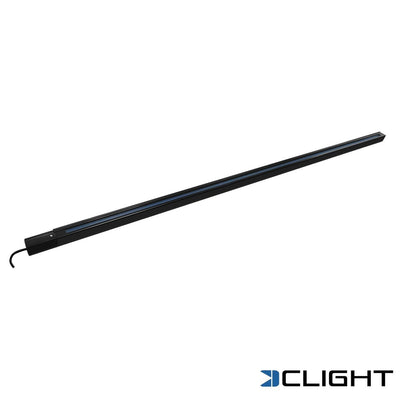
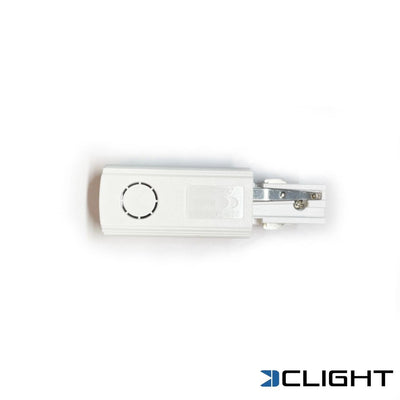
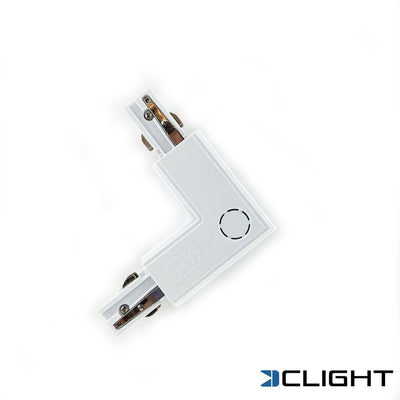
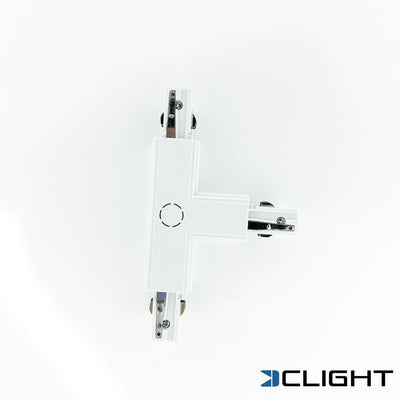
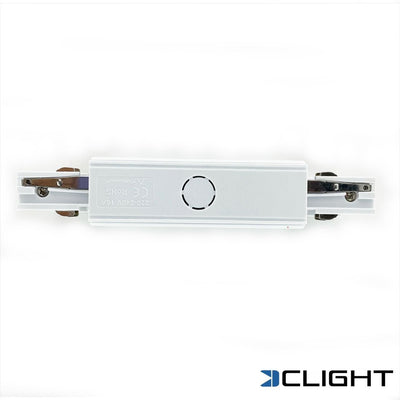
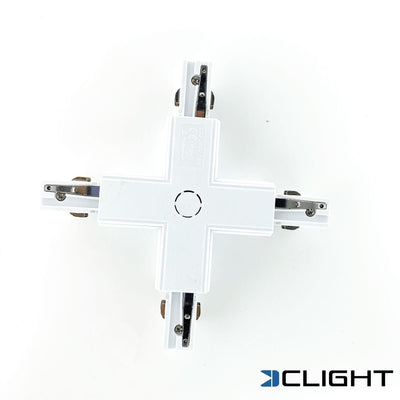
The track system is assembled into any desired layout using connectors. For straight extensions use the I-connector, for corners the L-connector, for T-shaped branches the T-connector and for crossings the X-connector. The power feed is made via a dedicated feed-in unit that accepts the 5-conductor supply (L1, L2, L3, N, PE).
System accessories for your 3-phase track lighting system: tracks, connectors and power feeds for a clean, standards-compliant installation.
Spotlight Selection: Wattage and Light Quality by Segment
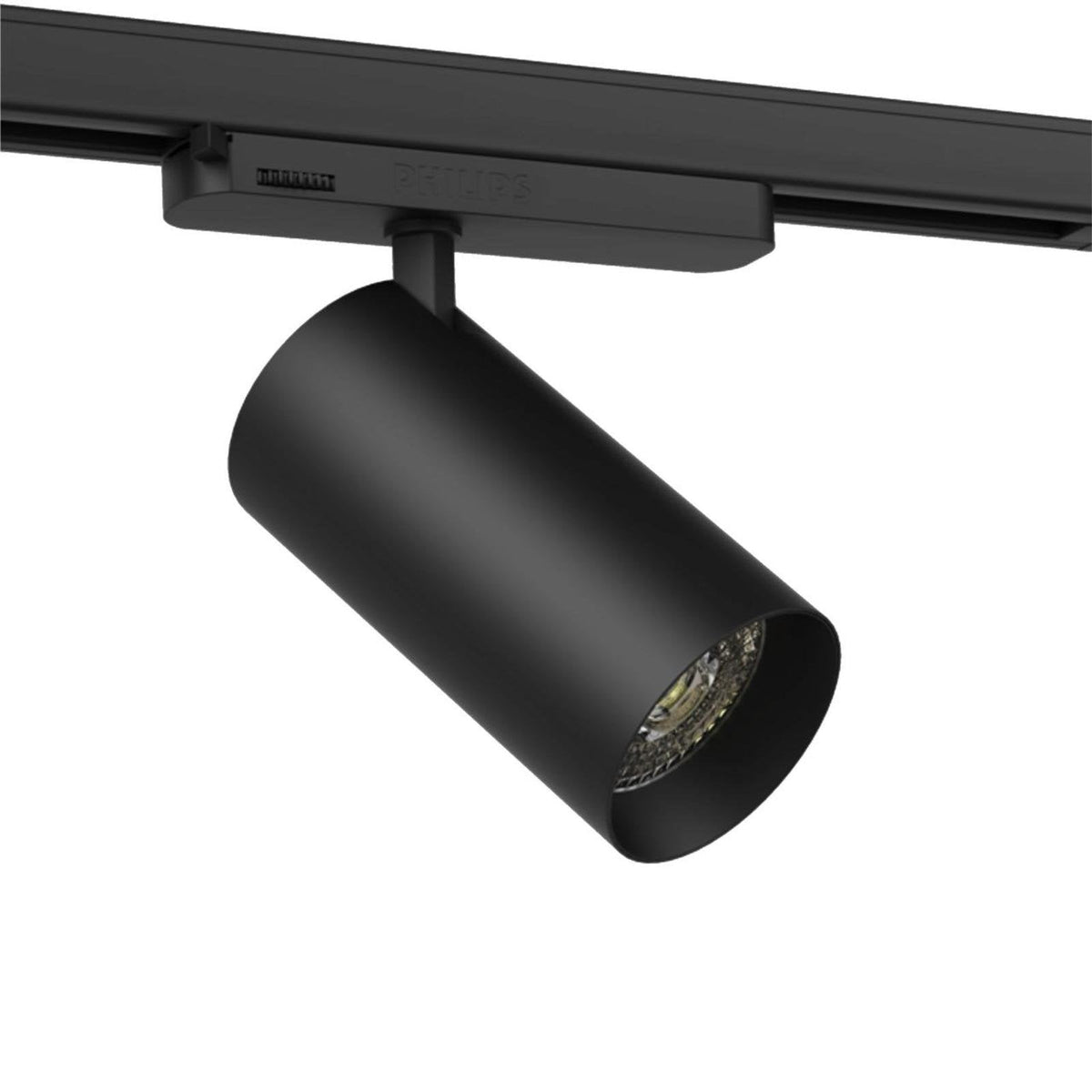
Spotlight selection follows from the light planning parameters established earlier: lux target, ceiling height, beam angle and CRI. For standard retail and commercial applications, 10–30W spotlights with a 36° beam angle and CRI ≥ 80 are the most common choice. For accent lighting in galleries or jewellery shops, 10–15W spotlights with 15–24° and CRI ≥ 90 are recommended.
For industrial halls with ceiling heights above 6 m and illuminance requirements above 500 lx, track spotlights with 40–60W and a wide beam angle or asymmetric optics are required. Alternatively, LED high bays are well suited to these heights and can be mounted as pendant luminaires on the track. For warehouse applications, also refer to our warehouse lighting guide.
For outdoor applications – such as covered loading bays or carports – you require track spotlights with at least IP44. Note that the track itself must also carry the required ingress protection rating. Our guides on IP protection ratings explain the practical differences between IP44, IP54 and IP65.
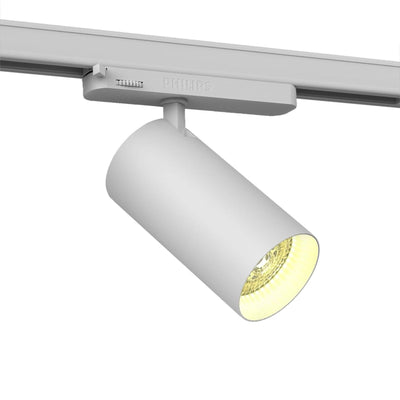
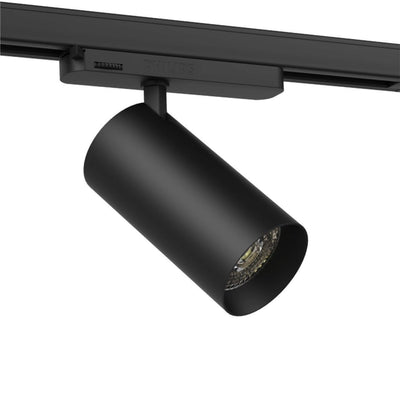
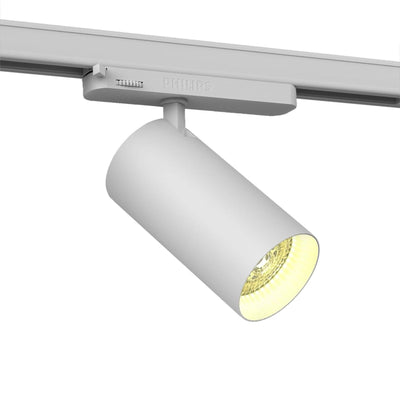
Proven 3-phase track spotlights for retail, commercial and industrial use – with a 5-year guarantee.
Frequently Asked Questions about LED Track Lighting Systems
Are all 3-phase tracks compatible with one another?
Most 3-phase tracks follow the European standard to IEC 60570 with a uniform adapter cross-section. Spotlights from different manufacturers are generally compatible, provided both conform to the standard. Nevertheless, check the manufacturer's specifications before purchasing, as proprietary profiles do occasionally exist.
How many watts do I need at a 3 m ceiling height?
At a ceiling height of 3 m and a beam angle of 36°, 15–30W per spotlight is typically sufficient for general lighting (300–500 lx). For accent lighting, 10–15W with a narrower angle is adequate. The decisive factor is the luminous flux required at the working surface – calculate this using the formula: target lux × area ÷ maintenance factor.
Can I mix spotlights from different manufacturers on one track?
Yes, provided all spotlights conform to the IEC 60570 standard. Note, however, that DALI control and dimming behaviour can vary between manufacturers. For consistent light quality and straightforward maintenance, using a single spotlight type per track run is recommended.
Is 3-phase really worth it compared to 1-phase?
For projects with more than one lighting zone or planned dimming operation, 3-phase is almost always worthwhile. The additional cost for the track and power feed is modest; the elimination of separate switching circuits and the greater planning flexibility more than compensate. For simple single rooms without zone control, 1-phase may suffice.
Which CRI value is recommended for food retail?
DIN EN 12464-1 recommends Ra ≥ 90 for sales areas with fresh produce (meat, fruit, vegetables) in order to render colours true to nature. For general sales floors, Ra ≥ 80 is the minimum value stipulated by the standard.
How do I plan the load distribution across three phases?
Divide the total number of spotlights as evenly as possible across the three phases. Do not deviate by more than 10–15% from equal distribution. Enter the wattage of each spotlight into a phase table and verify that no phase exceeds the 16 A limit (3,680W at 230V). The final protection arrangement is determined by the qualified electrician.
What ingress protection rating do track spotlights need for outdoor use?
For covered outdoor areas (carports, loading ramps), a minimum of IP44 is required. Where direct exposure to rain is possible, IP65 is recommended. Note that the track itself must also carry the appropriate ingress protection rating. Details on IP protection ratings can be found in our IP protection ratings guide.
Can track spotlights be dimmed via DALI?
Yes, provided the spotlights are fitted with DALI-capable drivers. One DALI segment supports up to 64 addressable devices. Plan DALI lines per phase separately and ensure that the DALI gateway is suited to the number of devices. Read more about dimming protocols in our guide on 0-10V, 1-10V and TRIAC dimming.
Our light planning team will produce a free DIALux light plan for you – standards-compliant to DIN EN 12464-1, with phase distribution, spotlight count and lux verification. EU-wide delivery in 2–5 working days, up to 5 years' guarantee.
Request a free light plan