Warehouse Lighting Calculation: Lux, Number of Luminaires & Spacing
How many LED high bays do you actually need? Calculate illuminance, number of luminaires and optimum spacing – with standards tables, zone planning and B2B product recommendations.
The number of LED high bays required is determined by the floor area, the required illuminance (lux), the luminous flux per luminaire and the maintenance factor to DIN EN 12464-1. Using the correct formula and the calculators on this page, you can determine the number of luminaires, optimum spacing and wattage for every zone of your facility – before you place your order.
- Basic formula: Number of luminaires = (Em × Area) ÷ (Luminous flux per luminaire × Maintenance factor × Efficiency)
- Maintenance factor to DIN EN 12464-1 is 0.8 as standard – reduce to as low as 0.45 in dusty environments or rooms with dark walls
- Luminaire spacing must not exceed 1 to 1.5 times the mounting height, otherwise dark zones will occur
- Wattage is determined by mounting height: up to 6 m → 100W, 6–8 m → 150W, 8–10 m → 200W, above 10 m → 240–300W
- Calculate different facility zones (storage, dispatch, workbench) separately – this saves luminaires and energy
The Basic Formula: How to Calculate the Number of Luminaires
Light planning calculations for warehouses and industrial facilities are based on the maintained illuminance (Em) to DIN EN 12464-1. The formula is:
N = (Em × A) ÷ (Φ × MF × η)
Here N is the number of luminaires, Em is the required maintained illuminance in lux, A is the floor area in m², Φ is the luminous flux of one luminaire in lumens, MF is the maintenance factor and η is the light distribution efficiency (typically 0.7–0.85 depending on the reflectance of walls and ceiling).
Lumens per m² as a Quick Estimate
As an approximation: divide the target lux value by the assumed overall efficiency (MF × η) to obtain the required luminous flux per m². With MF = 0.8 and η = 0.75, this gives a factor of 0.6. For 100 lx you therefore need approximately 167 lm/m², for 300 lx approximately 500 lm/m², and for 500 lx approximately 833 lm/m². This approximation does not replace a full light planning exercise, but is suitable for an initial quantity estimate.
Important: Mounting Height, Not Ceiling Height
Always use the actual mounting height of the luminaires above the working plane (typically 0.85 m above floor level), not the ceiling height. In a facility with a 10 m ceiling, luminaires mounted at the ceiling and a working plane at 0.85 m, the mounting height is 9.15 m. This is one of the most common errors in practice and leads to systematic under-illumination.
Standards-Compliant Lux Requirements to DIN EN 12464-1
DIN EN 12464-1 defines a maintained illuminance (Em), a UGR limit and a colour rendering index Ra for every type of activity. These values are the binding basis for light planning. ASR A3.4 supplements the standard with legally binding requirements for workplaces.
| Activity Area | Em (Lux) | UGR max. | Ra min. | Typical Wattage (8 m height) |
|---|---|---|---|---|
| Storage (rough, infrequently used) | 100 | 28 | 40 | 100W |
| Dispatch / Packing | 300 | 25 | 60 | 150W |
| Assembly (rough) | 300 | 25 | 60 | 150W |
| Assembly (medium) | 500 | 22 | 80 | 200W |
| Fine assembly / Electronics | 1,000 | 16 | 90 | 200W + task light |
| Production facility (general) | 300–500 | 22–25 | 80 | 150–200W |
| Sports hall Class III (DIN EN 12193) | 200 | – | 65 | 100–150W |
| Sports hall Class I (DIN EN 12193) | 750 | – | 65 | 200–240W |
Detailed lux requirements for all areas can be found in our guide How much lux do you need?. For sports halls we also recommend the guide Light distribution on sports fields.

Wattage and Beam Angle by Mounting Height
The mounting height determines which wattage and beam angle are appropriate. A beam angle that is too wide at a great height results in stray light and poor uniformity. A beam angle that is too narrow creates bright spots with dark areas in between.
| Mounting Height | Recommended Wattage | Beam Angle | Max. Luminaire Spacing | Luminous Flux (guideline) |
|---|---|---|---|---|
| Up to 5 m | 70–100W | 90–120° | 5–6 m | 10,000–15,000 lm |
| 5–7 m | 100–150W | 90–120° | 6–8 m | 15,000–22,500 lm |
| 7–9 m | 150–200W | 60–90° | 8–10 m | 22,500–30,000 lm |
| 9–12 m | 200–240W | 60° | 10–12 m | 30,000–36,000 lm |
| 12 m and above | 240–300W | 45–60° | 12–15 m | 36,000–45,000 lm |
Our guide Symmetrical and asymmetrical light distribution in LED luminaires explains beam angles and their effect on light distribution in greater detail.
Calculating Luminaire Spacing
The maximum spacing between two luminaires should not exceed 1 to 1.5 times the mounting height. At a mounting height of 8 m, this means a maximum spacing of 8–12 m. Towards the walls, half this value should be used as the perimeter offset to avoid dark zones along the facility walls.
Zone-Based Light Planning: Different Lux Requirements Within One Facility
Most industrial facilities consist of several zones with different requirements. A storage area requires 100 lx, the adjacent dispatch area 300 lx and the workbench 500 lx. Illuminating all zones to the highest lux value wastes energy and capital expenditure.
Practical Example: Production Facility 2,000 m²
Zone A – Storage (800 m², Em = 100 lx, MF = 0.8, η = 0.75): N = (100 × 800) ÷ (15,000 × 0.8 × 0.75) = 80,000 ÷ 9,000 = 8.9 → 9 high bays at 100W. Zone B – Dispatch (600 m², Em = 300 lx, MF = 0.8, η = 0.75): N = (300 × 600) ÷ (22,500 × 0.8 × 0.75) = 180,000 ÷ 13,500 = 13.3 → 14 high bays at 150W. Zone C – Assembly (600 m², Em = 500 lx, MF = 0.8, η = 0.75): N = (500 × 600) ÷ (30,000 × 0.8 × 0.75) = 300,000 ÷ 18,000 = 16.7 → 17 high bays at 200W. Total requirement: 40 high bays instead of approximately 56 had the entire facility been designed uniformly to 500 lx.
For professional zone-based light planning with DIALux simulation, Clightstore offers a free light planning service.
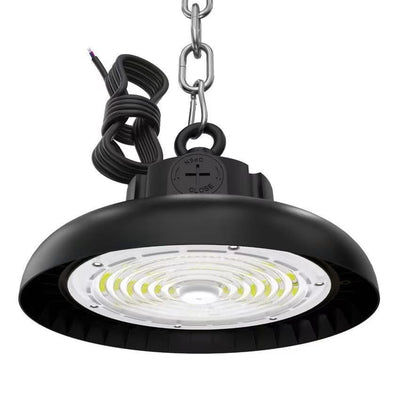
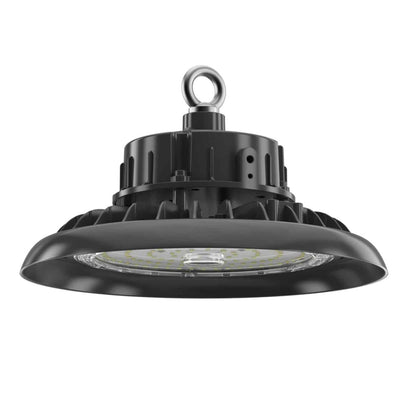
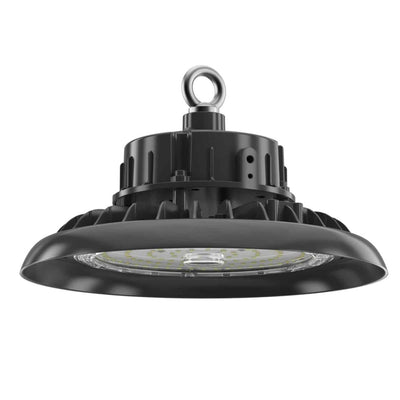
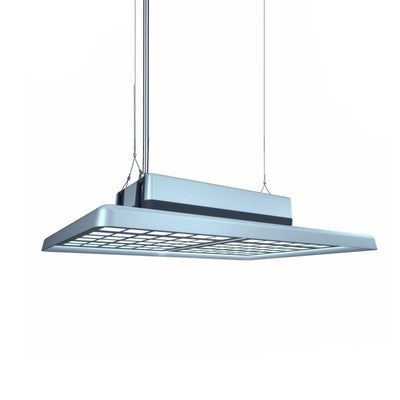
LED high bays for low to medium mounting heights (up to 8 m) – 100W and 150W with Philips or SOSEN driver, IP65, 5-year warranty:

Maintenance Factor: The Most Frequently Underestimated Planning Parameter
The maintenance factor (MF) accounts for the reduction in luminous flux due to lamp ageing and soiling over time. DIN EN 12464-1 sets it at 0.8 as standard. In practice, many planners deviate from this – with significant consequences.
Which Maintenance Factor to Use and When
In clean office or retail environments, 0.8 is realistic. In production facilities with dust, oil vapour or dark walls and racking reaching up to the ceiling, you should calculate with 0.6 or even 0.45. Anyone who plans with 0.8 but operates in a dusty environment will often find that only 60–70% of the planned illuminance remains after a few years.
Regular cleaning intervals (at least annually) and the use of IP65 luminaires extend maintenance cycles and justify a higher maintenance factor. Our guide IP protection ratings explained provides further detail on IP classifications.
Sector-Specific Requirements: Industry, Warehousing, Sport, Outdoors
Industrial and Production Facilities
General production areas require 300–500 lx, UGR ≤ 22 and Ra ≥ 80. Neutral white light at 4,000K is the standard, as it promotes concentration and renders colours accurately. Dimmable luminaires with 1-10V or DALI interfaces enable daylight-responsive control and can significantly reduce energy consumption depending on the usage profile. In areas at risk of explosion, only ATEX-certified LED luminaires are permitted – further details are available in our guide ATEX & Ex-protection LED lighting.
Warehouses and Logistics
High-bay warehouses require at least IP65 and IK08, as forklift trucks and stacker cranes cause mechanical impacts. The guide Warehouse lighting covers high-bay-specific requirements in detail. For aisles between racking, linear high bays are recommended as they direct light precisely into the aisle.
Sports Halls
DIN EN 12193 defines three classes: Class III (recreational use) 200 lx, Class II (regional competition) 500 lx, Class I (national/international competition) 750 lx – each with Ra ≥ 65. IK10 protection is recommended as balls can cause direct impacts. For basketball and handball, please refer to our basketball court lighting range.
Outdoor Areas and Yard Lighting
For commercial yards, loading bays and outdoor storage areas, IP66 and IK08 are the recommended minimum requirements. Floodlights with asymmetric light distribution illuminate large areas uniformly without causing glare for drivers. For outdoor areas, Clightstore offers a wide range of LED floodlights.

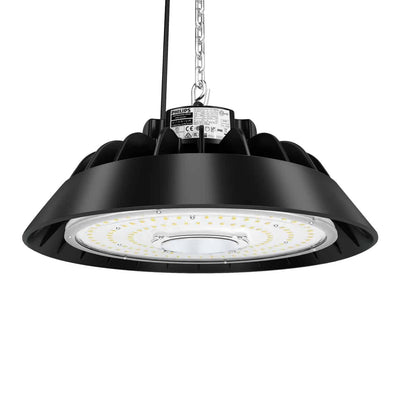
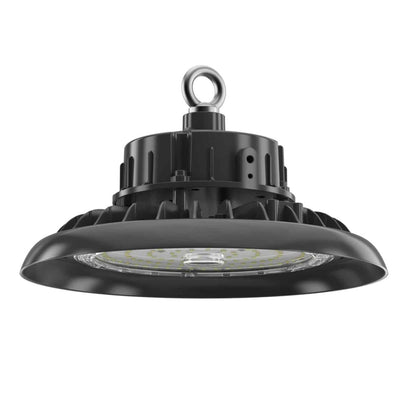
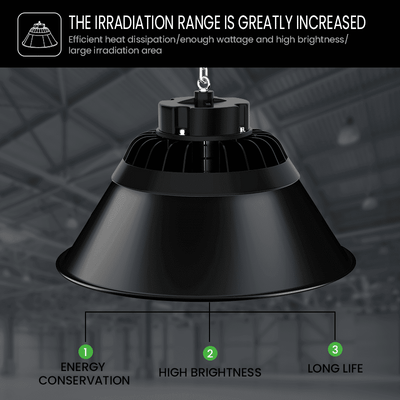
LED high bays for large mounting heights from 8 m – 200W and 240W with SOSEN or Philips driver, IP65, dimmable, 5-year warranty:
Common Planning Errors and How to Avoid Them
Even experienced planners make recurring errors that lead to under-illumination, glare or unnecessary costs. The following overview helps you to systematically eliminate these mistakes.
- Ceiling height instead of mounting height: Always use the height above the working plane (0.85 m), not the structural ceiling height.
- Maintenance factor ignored: Without the MF deduction, the installation will fall below the planned illuminance after a few years of operation.
- Excessive luminaire spacing: Spacing greater than 1.5 × mounting height results in a uniformity ratio U₀ below 0.6 – which is not standards-compliant.
- Incorrect colour temperature: 6,000K in production facilities can cause fatigue; 4,000K is the proven standard. Our guide LED colour temperature explains the differences.
- UGR not checked: Glare from incorrectly positioned luminaires compromises workplace safety. Further information is available in the guide UGR value explained.
- No zone planning: Uniform lux values across the entire facility unnecessarily increase both capital and operating costs.
- Dimming system not coordinated: 0-10V, 1-10V and DALI are not compatible – clarify before ordering. Details in the guide 0-10V, 1-10V & TRIAC dimming.
ROI and Payback Period: When Does Retrofitting Pay Off?
LED high bays typically consume 50–70% less electricity than metal halide luminaires. With operating hours exceeding 3,000 hours per year and an existing installation older than 10 years, the payback period is frequently under 3–5 years – depending on energy costs and available grant schemes. In addition, maintenance costs for lamp replacement are eliminated, as LED high bays achieve service lives of 50,000 hours and more.
Our guide Calculating LED payback period enables a detailed calculation of your individual savings. For a complete modernisation plan, we also recommend the guide Modernising LED lighting.
Safety Notice Regarding Installation
All connection and installation work on 230V/400V systems must be carried out exclusively by qualified electricians (DIN VDE 0100, DGUV Regulation 3, 5 safety rules). Plan the lighting installation in parallel with the facility and machinery planning to avoid costly alterations at a later stage.
Frequently Asked Questions
How many LED high bays do I need per 100 m²?
This depends on the required lux value. For a storage area requiring 100 lx, with 15,000 lm per high bay, MF = 0.8 and η = 0.75, you need approximately 1.1 high bays per 100 m². For a workshop requiring 300 lx, this rises to approximately 3.3 high bays. Above a mounting height of 6 m, the maximum luminaire spacing often determines the quantity rather than the light output alone.
Which wattage is correct for which facility height?
As a rule of thumb: up to 6 m mounting height use 100W, 6–8 m use 150W, 8–10 m use 200W, above 10 m use 240–300W. The decisive factor is always the combination of wattage, luminous flux (lm/W) and beam angle. A 200W high bay at 150 lm/W delivers 30,000 lm – a 200W high bay at 100 lm/W delivers only 20,000 lm.
How far apart can high bays be spaced?
The spacing between two luminaires should not exceed 1 to 1.5 times the mounting height. At a mounting height of 8 m, this means a maximum of 8–12 m. The distance to the wall should be half the luminaire spacing. Greater spacings result in uniformity values below U₀ = 0.6 and are not standards-compliant.
Which maintenance factor should I use?
DIN EN 12464-1 recommends 0.8 as standard. In dusty or contaminated environments (woodworking, metalworking, food production) you should use 0.6 or 0.45. A maintenance factor set too high means the installation will fall below the required standards values after a short period of time.
Which colour temperature is correct for industrial facilities?
4,000K (neutral white) is the proven standard for industrial and warehouse facilities. It promotes concentration, renders colours accurately and is perceived as comfortable by most workers. 5,000K is suitable for areas with high colour perception requirements; 6,000K is occasionally used for outdoor installations.
When must I use ATEX luminaires?
In areas at risk of explosion (Zone 1, 2, 21, 22), only ATEX-certified luminaires are permitted. This applies to spray booths, tank farms, mills and similar operations. Standard LED high bays are not approved for use in these areas. Our guide on ATEX & Ex-protection explains the zone classification and requirements.
Is retrofitting to LED worthwhile with short operating hours?
With fewer than 2,000 operating hours per year, the payback period extends accordingly. Nevertheless, retrofitting may still be worthwhile, as LED luminaires require less maintenance and grant schemes can reduce the capital investment. Calculate your individual payback period using our guide on LED payback period calculation.
When should light planning begin?
Ideally in parallel with the facility and machinery planning, as soon as floor plans and usage zones are established. Later changes to cable routes, suspension points and switching circuits are time-consuming and costly. Clightstore offers a free DIALux light planning service that you can make use of during the planning phase.
Our light planning team will produce a free DIALux simulation for you, including lux distribution, luminaire layout and product recommendations – tailored specifically to your facility zones and standards requirements. EU-wide delivery in 2–5 working days, up to 5 years warranty.
Request free light planning