


Project: VS Rubber – LED high bays, LED panels and LED tri-proof lights
Rubber recycler VS Rubber in Lanklaar replaced 82 first-generation LED high bays and fluorescent fittings with LED high bays, LED panels and LED tri-proof lights: 510 lux everywhere, 37% less power and €4,054 saved pe...
Rubber recycling company VS Rubber in Lanklaar (Belgium) relit its 4,000 m² of production halls and 500 m² of offices. 82 fittings, from first-generation LED high bays to fluorescent office and workshop lights, were replaced by 44 LED high bays, 20 LED panels and 18 LED tri-proof lights. The light level went up to 510 lux in both the halls and the offices, while the power went down by 37%.
- Relighting of 4,000 m² of production halls and 500 m² of offices and workshop.
- 82 old fittings replaced one for one: 44 LED high bays 150W, 20 LED panels 62×62 25W and 18 LED tri-proof lights 45W.
- More light: from 400 to 510 lux in the halls and from 380 to 510 lux in the offices, planned with a DIALux light study.
- 7,910W connected load instead of 12,580W: 37% less power, 13,076 kWh and €4,054 less on electricity per year.
- Luminaire investment of €4,939, half covered by subsidy: earned back in just over seven months.
Project facts
| Client | VS Rubber, rubber recycling |
| Location | Lanklaar, Belgium |
| Buildings | Production halls approx. 4,000 m², offices approx. 500 m² |
| Completed | 2026 |
| Old lighting | 82 fittings: 200W first-generation LED high bays, 72W fluorescent recessed fittings, 130W twin fluorescent battens |
| High bays | 44 × LED high bay 150W, 4000K |
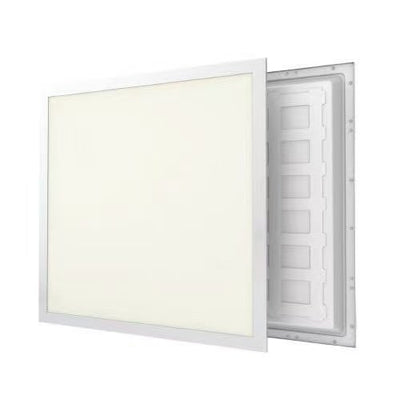
| Panels | 20 × LED panel 62×62, 25W |
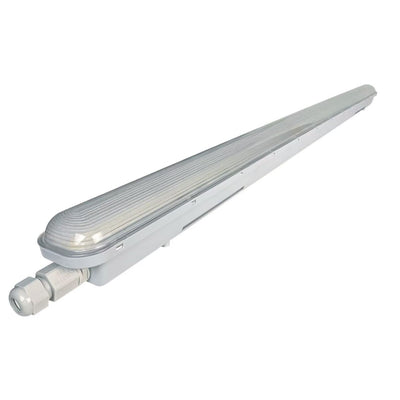
| Tri-proof lights | 18 × LED tri-proof light 150 cm, 45W |
| Mounting | High bays at 8 m on chains, panels recessed in the ceiling at 2.3 m |
| Control | Hall dimmable, offices on/off |
| Illuminance | Halls 400 → 510 lux, offices 380 → 510 lux |
| Planning | DIALux light study |
The starting point
VS Rubber recycles rubber in a production plant in Lanklaar, with around 4,000 m² of halls and 500 m² of offices. The halls had already been fitted with LED high bays years ago, but these were first-generation fittings of 200W each. The offices still used fluorescent tubes in recessed fittings of 72W, and the workshop had twin fluorescent battens of around 130W.
Old LED is not the same as new LED
Early LED high bays typically reach far fewer lumens per watt than current fittings, and their light output drops as the LEDs and drivers age. In the halls that meant 400 lux at 200W per fitting, with several fittings no longer working.
Too dark, high consumption, failures
The offices reached only 380 lux, below the 500 lux commonly recommended for office work. Together the 82 fittings drew 12,580W, and failed fluorescent tubes and defective high bays meant regular repairs.

The solution
Light study first
Before ordering, we made a DIALux light study for the halls and the offices. The target was 510 lux in both, with the same number of light points as before, so that every fitting could be swapped one for one on the existing suspension points and ceiling grid.
Production halls: 44 LED high bays 150W
The 200W first-generation high bays were replaced by 44 LED high bays, hung on chains at 8 m. The luminaire can be set to 90W, 120W or 150W; here it runs at 150W. At 210 lm/W each fitting produces around 31,500 lumen, so the hall gets more light with 50W less per fitting. The high bays are 0-10V dimmable and IP65, which suits the dust of a rubber recycling plant. More on wattage and mounting height in our LED high bay guide and the range in high bays 150W.

Offices: 20 LED panels 62×62
In the offices, the 72W fluorescent recessed fittings made way for 20 LED panels 62×62. They drop straight into the existing suspended ceiling. Each panel is set to 25W and delivers 5,000 lumen at 200 lm/W, with UGR<19 for glare-free screen work and neutral white 4000K. The offices are switched on and off as before. Unsure about 60×60 or 62×62? See our LED panel size guide or all LED panels.


Workshop: 18 LED tri-proof lights 45W
In the technical workshop and the welding area, the twin fluorescent battens were replaced by 18 LED tri-proof lights 150 cm. Each 45W fitting gives 9,000 lumen at 200 lm/W. The closed IP65 polycarbonate housing protects against dust and fumes, and the fittings can be linked in a row. See our tri-proof light guide or all tri-proof lights 150 cm.


LED luminaires used in this project

Energy savings in figures
Every old fitting was replaced by one new LED luminaire. The table compares the old installation with the new one.
| Old | New LED | Difference | |
|---|---|---|---|
| Production halls | 44 × 200W first-generation LED | 44 × 150W LED high bay | −2,200W |
| Offices | 20 × 72W fluorescent | 20 × 25W LED panel | −940W |
| Workshop | 18 × 130W twin fluorescent | 18 × 45W LED tri-proof light | −1,530W |
| Connected load | 12,580W | 7,910W | −37% |
| Illuminance halls / offices | 400 / 380 lux | 510 / 510 lux | +28% / +34% |
| Consumption per year | 35,224 kWh | 22,148 kWh | −13,076 kWh |
| Electricity cost per year | €10,919 | €6,866 | −€4,054 |
| CO2 per year | 5.3 t | 3.3 t | −2.0 t |
How we calculated this
- Old: 44 × 200W + 20 × 72W + 18 × 130W = 12,580W × 2,800 h = 35,224 kWh per year.
- New: 44 × 150W + 20 × 25W + 18 × 45W = 7,910W × 2,800 h = 22,148 kWh per year.
- Cost: 13,076 kWh × €0.31/kWh = €4,054 per year.
- CO2: 13,076 kWh × 0.15 kg/kWh = 2.0 t per year.
The saving comes on top of a clear increase in light: 28% more lux in the halls and 34% more in the offices with 37% less power.
Investment and payback
At current webshop prices, the 82 LED luminaires cost €4,939 (44 high bays, 20 panels and 18 tri-proof lights). Half of the investment was covered by a relighting subsidy, leaving €2,470. With €4,054 lower electricity costs per year, that amount is earned back in just over seven months. Installation is not included in that figure.
Calculate the savings for your building
The calculator below is pre-filled with the figures of this project. Change the values to see what new LED would save in your own halls and offices, even if you already have older LED.
Savings calculator
Pre-filled with this project. Power is the average per luminaire (here: 44 high bays, 20 panels and 18 tri-proof lights).
The result
- More light everywhere: 510 lux in the halls and the offices, up from 400 and 380 lux.
- 37% less power: 7,910W instead of 12,580W for the same 82 light points.
- Glare-free offices: UGR<19 panels for comfortable screen work.
- No more failures: no more defective old high bays or burnt-out fluorescent tubes, and 5 years' warranty on the new luminaires.
- Lower running costs: €4,054 less on electricity every year and 2.0 tonnes less CO2.
Frequently asked questions
Does it pay to replace old LED high bays with new LED?
Often yes. First-generation LED high bays need more watts for less light than current fittings at 210 lm/W. At VS Rubber, replacing 44 high bays of 200W by 150W fittings saves 2,200W, or 6,160 kWh and €1,910 per year, while the hall gets 28% more light.
Which LED panel fits a suspended ceiling: 60×60 or 62×62?
That depends on the grid. Ceilings with 600 mm tiles take 60×60 panels, ceilings with 625 mm tiles take 62×62. The offices of VS Rubber have a 625 mm grid, so 62×62 panels could replace the old fittings without changes to the ceiling.
How many lux does an office need?
For desk and screen work, 500 lux on the work surface is the common reference in EN 12464-1. The offices of VS Rubber went from 380 to 510 lux with LED panels of 25W each.
Which luminaire is suitable for a workshop with welding?
A closed IP65 tri-proof light is a good choice: dust and fumes cannot get inside and the housing is easy to clean. In the VS Rubber workshop, 45W tri-proof lights replace twin fluorescent battens of around 130W.
Is there a subsidy for replacing lighting?
That depends on the country and region. On this project half of the luminaire investment was covered by a relighting subsidy. We tell you which schemes apply to your building and supply the technical data needed for the application.
Can you make a free light plan for my building?
Yes. Send us the floor plans with ceiling heights, or a few photos of the current lighting. We make a free DIALux light study, work out how many luminaires you need and send a non-binding quote at direct-import prices.
Send us the floor plans and ceiling heights. We prepare a free DIALux light plan and a non-binding quote at direct-import prices, 2 to 4 times below comparable branded luminaires. Delivery throughout the EU, up to 5 years' warranty.
Request free light planning

