Project: Taura Natural Ingredients – LED high bays and LED panels for warehouse and office
Taura Natural Ingredients in Geel replaced 68 mercury vapour lamps and 110 fluorescent fittings with LED high bays and LED panels with motion sensor: warehouses from 210 to 305 lux, offices from 380 to 500 lux, 69% le...
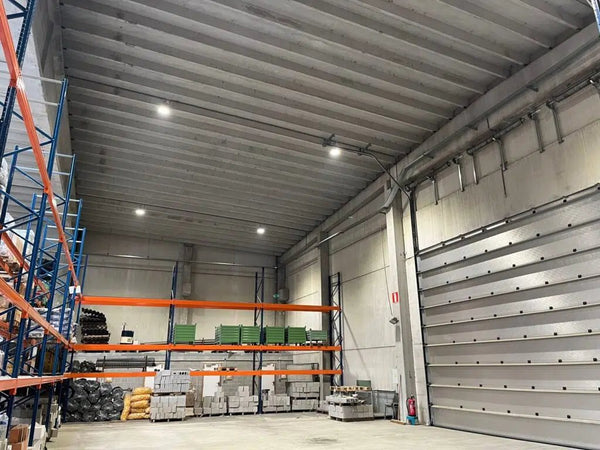
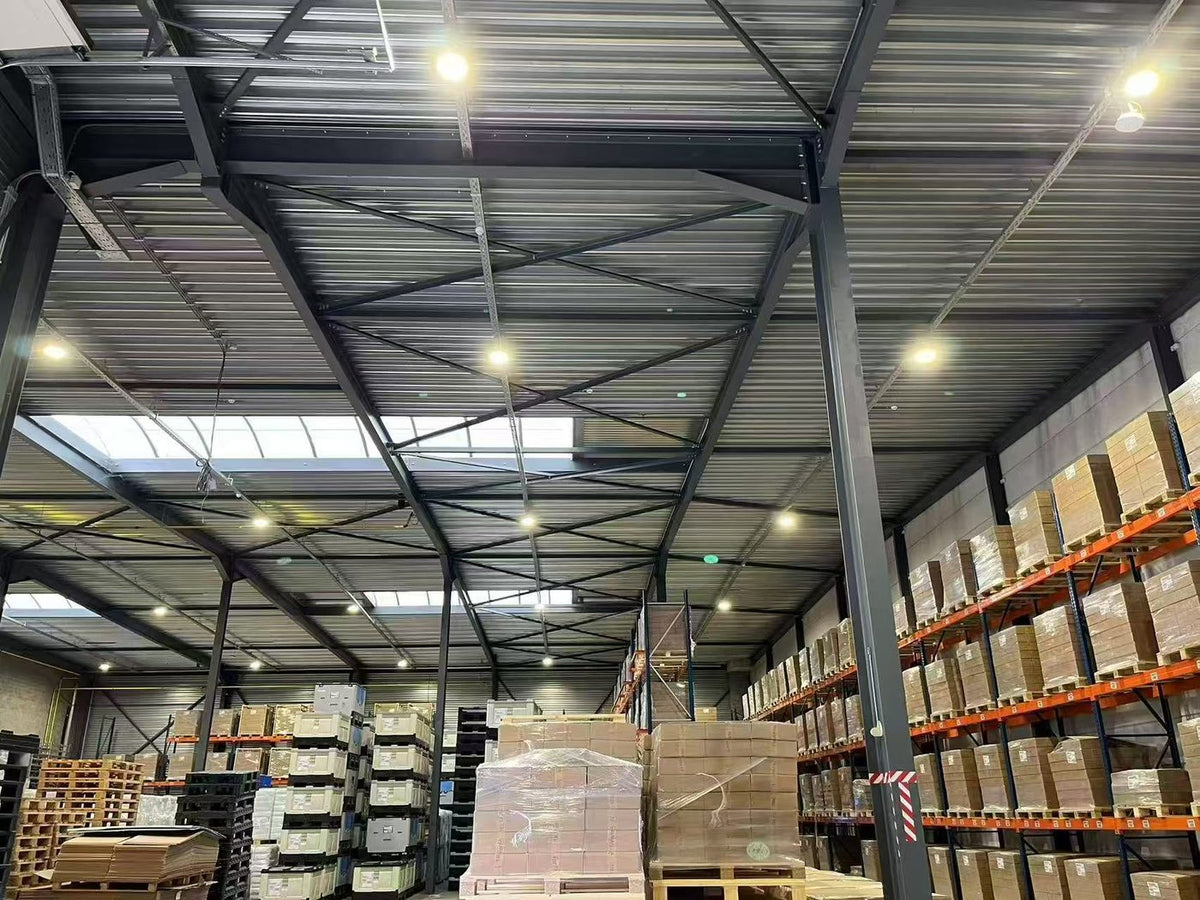
At food ingredients company Taura Natural Ingredients in Geel (Belgium), we relit around 8,000 m² of warehouses and offices. 68 mercury vapour lamps of 400W made way for 68 LED high bays of 100W at 9 m, and 110 old 4×18W fluorescent fittings in the offices for 110 LED panels 120×30 with a built-in motion sensor. The warehouses went from 210 to 305 lux, the offices from 380 to 500 lux, and the power dropped by 69%.
- Relighting of the warehouses and offices of a food ingredients producer, approx. 8,000 m².
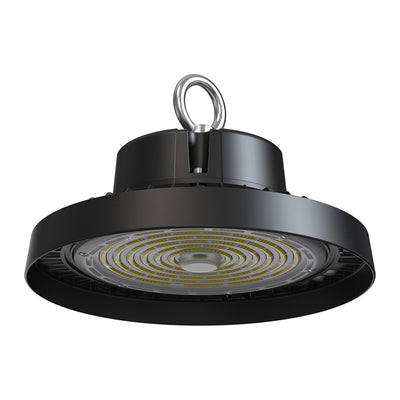
- Warehouses: 68 × 400W mercury vapour replaced one for one by 68 LED high bays 100W at 9 m.
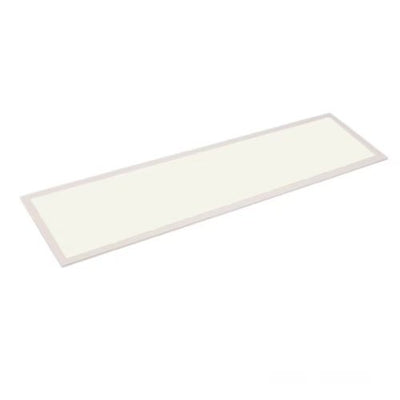
- Offices: 110 × 4×18W fluorescent replaced by 110 LED panels 120×30 of 36W with motion sensor.
- Warehouses from 210 to 305 lux, offices from 380 to 500 lux, with less glare and no flicker, planned with a DIALux light study.
- 10,760W instead of 35,120W: 69% less power, 106,697 kWh and €37,344 less on electricity per year.
- Luminaire investment of €7,883, half covered by subsidy: earned back in less than two months.
Project facts
| Client | Taura Natural Ingredients, food ingredients |
| Location | Geel, Belgium |
| Scope | Warehouses and offices, approx. 8,000 m² (not the production areas) |
| Completed | 2024 |
| Old lighting | 68 × 400W mercury vapour, 110 × 4×18W fluorescent |
| Warehouses | 68 × LED high bay 100W, 4000K, at 9 m on eye hooks |
| Offices | 110 × LED panel 120×30, 36W, 4000K, motion sensor, recessed at 2.3 m |
| Operating hours | Around 12 hours a day |
| Illuminance | Warehouses 210 → 305 lux, offices 380 → 500 lux |
| Planning | DIALux light study |
The starting point
Taura Natural Ingredients makes fruit-based ingredients for the food industry. At its site in Geel, the warehouses store raw materials, drums and pallets of finished product, and the offices house planning, sales and management. We relit the warehouses and the offices.
Warehouses: dark, glaring mercury vapour lamps
The warehouses were lit by 68 mercury vapour lamps of 400W, giving only around 210 lux. The bright lamps caused glare for forklift drivers looking up at the racking, and mercury vapour lamps are being phased out in the EU.
Offices: flickering 4×18W fittings
The offices still had 110 fluorescent fittings with four 18W tubes each, giving around 380 lux. Many tubes flickered, and the lights often stayed on in empty rooms.
The solution
Warehouses: 68 LED high bays 100W
Every mercury vapour lamp was replaced one for one by an LED high bay 100W at 9 m. Each fitting gives 15,000 lumen at 150 lm/W in neutral white 4000K, with a 90° beam. The existing hook points and wiring could be reused, and the warehouses now get 305 lux instead of 210 lux, with steady, flicker-free light. More in our LED high bay guide or all high bays 100W.


Offices: 110 LED panels 120×30 with motion sensor
In the offices, each 4×18W fitting made way for an LED panel 120×30 with motion sensor of 36W. The panels are recessed into the ceiling at 2.3 m and give 3,960 lumen each, raising the offices from 380 to 500 lux, with UGR<22 and a flicker-free driver for comfortable screen work. The built-in sensor switches the light off automatically in empty rooms. See our guide on office lighting or all LED panels.


LED luminaires used in this project
Energy savings in figures
The table compares the old installation with the new one, at around 12 hours a day all year.
| Old | LED | Difference | |
|---|---|---|---|
| Warehouses | 68 × 400W mercury vapour | 68 × 100W LED high bay | −20,400W |
| Offices | 110 × 72W fluorescent (4×18W) | 110 × 36W LED panel | −3,960W |
| Connected load | 35,120W | 10,760W | −69% |
| Load per m² | 4.4W/m² | 1.3W/m² | −3.0W/m² |
| Illuminance warehouses | 210 lux | 305 lux | +45% |
| Illuminance offices | 380 lux | 500 lux | +32% |
| Consumption per year | 153,826 kWh | 47,129 kWh | −106,697 kWh |
| Electricity cost per year | €53,839 | €16,495 | −€37,344 |
| CO2 per year | 23.1 t | 7.1 t | −16.0 t |
How we calculated this
- Operating hours: 12 h × 365 days = 4,380 h per year.
- Old: 68 × 400W + 110 × 72W = 35,120W × 4,380 h = 153,826 kWh per year.
- LED: 68 × 100W + 110 × 36W = 10,760W × 4,380 h = 47,129 kWh per year.
- Cost: 106,697 kWh × €0.35/kWh = €37,344 per year.
- CO2: 106,697 kWh × 0.15 kg/kWh = 16.0 t per year.
The warehouses account for €31,273 of the saving and the offices for €6,071, while both get clearly more light. The calculation is conservative: ballast losses of the old lamps are not counted, and the motion sensors in the offices save more on top, because empty rooms are no longer lit.
Investment and payback
At current webshop prices, the 68 LED high bays and 110 LED panels cost €7,883 together. Half of the investment was covered by a relighting subsidy, leaving €3,942. With €37,344 lower electricity costs per year, that amount is earned back in less than two months. Installation is not included in that figure.
Calculate the savings for your building
The calculator below is pre-filled with the figures of this project. Change the values to see what LED would save in your own warehouse or office.
Savings calculator
Pre-filled with this project. Power is the average per luminaire (here: 68 high bays and 110 panels).
The result
- Brighter warehouses: 305 lux instead of 210 lux, with steady light instead of dim mercury vapour lamps.
- Brighter offices: 500 lux instead of 380 lux at the desks and meeting tables.
- Less glare: modern LED high bays instead of glaring mercury vapour lamps above the racking.
- Comfortable screen work: flicker-free LED panels with UGR<22, and motion sensors so empty rooms stay dark.
- 69% less power: €37,344 less on electricity every year and 16 tonnes less CO2.
Another project with LED in both warehouse and office: LKQ.
Frequently asked questions
Can mercury vapour lamps still be used?
Mercury vapour lamps have been phased out under EU rules and are no longer sold for general lighting. Existing lamps may keep running until they fail, but replacements are getting hard to find. LED high bays are the direct replacement.
What replaces a 400W mercury vapour lamp?
In most halls, a 100W to 150W LED high bay replaces a 400W mercury vapour lamp one for one, depending on the height and the required light level. Here 100W high bays at 9 m raised the warehouses from 210 to 305 lux.
What replaces a 4×18W fluorescent fitting in an office?
A 36W LED panel gives more light than a 4×18W fitting at around half the power: here the offices went from 380 to 500 lux. The 120×30 format used here also fits strip and lamellar ceilings, and the built-in motion sensor saves extra energy in rooms that are often empty.
How much does a motion sensor save in an office?
That depends on how often rooms are empty. In meeting rooms, archives and shared offices, the light is often on for hours with nobody there. A built-in sensor switches it off automatically, which saves on top of the LED saving.
Is there a subsidy for replacing mercury vapour and fluorescent lighting?
That depends on the country and region. On this project half of the luminaire investment was covered by a relighting subsidy. We tell you which schemes apply and supply the technical data needed for the application.
Can you make a free light plan for my warehouse and offices?
Yes. Send us the floor plans with ceiling heights. We make a free DIALux light study for every zone and send a non-binding quote at direct-import prices.
Send us the floor plans and ceiling heights. We prepare a free DIALux light plan and a non-binding quote at direct-import prices, 2 to 4 times below comparable branded luminaires. Delivery throughout the EU, up to 5 years' warranty.
Request free light planning