


Project: Soenen Golfkarton – LED high bays and LED tri-proof lights
New 32,000 m² site in Dilsen-Stokkem lit from day one with 2,200 LED high bays 150W and 580 LED tri-proof lights: 340 lux, 63% less power and €575,328 saved per year.
For its new production site of around 32,000 m² in Dilsen-Stokkem (Belgium), corrugated cardboard manufacturer Soenen Golfkarton chose LED from day one: 2,200 LED high bays 150W and 580 LED tri-proof lights 150 cm of 45W. The halls get 340 lux on the floor with 63% less power than a conventional installation would need.
- New build: approx. 32,000 m² of production and warehouse space, lit from the start with 2,780 LED luminaires.
- 2,200 LED high bays 150W in the high halls and 580 LED tri-proof lights 150 cm of 45W in the lower zones.
- 340 lux on the floor, planned in advance with a DIALux light study.
- 356,100W connected load instead of 955,400W for a comparable conventional installation: 63% less power.
- €575,328 lower electricity costs and 269.7 tonnes less CO2 per year than the conventional alternative.
Project facts
| Client | Soenen Golfkarton, corrugated cardboard manufacturer |
| Location | Dilsen-Stokkem, Belgium |
| Building | New production and warehouse halls, approx. 32,000 m² |
| Completed | 2024 |
| High halls | 2,200 × LED high bay 150W |
| Lower zones | 580 × LED tri-proof light 150 cm, 45W |
| Mounting | 8 m, suspended |
| Illuminance | 340 lux |
| Planning | DIALux light study |
The starting point
Soenen Golfkarton built a completely new site of around 32,000 m², with production halls for corrugated cardboard, a large finished-goods warehouse and an automated high-bay storage system. There was no existing lighting to replace: the question was how to light a site of this size well and economically from the very first day.
Requirements for the halls
Corrugated cardboard production runs in long shifts, with forklifts, conveyors and automated storage working side by side. The halls needed bright, even light of around 340 lux over the whole floor, with luminaires that keep paper and cardboard dust out.
Why not conventional lighting
A conventional installation for halls like these would typically use 400W metal halide high bays and fluorescent tube luminaires of around 130W. On a site of this size, that adds up to almost a megawatt of lighting load, plus warm-up time and regular lamp replacement. Choosing LED in a new build avoids all of that from the start.

The solution
Light study first
Before ordering, we made a DIALux light study of the entire site. It set out where high bays were needed and where linear tri-proof lights would work better, and how many of each to reach 340 lux across the halls.
High halls: 2,200 LED high bays 150W
In the production halls and the finished-goods warehouse, 2,200 LED high bays 150W hang at 8 m in an even grid. With 150 lm/W, a 120° beam and neutral white 4000K light, they spread the light evenly over the floor between the columns and pallet stacks. They are IP65 rated against cardboard dust and 1-10V dimmable. More on choosing wattage and beam in our LED high bay guide.

Lower zones: 580 LED tri-proof lights 150 cm
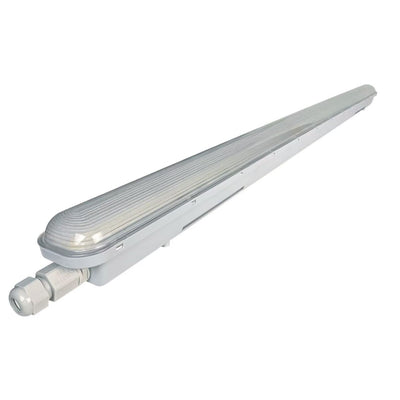
Where the ceiling is lower and round high bays would glare, 580 LED tri-proof lights 150 cm of 45W are mounted in rows. At 200 lm/W they are among the most efficient linear luminaires available, with a flicker-free driver and IP65 protection. Read more in our guide on choosing LED tri-proof lights.

LED luminaires used in this project

Energy savings in figures
Because this is a new build, there was no old installation. The figures below compare the LED installation with the conventional installation the halls would otherwise have needed.
| Conventional | LED | Difference | |
|---|---|---|---|
| High halls | 2,200 × 400W metal halide | 2,200 × 150W LED high bay | −550,000W |
| Lower zones | 580 × 130W fluorescent | 580 × 45W LED tri-proof | −49,300W |
| Connected load | 955,400W | 356,100W | −63% |
| Load per m² | 29.9W/m² | 11.1W/m² | −18.7W/m² |
| Consumption per year | 2,866,200 kWh | 1,068,300 kWh | −1,797,900 kWh |
| Electricity cost per year | €917,184 | €341,856 | −€575,328 |
| CO2 per year | 429.9 t | 160.2 t | −269.7 t |
How we calculated this
- Conventional: 2,200 × 400W + 580 × 130W = 955,400W × 3,000 h = 2,866,200 kWh per year.
- LED: 2,200 × 150W + 580 × 45W = 356,100W × 3,000 h = 1,068,300 kWh per year.
- Cost: 1,797,900 kWh × €0.32/kWh = €575,328 per year.
- CO2: 1,797,900 kWh × 0.15 kg/kWh = 269.7 t per year.
Ballast losses of metal halide and fluorescent luminaires are not counted, so the real difference is even larger.
Investment and payback
At current webshop prices, the 2,780 LED luminaires cost €155,423 (2,200 high bays and 580 tri-proof lights). Half of the investment was covered by an energy-efficiency subsidy, leaving €77,712. With €575,328 lower electricity costs per year than a conventional installation, that amount is earned back in under two months. Installation is not included in that figure.
Calculate the savings for your hall
The calculator below is pre-filled with the Soenen figures. Change the values to see what LED would save in your own building, whether it is a new build or a relighting.
Savings calculator
Pre-filled with this project. Power is the average per luminaire (here: 2,200 high bays and 580 tri-proof lights).
The result
- 340 lux from day one: bright, even light across around 32,000 m² of production and storage.
- 63% less power: 356,100W instead of 955,400W for a comparable conventional installation.
- The right luminaire per zone: high bays in the high halls, glare-free tri-proof lights in the lower zones.
- Dust-proof: IP65 luminaires throughout, built for a cardboard production environment.
- Lower running costs: €575,328 less on electricity every year and 269.7 tonnes less CO2.

Frequently asked questions
How do you calculate savings for a new building without old lighting?
We compare the LED installation with the conventional installation the building would otherwise have received: 400W metal halide high bays in the high halls and 130W fluorescent luminaires in the lower zones. At Soenen that difference is 599,300W, or almost 1.8 million kWh a year at 3,000 operating hours.
How do you plan lighting for a site of 32,000 m²?
With a DIALux light study per hall and zone. It shows where high bays fit and where linear tri-proof lights work better, and how many luminaires are needed to reach the target lux level evenly. For Soenen that meant 2,200 high bays and 580 tri-proof lights for 340 lux.
Why combine high bays and tri-proof lights?
High bays are the most efficient choice under high, open ceilings. In zones with a lower ceiling, round high bays cause bright spots and glare, so linear tri-proof lights give a more even, comfortable light there.
Can you supply thousands of luminaires for one project?
Yes. Because we import directly, we can supply large volumes at direct-import prices, 2 to 4 times below comparable branded luminaires. For Soenen we supplied 2,780 luminaires for one new build.
Can you make a free light plan for my new building?
Yes. Send us the floor plan with the ceiling heights. We make a free DIALux light study, work out how many luminaires you need per zone and send a non-binding quote at direct-import prices.
Send us the floor plans and ceiling heights. We prepare a free DIALux light plan and a non-binding quote at direct-import prices, 2 to 4 times below comparable branded luminaires, also for large volumes. Delivery throughout the EU, up to 5 years' warranty.
Request free light planning

